Showing posts with label churches. Show all posts

Thursday, 2 June 2016

The Biggest Bird You'll Ever See?

We'd seen several condors before on our trip, most notably during our trek towards Machu Picchu and several around El Chaltén, but never close enough to really appreciate their size. This time, while walking early in the morning, all alone in the Quebrada del Condorito national park, we saw two figures on a nearby hill. At first, we thought they were two more people, detracting from our uniqueness, but then they spread their wings and took off! They were enormous. They can have a wingspan of up to 3.3m and weigh up to 15kg.

Condor flying overhead at Quebrada del Condorito
This wasn't our last encounter with condors for the day. When we reached the quebrada (canyon), we saw several more circling overhead and some landing on the opposite cliff. Then, a group of about 15-20 decided to pass right above us before flying into the distance. It was an incredible experience to see them swoop over us one by one before disappearing behind the mountain.

The Quebrada del Condorito
The national park was our highlight of our time in and around Córdoba, Argentina's second city. We liked the city itself - it's an old colonial city and is home to our final World Heritage Site for Argentina. Of course, it was another Jesuit mission. We did a short tour around the church, and discovered that the surrounding buildings are home to the country's oldest university. As a major university city, it was home to many of the 'Disappeared' - those who were killed by the military dictatorship during the '70s and '80s.

The entrance to the Jesuit church
After a lot of time sitting in cars and wine tasting, we wanted to do some hiking, and handily there are several small mountain ranges just outside Córdoba - the Sierras. We visited the small town of Capilla del Monte in the Sierras Chicas (Small Sierras), home to Uritorco Hill. This was perfect for our needs - a day long hike with pleasant views over the town and the nearby reservoir. Before we arrived, we hadn't done much more research than that, and we soon found that the town is full of UFO spotters, 'magical' rocks and plastic pyramids full of 'mysteries'. In 1986, a scorched patch of ground was found and this was subsequently blamed on aliens. You can now watch some incredibly unrealistic videos online, or buy plenty of little green man dolls.

A 'mystical' pyramid in Capilla del Monte
After Córdoba, we set off for our final country on this continent - Uruguay. We'll stop in a couple of places on the way to break up the journey, but not spend much time there, before crossing the border to Fray Bentos.

Wednesday, 20 April 2016

A Mission to Paraguay

We reluctantly left the stunning waterfalls at Iguazú to head south through Argentina's Misiones province. We wanted to stop at a small town called San Ignacio on the way to Paraguay as it has the ruins of an old Jesuit mission there. The Jesuits were very active in this part of the world, with 30 missions in Brazil, Argentina and Paraguay. A few of them are now listed as world heritage sites so, obviously, we had to go.

The entrance to the church in San Ignacio in Argentina
The Jesuits started building missions in the Guaraní area in 1610, and continued up until they were expelled from South America by the Spanish empire in 1767. Their aim was to convert the native people to Christianity, but without imposing other European values on them. This was a significant difference from all of the other evangelising schemes of the time. We visited similar Jesuit missions in the east of Bolivia and on the island of Chiloé in Chile, although each location has distinct architecture. The churches in Bolivia and Chile are active to this day, but all that is left here are impressive red sandstone ruins.

The ruins in Trinidad in Paraguay
After we'd visited the ruin in San Ignacio, we went to withdraw some money before departing to Paraguay. This proved more difficult than we'd anticipated, however. The only two ATMs in town were empty of money, because it was a Sunday. No problem - we went on Monday morning instead. Where we found a looong queue of everybody else wanting money that couldn't get any at the weekend. Only one ATM was working now. When we got to the front of the line, the ATM ran out of money. Luckily, the hostel we stayed in let us pay in pounds, which we'd managed to not spend until now. This actually worked out okay for us - the ATMs in Argentina, after the fiasco of the Dolar Blue rate, now charge an 87 Peso (~£5) fee every time you use them, with a maximum withdrawal of 2000 Pesos (~£100). That's if you can find one that works and has money, of course.

Sunset over the Paraná River from Encarnación, Paraguay
We eventually escaped the fiscal peril of Argentina into Paraguay, where transactions are measured in thousands of Guaranis - there are 8000 Guaranis to £1. From the city of Encarnación, which is blessed with wonderful sunsets over the Paraná river, we went to visit the Paraguayan Jesuit ruins. These are very similar to the Argentine ones, but are bigger and better preserved. More importantly, they have a separate World Heritage Site listing, so we had to go there too.

Ornate Jesuit doorway in Trinidad, Paraguay
We're going to spend a bit more time in Paraguay, visiting a nature reserve and the capital Asunción. After that, we're returning to Argentina to explore the north of the country.

Tuesday, 5 January 2016

New Year in Ecuador and on into Colombia

We were sad to leave our lovely hostel in Quito but we had decided to spend New Year in Mindo, a backpackery little town in the cloud forest. The bus from Quito took about 2 hours, winding down through beautiful scenery with tree covered slopes.

Hummingbirds around Mindo
Mindo is down at 1200m and the climate is completely different to what we've got used to recently - very humid and pretty hot during the day. The town is mostly unpaved roads and has quite an outpost, jungly feel, with cloud forest all around. This feeling was enhanced by the amazing diversity of birds (and insects!) everywhere. Most cafes and hostels have hummingbird feeders outside and we saw so many beautiful examples of this tiny bird. We'd expected Mindo to be full of backpackers, but actually it was quite a mix of people, including a lot of older tourists here for birdwatching.

Peering in at one of the very large owl butterflies (they can have a wingspan of up to 16cm!)
We arrived in Mindo mid-afternoon but still managed to fit in two activities that day - a butterfly farm, and a chocolate tour. We started with the former. You might ask, why on earth would someone with a butterfly phobia possibly want to visit a butterfly farm?
 Well, I guess I thought it might be good for me - after all, I would actually like one day not to be in mortal fear when a butterfly or moth is in my vicinity. I braved entering the big netted off section with the butterflies once, and did okay until some of the gigantic owl butterflies started flying around. After that I made do with sticking my head through the entrance and withdrawing it whenever one came near. I think it did help, a little. Exposure therapy! But my bravery diminished rapidly that evening when we were confronted with the biggest moth I have ever seen, just casually sitting on the hostel wall. That was truly something out of my worst nightmares and it took a while for me even to pluck up the courage to run past it back to our room.

Cocoa beans drying, part of the chocolate making process

Immediately after the butterfly farm we did the aforementioned chocolate tour, which felt like a reward for surviving the house of horrors. Mindo has its own chocolate company, and over the hour or so of the tour we saw all stages of the chocolate making process, from the cocoa pods on the tree, to the finished bar. We also got to sample several of their chocolate products, including the (amazing) chocolate brownies, sea salt chocolate, and liquid 100% chocolate (added sugar required!).


We spent the first of our two full days here hiking in the jungle around Casa Amarilla. This, as you might expect from the Spanish, is a yellow house, owned by a friendly local lady. She also seems to own the surrounding jungle for miles around; at least, if you pay her a small entrance fee you can spend several hours exploring the paths she's made. We think it's great that she's chosen to open the area for hikers and birdwatchers, rather than getting rid of the trees to make room for cows, or digging for oil. The circuit we did took about 3 or 4 hours and included an enchanting viewpoint, looking down on tiny Mindo surrounded by cloud forest for miles in all directions. We met a Dutch guy and chatted with him for most of the hike; maybe we were making too much noise as we failed to see many birds!

View of Mindo (in the distance) from viewpoint during our jungle hike
Our second day in Mindo was New Year's Eve. In the morning we had a go at ziplining - zooming high above the trees along cables. For $20 we got to do an hour or two's circuit of 10 different ziplines ranging from 75 - 400m in length. It was great fun! Especially trying the 'Butterfly' position - literally upside down, with your legs in the air! Absolutely terrifying, but awesome. We spent the evening hanging out with some fellow travellers, enjoying free cocktails courtesy of our hostel, and then plenty of beers outside watching the festivities in the square. It is traditional in Ecuador to make sort of large dolls, a bit like the 'guys' on Guy Fawkes' Night, and burn them in the street at midnight. Often the dolls have masks representing unpopular politicians or celebrities. There were also kids running around everywhere in masks, and the odd guy or two wearing drag (another tradition apparently)! It felt more like Halloween than New Year! Really fun though, and interesting to see another culture's completely different style of celebration.

Ziplining and the 'Butterfly'
New Year's celebrations in Mindo
We returned from Mindo to Quito on the 1st, feeling a little the worse for wear after the night before (the twisty bus ride didn't help) and spent that afternoon in our hostel recovering. We had intended to proceed to Colombia the next day, but we'd not bargained on the city we were heading to in Colombia, Pasto, being so booked up and expensive! It turns out that Pasto has its annual carnival on the days we were planning to be there. It's so popular that Colombians book up all the places to stay months in advance. The only place we could find to stay was an (expensive) AirBnB, so we ended up prolonging our stay in Quito by a day so as to just spend the one night in Pasto. We were pretty happy to have an extra day in Quito at our favourite hostel, anyway! That day we visited the Basilica del Voto Nacional, a huge neo-Gothic church, and climbed up to the top of one of the towers. The ascent began like normal stairs but ended with some quite scary vertical metal ladders! The view from the top over the historic centre was worth it though.

On our way up the Basilica in Quito
On the Sunday we finally left Kinde House for good and proceeded 5 hours north to the Colombian border by bus. The Ecuador side of the border had a horribly long queue, due to mainly to Ecuadorian citizens returning from a weekend in Colombia. Anything in Ecuador that is imported carries a huge tax. Thus a lot of locals hop across to Colombia at the weekend to buy things like electronics and toiletries there - it's so much cheaper it's worth the journey! Luckily the queue moved quickly and within an hour we were through both Ecuadorian and Colombian immigration.

The Las Lajas church in the daylight...
Our first stop in Colombia was the small village of Las Lajas, only a few km from the border. The main reason for visiting here was to see the famous church, El Santuario de Las Lajas, which is literally built across a gorge. We expected this place to be very quiet but actually it was heaving with crowds of local tourists - it's something of a pilgrimage site for Colombians, it seems. The only place to stay was a sort of convent converted into a very basic hotel and run by nuns. The room was like a cell and the bed might as well have been a rock. I'm not sure being a nun is for me... The one consolation was that it cost £5.60 for the night.

...and by night
In the evening the church was lit up with neon lighting, constantly changing colour, which we found somewhat tacky but quite amusing. We got up early the next day and had a better look in the daylight with fewer tourists. It's certainly a spectacular setting - hopefully the photos demonstrate this better than I can describe. We have now arrived in Pasto for our night in an AirBnB around 10 times the price of last night - about 10 times nicer too. Tomorrow we are flying to Cartagena, on the Caribbean coast, and excited to be meeting up with our old travelling buddies Cindy and Julien again there.

Wednesday, 30 December 2015

Celebrating Christmas in Ecuador

Before we left for the Galápagos, we'd thought ahead, done some research and reserved somewhere that sounded social but not a party hostel to stay in Quito for Christmas. Unfortunately, when we returned, and after we'd reconfirmed with them, they'd decided to cancel the reservation and close for Christmas. Thanks BoutiQuito. Luckily for us, that meant that we found KindeHouse instead.

Christmas lunch with our fantastic hostess, Monserrate
Although there weren't many other people staying there, we were welcomed by a very friendly Ecuadorian family. We came back one evening after dinner and joined the daughter and her work colleagues for pre-Christmas drinks and, on Christmas Day, were cooked a fantastic festive lunch - traditional Ecuadorian style with three meats, rice, token salad, a very sweet condensed milk and cake dessert, and Sangria! The next day the mother randomly brought us each a little glass of a homemade cocktail a little like Baileys. The family were really very welcoming and couldn't have been more helpful. Better still was that we were just around the corner from Bandido Brewing, which has by far the best craft beer we've tasted in Ecuador.

The cathedral and main square in Quito
Quito, the capital of Ecuador, is set in a valley so is lined on both sides by high mountains. We were driven to a cable car running up one side of it by our host family one day. From the valley base at around 2800m, the top of the cable car is at 4100m. At the top we did a short hike to a 4700m peak with marvellous views over the city, 2 kilometres below us. The 600m climb to the peak was quite tough - we're not used to that altitude at the moment.

The view 2km down to Quito, from Rucu Pichincha mountain
The real highlight of the city though is just wandering around the UNESCO-listed historic centre. It is filled with grand plazas and beautiful churches. There are picturesque streets filled with artisanal shops and interesting museums. Looking over it all is a statue of the Virgin Mary atop a small hill. Locals claim this is the only statue of the Virgin with wings in the world - it just looks like an angel to us!

The winged Virgin, in the distance, above the city
Close to Quito, an hour's bus ride away, is a monument to the Equator - Ecuador takes its name from the imaginary line running close to the capital. The actual Equator meanders over the course of the year in a 5km wide strip, but I guess they had to choose somewhere to put a monument. It is called the 'Mitad del Mundo', or 'Centre of the World'. This is somewhat ironic - as the Earth bulges slightly at the centre, and Ecuador is at around 3000m above sea level, this point is one of the furthest places you can actually be from the centre of the Earth.

The Equator line at the Mitad del Mundo monument
We've now said goodbye to the family in Quito and have come to the cloud forest of Mindo to celebrate New Year. From here, we'll soon be heading into Colombia.

Sunday, 30 August 2015

Cusco - Historic Inca Capital (And Tourist Capital Of South America)

We took a nightbus from Arequipa to Cusco, where we've spent the last five days. Although best known as the tourist hub for the thousands of visitors that flock to Machu Picchu each year, it is also a fascinating place in its own right, with some amazing Inca sites to check out in the city and surrounding area.

Inca walls in Cusco
Cusco was the capital of the Inca empire, founded in the 13th century. It's now a world heritage site and is an interesting mix of Incan and colonial architecture. Inca walls built with huge blocks of stone line many of the streets; the blocks, despite being all shapes and sizes (one is 12 sided!), fit together like a jigsaw so well that you cannot see any sign of mortar holding them together. Alongside the Inca features, you see plenty of evidence of the Spanish conquest - the main square with its Catholic cathedral and Jesuit church, for example. Despite being full of tourists, it's a beautiful city and we've enjoyed exploring it.

The cathedral in Cusco's main square
On our second day here, we met up with our German friends from the Colca Canyon and took a bus out to Tambomachay, one of four Inca sites within a few km of the city. We walked back, taking in all the other sites and managing to avoid tour groups in the main. The largest of these sites is Sachsaywaman ('sexy woman' is the best way to remember the name!), which was an enormous fortress guarding Cusco. Some of the stone blocks here were simply gigantic - the largest weighed around 300 tons. It's hard to imagine how such might could have fallen to a Spanish force of around 50 horsemen.  

The Inca ruins of Sachsaywaman
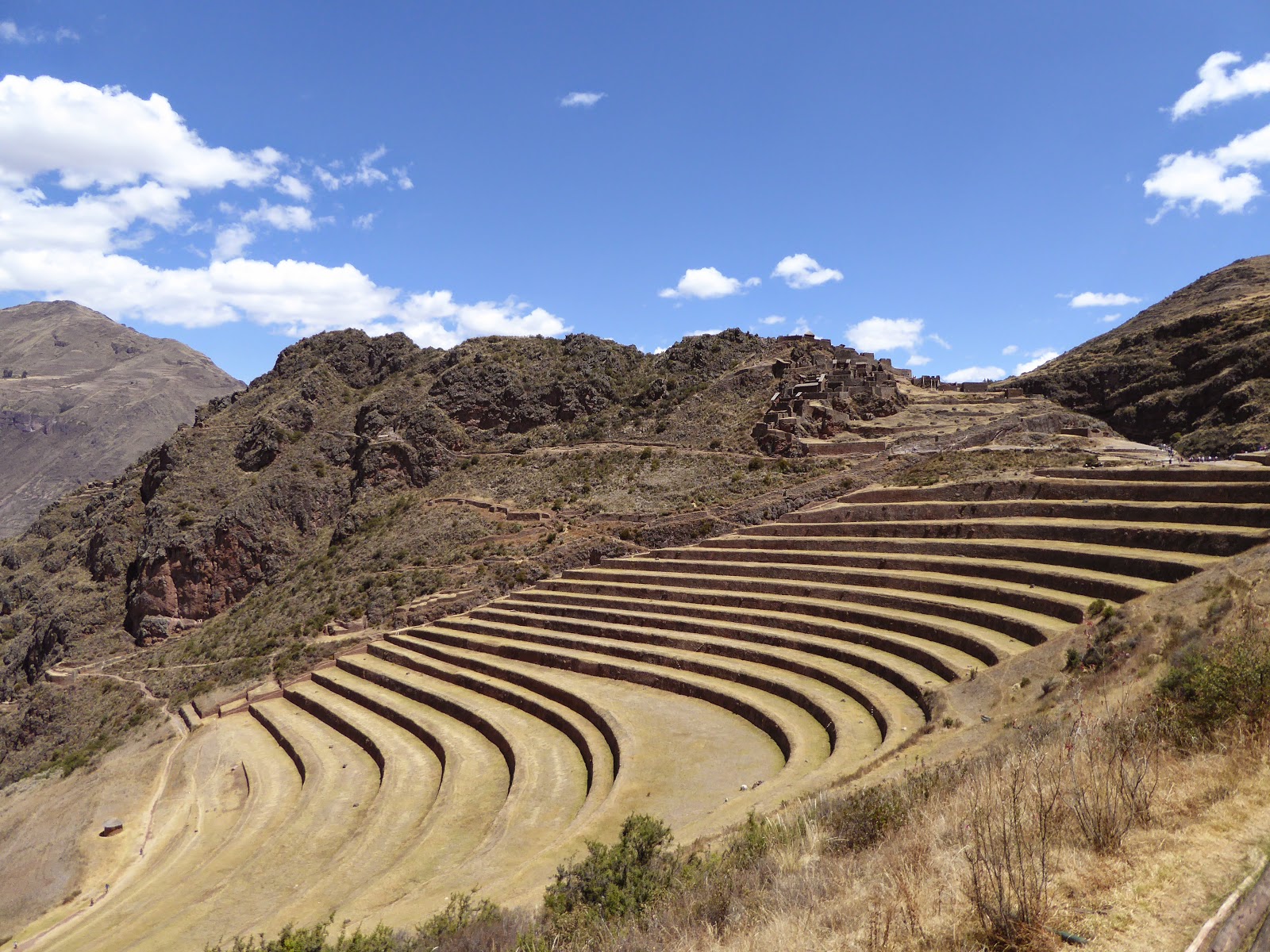
Other Incan ruins around Cusco include those at Pisac, an insanely touristy town nearby. We took a taxi up to the ruins from the town centre and were dismayed to find at least twenty tour buses outside, while inside were umbrella carrying tour guides and megaphones galore. Fortunately most groups seemed to be on their way out, so within an hour or so we had the place almost to ourselves. The site is a citadel and small town, with impressive agricultural terraces carved out of the steep hillside right down into the valley.

Inca terraces at Pisac
We saw more agricultural terraces at Moray, another Inca site nearby. The terraces here are unusual in that they are deep and circular - very striking. Research has shown a temperature variation of 15°C or more between the top and bottom, and it seems that the Incas used the area as a kind of laboratory to test the effects of different microclimates on crops.

Circular agricultural terraces at Moray
Perhaps my favourite of all the sites we visited here was the salt pans or Salinas near the village of Maras. This is a set of several hundred rectangular ponds on several levels, into which salt water flows from a subterranean source and evaporates to form salt. The view from above is quite stunning - a patchwork of rectangles, punctuated by local people harvesting the salt in buckets and bags. The pans vary in colour depending on how long they've been evaporating, from brown to sparkling white. You can walk across the whitest ones, which reminded us of the salt flats in Bolivia.

The Salinas (salt pans) near Maras
While in Cusco we've met up with several friends from the last couple of weeks in Peru. It's been lovely catching up over craft beer and pisco sours. Most of these have already visited Machu Picchu, but we have decided not to rush things... Instead we have booked ourselves on an epic 9 day trek to get there! We leave tomorrow and trek first to Choquequirao, another Inca city, before heading onto Machu Picchu. We look forward to telling you all about it in ten days time...

Monday, 24 August 2015

Arequipa and Trekking the Colca Canyon

We've spent the last few days sightseeing in the old colonial city of Arequipa before getting out of the city for some trekking in the nearby (only 6 bus hours away!) Colca Canyon.

The cathedral in the main square in Arequipa
Arequipa - more Jesuit churches
Arequipa itself has a very pretty centre, mostly constructed from sillar - a white stone taken from the three volcanoes overlooking the city. There are ornate churches, a huge cathedral and a frozen mummy of a 12 - 14 year old girl called Juanita. It felt a lot like Sucre, in Bolivia, to us. Apart from Juanita.

Juanita was an Incan sacrifice to one of their mountain gods. It would have been a great honour to her to accompany the priests to the freezing summit to offer herself to appease the gods that were causing the nearby volcano to erupt. Preserved in nearly perfect condition she was found in 1996, ironically due to another nearby volcano erupting and melting her icy tomb. She has been on display ever since, and it's a very moving experience to come face to face with her in the museum.


One of our favourite things was spending an afternoon wandering around the picture-perfect Santa Catalina Convent. The convent occupies a whole block in the city and has its own interior streets and cloisters - a quiet island cut off from the busy streets outside. It was constructed in 1579, and there is still a section where a few nuns live in seclusion today, as in days gone by.

The quiet streets of the Santa Catalina convent
Running through Arequipa is the Chili River, which is well known for its whitewater. We spent half a day on the river - Jo for her first time in a raft and me kayaking. We both really enjoyed it - the rapids were continuous class III with little respite, with a class IV in the middle. It was great for me to be back in a kayak on whitewater again, for the first time on this trip, and Jo found the raft to be a good level of fun and fright.

Running the Chili River
From Arequipa we made our way to the Colca Canyon, the second deepest canyon in the world. The deepest is another few hours away by bus, and is very difficult to explore properly without paying a lot of money for a tour and a guide. The Colca Canyon is a lot more visited by people doing day trips from Arequipa to a great viewpoint for seeing condors. We skipped this, and continued further along the road to get closer to the canyon.

The Oasis of Sangalle at the bottom of the Colca Canyon
We spent three days trekking. The first was spent gradually descending down the steep wall to Llahuar where we were rewarded with (almost) hot springs to soak our aching muscles. There, we met a great group of people to continue for a full day along (with a lot of up and down) the Colca River at the base of the canyon to San Juan de Chuccho. From our basic lodgings there we could see the daunting ascent for the following day - we'd be climbing over 1000m back up to the trek's starting point. We hadn't anticipated that the bit we could see would be the easiest part of the climb - it turned out that part only took an hour. The next two hours were even steeper and we were exhausted by the time we reached the top.

Our smiling group, before the exhausting ascent
We did make the top in time to catch the bus back to Arequipa. Perhaps 6 hours in a bus isn't the best thing for stiff legs after such a climb, but we're moving on again and will take a night bus tonight to the heart of the Inca empire - Cusco.

Sunday, 16 August 2015

From Bolivia Into Peru - Lake Titicaca From Both Sides of the Border

We left La Paz wishing we'd had a bit more time there, but also excited about the thought of a new country before too long. First, we wanted to stop in Copacabana, 7km from the Peruvian border, to see Lake Titicaca and Isla del Sol.

Our bus to Copacabana - it got on its own little boat for some of the way!
We decided to treat ourselves again in Copacabana as we'd heard great things about a rather unusual hotel there, Las Olas. The hotel is made up of several 'suites' that are in fact little freestanding houses, all with very quirky designs. Our suite was the Sea Tower, three floors high and with a fantastic view of the lake from our top tower room. All the floors were circular and we even had a specially designed circular bed! We also had a little fireplace, which kept the place cosy during the freezing Copacabana evenings.

Our Sea Tower home in Copacabana
Lake Titicaca is the highest navigable lake in the world at 3800m, and even before arriving in South America we'd intended to stay a night on its largest island, Isla del Sol (the Sun Island). However, it turned out this was not meant to be. Having been talking in La Paz about how we always have good luck with the weather, we appeared to have jinxed it... Storms, heavy rain and snow put paid to any plan to head across the lake by boat. The first time either of us have seen snow in August!

The Basilica of Our Lady of Copacabanca, in a very grey Copacabana
Despite the weather, we still enjoyed our time in Copacabana. We visited the town's basilica, which is very grand - completely out of proportion to the size of the town! The church contains a famous 16th century icon of the Virgin of Copacabana, the patron saint of Bolivia, who is traditionally worshipped on the 5th August. Although we were there a week later there were still queues and queues of vans and buses arriving from across Peru and Bolivia to see the icon. We also managed between snow showers to climb the steep hill behind our hotel, for a wonderful vista of Lake Titicaca and the town spread out below. This hill was another pilgrimage site, with stone crosses marking the stations of the cross and another icon at the top. Sadly though, everywhere was completely strewn with litter after a lot of people came up here for the festival on the 5th.

Looking down on Copacabana and Lake Titicaca
We decided not to waste any time waiting for the weather to improve and after two nights in Copacabana took a bus over to Puno, in Peru. Puno is also on Lake Titicaca and is the main entry town from the Peruvian side, so there are a LOT of tourists here! Quite a shock for us. On the plus side however, we have already noticed a dramatic improvement in the food here compared with any of the previous countries. It's great seeing dishes with sauces, spices, herbs... we are feeling quite positive about Peruvian cuisine!

The beautiful Lake Umayo, at Sillustani
Near Puno there is an interesting archaeological site at Sillustani; it is a hillside scattered with 'chullpas' - huge funerary towers or urns varying from around 4 to 12 metres in height. These stone, cylindrical structures were used as tombs by pre-Inca cultures from this region and then by the Inca themselves, dating from around the 12th to the 15th centuries. They are now in varying conditions, with some remaining almost perfect and others reduced to piles of rubble. There were other remains to see, including stone circles used by the Inca for sacrifices. The complex is in a beautiful location, on the shores of Lake Umayo where we even saw a couple of flamingoes.

Local ladies sitting outside one of the Inca chullpas
While in Puno we also paid the mandatory visit to the Uros Islands, which are artificial islands built entirely of reeds. Despite taking a ferry rather than taking a tour, the experience was still massively touristy - think floating souvenir shops. However, it was still worth doing to learn how the islands were built and to see what life is like for people living in such an unusual place. The islands are tethered but still move slightly with the wind and with the movement of people walking around; it felt a little like being on a boat.

Uros islands - reed islands in Lake Titicaca, near Puno
We are leaving Puno tomorrow for Arequipa, Peru's second largest city, and renowned for its cuisine.


Saturday, 25 July 2015

To Tour or Not to Tour in Eastern Bolivia

When Kev last wrote, we were just about to leave Sucre for Santa Cruz in eastern Bolivia. Santa Cruz is a big, very busy city down at an altitude of only 400m or so - quite a change from our last few weeks high in the altiplano. The weather was noticeably more humid and the city was partly flooded when we arrived, after heavy rains over the last two weeks. I think we will always associate Santa Cruz with grey skies!  There is very little to do in the city itself but we wanted to use it as a base for several activities in the area, beginning this week with the Jesuit Missions Circuit.

The cathedral in Santa Cruz - the Pope visited here a week before we arrived
There are a number of villages within a day's travel of Santa Cruz, all founded by Jesuit missionaries in the late 17th and early 18th centuries, and all with unusual, very beautiful Jesuit churches. Six of these were collectively designated a Unesco World Heritage Site in the 1990s and the route round them is known as the Jesuit Missions Circuit. Tour agencies offer a 3 or 4 day tour for around 450 US dollars. To tour or not to tour? It didn't take us long to choose to go it alone.  But now we had to negotiate the local transport, which is notoriously slow and unreliable in this region (hence why most travellers opt for the tour!).

The viewpoint in Santiago de Chiquitos
While the tiny village of Santiago de Chiquitos, is not officially part of the missions circuit, we had been recommended to make a stop here to enjoy the natural beauty of the surrounding area. We stayed in Santiago's only hostel, which also serves as a restaurant as well as an art exhibition centre. The hostel had a lovely garden with toucans frequenting one of the fruit trees. We climbed up to the viewpoint just out of town and were rewarded with glorious views of the Tucabaca Valley below - a sea of trees. During this walk we saw one of the largest butterflies I've ever seen; those who know me well can imagine my reaction. We also hired a local guide who took us though the jungle to visit two amazing caves, one with rock paintings and one with a lovely waterfall.

The church in San José de Chiquitos
From Santiago we moved on by bus to San José de Chiquitos, arriving in the late afternoon in time to see the church. Unlike those later on the circuit, this church was the only one to be built of stone. It was huge, with four main buildings stretching along one whole side of the village square. The cloister-like corridors around a central garden had walls adorned with paintings in the characteristic Jesuit style. We stayed in a very basic hotel and were up at dawn to catch the only bus of the day to San Ignacio de Velasco, our next stop.

The church at San Miguel - all of the others, apart from San José, are in a similar style
The local bus to San Ignacio was interesting - 6 hours bumping along the red, dusty, unpaved road, stopping to pick up more and more people and more and more cargo, including several crates of (live) chickens. From San Ignacio we spent a day with a driver taking us round the three other Jesuit villages nearby - Santa Ana, San Rafael and San Miguel. All of these churches were lovely, and very representative of the Jesuit style: carved wooden columns; adobe walls painted white on the inside and then decorated with simple floral motifs, mostly in reds and oranges; ceilings of reeds or bamboo; wonderfully carved wooden pulpits decorated in gold; and magnificent altars covered in gold, silver or mica. Perhaps my favourite was San Rafael, where the interior paintings also included angels playing various instruments.

Inside the churches at San Rafael and San Miguel
The next leg of the trip, up to Concepción, was to be the most challenging. There was only one bus a day from San Ignacio and we duly got on it at 11 am. At 12.30, the bus broke down, literally in the middle of nowhere. There were no other buses due until the evening, so we were all given (some of) our money back and then left to wait hopefully on the side of the road in the heat and the dust. An hour later, Kev and I ended up getting a lift with a few other people in a huge lorry, with him in the back while I was squashed into the cab. The truck dropped us at the nearest village, 25 km away, and after a lot of waiting around and negotiating with a bus company office, we finally procured ourselves a minibus to Concepcion, where we arrived around 6 pm. Only 3 hours later than planned, and ironically, this all worked out cheaper than the original bus!

Waiting for a lorry to come along
We were able to look at the church in Concepción in the evening before mass, and the atmospheric lighting at this time almost made the long journey to arrive this late worth it. The next day we had a smooth journey to nearby San Javier, the last of the circuit, and back to Santa Cruz.

Made it! The final church in San Javier
The whole experience was a challenging one, but certainly far more rewarding and eye-opening than a tour would have been. We saw no other tourists on the buses, but got to travel as the locals have to and experience the difficulties of living so remotely with so little transport. We had time to see all the churches for ourselves, as well as seeing the rest of the villages, eating in local restaurants and speaking only in Spanish. We even worked out that we saved a third on what the tour would have cost, despite spending more than twice as much as time. Once again we've learnt that the easy option isn't always the best one.