Showing posts with label weather. Show all posts

Wednesday, 25 May 2016

Wine Tasting (and a Run In with the Police)

We had been looking forward to visiting Mendoza for a while, for several reasons. Firstly, we'd arranged to reunite with our London friends Ralph and Shehnaaz there. Secondly, we hoped the climate might be a bit more forgiving - it's been pretty cold and grey for us recently but Mendoza is known for its sunny skies and lack of rain. And thirdly, it is of course Argentina's capital of wine. Buy any Argentinian wine in the UK, and the chances are pretty high that it's from Mendoza (and that it's a Malbec)! Arriving in the city in the late afternoon, alas, we were to be disappointed on the second of these counts - it was 8 degrees and tipping it down with rain. Ah well. Unfortunately, this weather continued for the majority of our time round Mendoza, but this did not impact too much on our enjoyment.

Wine tasting at Tempus Alba winery, in Maipú
Ralph and Shehnaaz met us on our first evening in Mendoza - we'd not realised they were intending to stay at the same hostel as us, so were surprised to hear familiar English voices downstairs! It was great to see them again and exchange stories of our very different last three months or so since we were last together in Colombia. While we'd been making haste through the Guyanas, Brazil and Paraguay, Ralph and Shehnaaz had spent the majority of their time driving through Patagonia in a van they'd hired and then converted themselves into a camper van. We had a look at the inside of the van (very impressive) and even had a ride in the back several times, slightly illegally!

We spent a day in Mendoza itself, wandering around chatting and avoiding the enormous holes in the road. Mendoza has huge drainage channels going down either side of its roads, and they aren't covered at all, so you frequently find yourself having to jump quite a distance to avoid falling in! There isn't actually a lot to see or do in the city - it's a pleasant enough place, with tree lined avenues and lots of squares, but few major sights to see. We did climb up to the top floor of the city hall, where there was a terrace with a view of the city. This was nice despite the grey skies. While we couldn't see much of the surrounding mountains (we're assured they do exist!) the view of the city itself helped to emphasise just how green (well, more yellow, orange and red, in this season) Mendoza is - there really are a lot more trees than your average city.

The two wines we managed to taste in Trapiche winery, Maipú
Of course, Mendoza's main draw is the surrounding wine growing region, and we duly spent most of our time in a couple of nearby towns that had plenty of bodegas for wine tasting. We made a point of avoiding the ridiculously overpriced tours that most people take to visit wineries near here, as it is perfectly possible to go independently to a lot of places. Our wine tasting adventures began with a day trip to the Maipú area (not to be confused with Chile's Maipo valley, also a wine region) an hour or so outside the city. Kev and I took the bus, while Ralph and Shehnaaz drove. Our hostel had recommended a winery called Trapiche, so we headed there first. Unfortunately, the man at the gatehouse told us we couldn't go in until 3pm, even though we only wanted to do a tasting, not the scheduled 3pm tour. We sat eating lunch in the back of the others' van for the required half an hour, and on entering the winery were told, oh, you only wanted to do a tasting, you could have come in straight away! Slightly frustrating!

A flock of geese in the grounds behind Trapiche winery
The winery was lovely, with a cool glass floor through which you could see barrels and barrels of maturing wine, some of them absolutely enormous, on the floor below. But sadly the tasting experience wasn't so good. The guy who'd let us in showed us to a table, plonked 2 bottles of wine and some glasses in front of us, and just left us to it! We weren't offered any information about the wines or the winery whatsoever, and both wines were straight out of a store cupboard so the white was too warm and the red too cold. We were a bit disappointed as we'd hoped for a better tasting experience here than in Cafayate, but again it seemed that staff could not really be bothered at all... unless you'd paid twice as much to do the guided tour as well as the tasting. We saw a group finishing their tour, upon which they got to try three wines, all well kept, with pourers on the bottles, and all introduced beforehand by a member of staff.  Still, maybe this was just bad luck, we thought, and drove on in the van to a different winery a few km down the road.

The next winery we tried was called El Cerno, and we arrived just as a lady from the winery was welcoming a tour group. The four of us stood awkwardly at the back, and were completely ignored by the staff - it was as if we didn't exist! Rude, we thought, and eventually decided to go across the road to a different place, leaving the van at El Cerno. This third winery, Tempus Alba, was much more of a success. We got to try six different reds, including a Merlot, Syrah and Tempranillo, which are a bit more unusual in Argentina. We had fun trying to identify them in a blind taste test, at which we all did surprisingly well. All the wines were very good, although the staff again just poured out the glasses and left us to it!

Autumnal vineyards under cloudy skies in Maipú
When we returned to El Cerno just before 6pm we had a shock: as we walked down the drive, we saw all the staff standing outside in their coats, clearly waiting for us to come back. Worse, we were overtaken on the drive by a police car! The winery closes at 6pm, and the staff, not knowing where the van had come from, had called the police. It seemed, to us, a bit premature to call them before it was even closing time... but there you go. Embarrassed, we did our best to explain (in Spanish of course) that we'd planned to come back for a tasting here and hadn't known it would be closed. The staff denied ignoring us when we first arrived - a complete lie! Luckily, the police seemed more amused than anything else, and we were able to leave with no problems (Kev and I thought it wise not to get in the back of the van this time though!).

Ralph and Shehnaaz camped in their van that night, while we returned to the hostel in Mendoza, and we reconvened the next day in Tupungato, in the Valle del Uco area. Lonely Planet, in typical style, states that the Valle del Uco is 'best visited on a guided tour' - or you can rent a car 'if you've got the time and patience'. It neglects to mention that there are frequent public buses from Mendoza to Tupungato, which is a town right in the heart of the region! We stayed in the appropriately named Hotel Chardonnay, from where it was easy to organise a taxi for winery visits.

Vineyards and the snowy Andes, from Tupungato on a sunny day
By this time we'd had enough of being treated like second class customers for only doing tastings, so we decided to push the boat out and go for lunch at Domaine Bousquet, an organic winery - in fact the 'world's most awarded organic wine producer', according to their website! This turned out to be an excellent plan. For less than £30 each, we feasted on a 6 course lunch, each course served with a paired wine. All of the wines were fantastic, and the food was pretty good too. To my surprise, my favourite wine of the day (and possibly of the whole Mendoza region) was the Pinot Noir from here. I normally find Pinot Noir to be nothing special, a bit light for a red, but this one had been aged in oak for a year and was amazing! Best of all, the service here was so much better. We ran out of time to visit any more wineries in Tupungato, but we drank plenty more of the local wine that evening at our hotel!

The next day, feeling slightly the worse for wear, we spent a relaxed morning around Tupungato, which turns out to have one of the most incredible settings for a town we've seen since Patagonia. That day, the sun had finally come out and suddenly we could see the Andes! In the distance behind the town, there were snowcapped mountains stretching for miles and miles. It was beautiful, especially with the vineyards in their autumnal colours all around too. Ralph and Shehnaaz had to leave that afternoon to begin their journey towards Santiago, where they needed to drop their van off in a day or two. We had a great time with them, and will now not see them again until we both return to the UK in a month or so.

And another beautiful view from Tupungato
Kev and I stayed another night in Tupungato before returning to Mendoza. The weather was still nice and we were excited to be able to see Aconcagua, South America's highest peak (6960m), from our bus! We had thought about going south for one more look at Patagonia, but in the end thought the 18 hour bus and the forecast of rain and snow down there made it probably not worth it. Instead, we took a nightbus from Mendoza to Córdoba, Argentina's second city, where we will spend a week or so before heading towards Uruguay.

Sunday, 1 May 2016

Why Does Nobody Go To Paraguay?

Paraguay is not somewhere you hear much about when travelling South America. Most people seem to skip it all together, or perhaps just go across for the day from Argentina or Brazil for a cursory country grab. Neither Lonely Planet or Rough Guide even bother to produce a guide for Paraguay - it gets a short mention in the Lonely Planet Shoestring guide that covers the whole continent, but that's it. So unlike most places we've been, we really didn't know anything about this country before we arrived, or have any idea what to expect of it.

Sunset in Encarnación
Paraguay is a landlocked country, bordering Bolivia, Brazil and Argentina. It is home to an amazing variety of different environments and habitats, including the Chaco, the Pantanal, and Atlantic rainforest. A lot of the country is still relatively untouched wilderness, and there are many conservation projects trying to limit deforestation and protect its rich biodiversity.

Street in Asunción
We had hoped to do more than the average tourist in Paraguay and get off the beaten track a little: we'd read that this is difficult to do, but dismissed this as hyperbole. However, once in the country we found that the reports were more accurate than we'd imagined! Paraguay really isn't particularly bothered about attracting tourists so there is very little tourist infrastructure and it is hard to find accurate information about anything other than the urban centres.

The Chaco region, a semi-arid area rich in wildlife, makes up more than 60% of Paraguay's land area, but less than 2% of the country's population lives there. We had wanted to explore this region, but as it so sparsely populated it is somewhat challenging to get around. The Pantanal, a wetland region on the border with Brazil, is also something of a mission to get to. We met an Australian at our hostel in Asuncion who was trying to go there - his journey would involve a 7 hour bus, a public boat for 3 days, and then having to hire another boat himself for the final section. Maybe earlier in our trip we'd have been up for this, but this late on we are trying to push on to see as much of the rest of the continent as we can in our last few weeks.

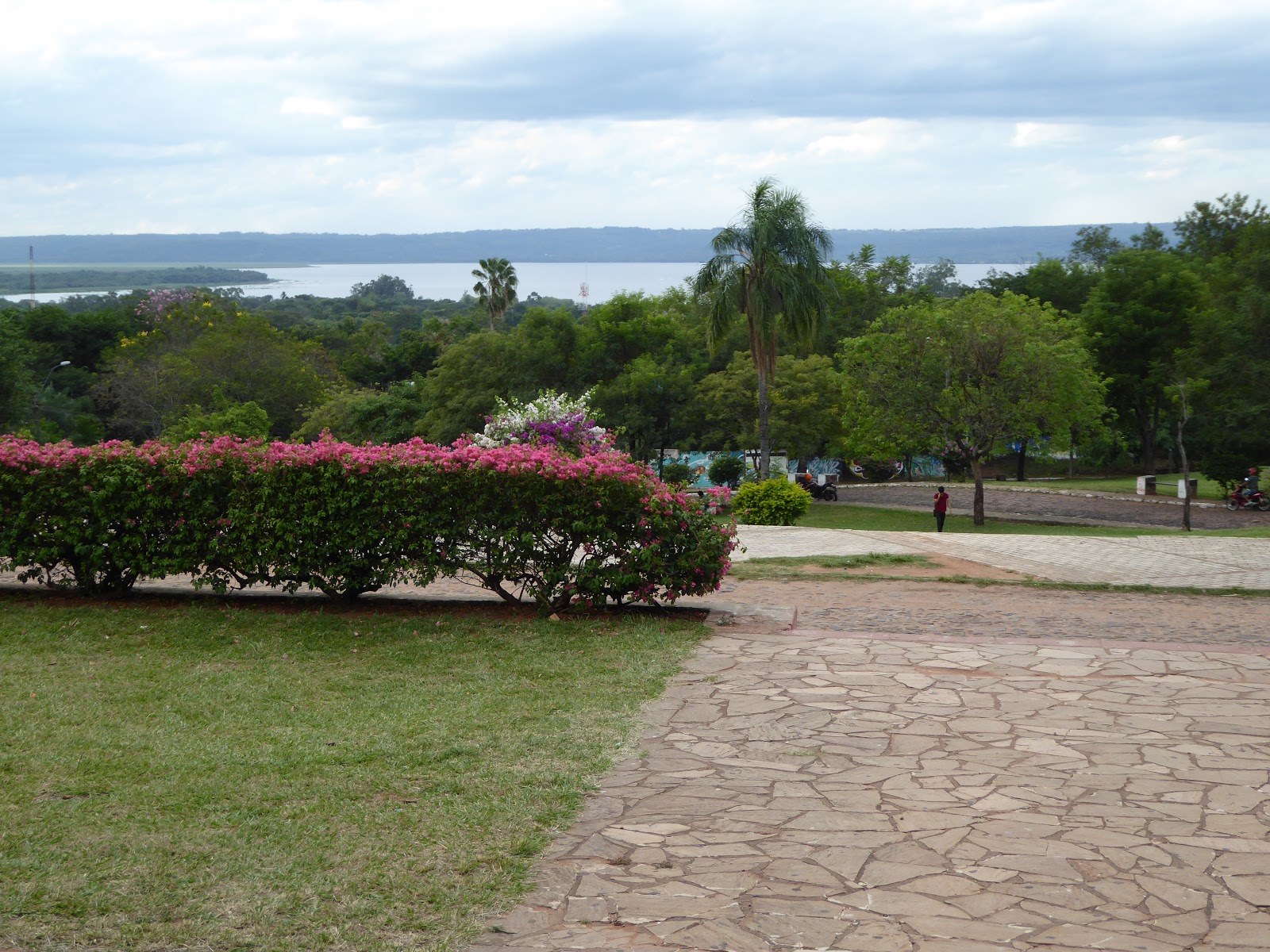
Lake view from Aregua, near Asunción
What we did think would be feasible was visiting one of the country's protected areas of Atlantic forest, the San Rafael National Park and Reserve. This is only a 3 or 4 hour journey from Encarnación, and we had already managed to get in touch with staff at the park and provisionally booked a cabin for a few days. However, when it came to our planned day of departure, circumstances conspired against us. The night before, the horrendously hot and humid weather (39 degrees!) finally broke - there was a big thunderstorm and it rained all night and was still pouring the next morning. The road to San Rafael is unpaved and often becomes impassable in bad weather. We managed to phone the park from our hostel, and were told it would be impossible to go that day. We stayed another night in Encarnación and hoped that the weather would brighten up enough to dry the road by tomorrow. Alas, the downpour continued all day, and park staff told us the next day that the road was still impassable. We really wanted to go, but the forecast wasn't good for the rest of the week either, so we reluctantly gave it up as a bad job and got on a bus to Asunción.

Ceramics for sale in Aregua, near Asunción
About an hour into the journey to Asunción, we went through the small town of Coronel Bogado. We remembered the name from something the friendly old lady at our hostel in Encarnación had said to us - that the best 'chipas' in the country are made there. Chipas are dense, baked rolls made from maize and flavoured with Paraguayan cheese. They are quite an institution in Paraguay and the neighbouring area of Argentina - street vendors carry baskets of them in all sorts of shapes and sizes. When the bus stopped in Coronel Bogado, a couple of sellers got on, and we knew this must indeed be the famous place as literally all the locals on the bus bought some! Obviously we did too, and they were the best we had anywhere. Yum. Another interesting part of Paraguayan culture is the tereré - like Argentinian maté tea, but served cold. Most locals constantly carry around large water flasks in special carry cases with a pocket for their tereré cup!

Palacio de Gobierno, Asunción
Despite being the Paraguayan capital, Asunción doesn't have a lot to see or do. We dutifully spent an afternoon wandering around the centre, but weren't very taken with any of the sites other than the Palacio de Gobierno, an impressive, large colonial building painted pale pink. We thought this was a lot prettier than the famous Casa Rosada in Buenos Aires! The city has bit of a feel of faded glory - there are quite a lot of old buildings but most are very dilapidated and little or no effort has been made to conserve them. Asunción is actually one of the oldest cities in South America, founded in 1537, and in colonial times it was also one of the most important. Since independence however, and after the Paraguayan war in the 1860s, the city lost its importance and the national economy has declined rapidly. The war, also known as the Triple Alliance war (Paraguay against the combined forces of Brazil, Argentina and Uruguay) had a massive impact on Paraguay. It was one of the worst military defeats ever inflicted on a nation - more than 60% of the population died, and 90% of the country's men. Really, Paraguay is still struggling to recover from the effects of the war today.

Modern and old combined, in a courtyard in Asunción
Asunción is built on the Paraguay river, and  few months ago it was hit by some of the worst floods in decades, which you might have seen on the international news. Tens of thousands of people were displaced from their homes, and sadly it seems many of them still have nowhere to live. We walked past a huge, makeshift camp or shanty town, with hundreds of people living in wooden shacks or just tents made from bin bags with no sides. The camp was in one of the city's biggest plazas, right on the doorstep of the presidential buildings - maybe to make a point, as the government is apparently doing little to help. It was sad and quite shocking to see.

Riverfront and very cool sky in Corrientes
We met no other tourists in Encarnación, so were surprised to find a really excellent, sociable hostel in Asunción (El Nomada). We spent a lot of time just hanging out there and chatting. Most people travelling Paraguay are not your ordinary tourist, and we met some great people, including a couple of bikers who'd been travelling the world with their huge bike and sidecar for three years! We also went with another English guy we met to a nearby town, Areguá, which is famous for its ceramics. We reluctantly left this fantastic hostel after 3 nights and embarked on another long bus ride (8 hours) back over the border to Argentina and the cities of Corrientes and Resistencia. The weather had been fine for the previous two days, but a little like our last night in Encarnación, there was a big storm the night before we left Asunción. The temperature dropped literally 20 degrees in a day. After being at temperatures well above 30 degrees for several weeks, 10 degrees was quite a shock! We had to dig out our coats and jumpers again that we'd thought we'd not need for the rest of the trip.

Monastery in Corrientes
For the next couple of days, we stayed in the Argentinian city of Corrientes, the capital of the Corrientes province. It is only a 20 minute drive away from the neighbouring city of Resistencia, across a river which marks the border between provinces. So, strangely, Resistencia is also the capital of a province - the Chaco province! We liked both of these cities as they were just typical Argentinian cities, with no tourists. The locals were super friendly and whenever we sat down in a cafe we'd get engaged in conversation by people curious to see us there! Corrientes is the more historic of the two, while Resistencia is known as Argentina's 'Capital of Sculptures'. Every 2 years the city has a competition that sculptors come from all over the world to take part in - they have 7 days to produce a sculpture. The best ones are displayed either in the museum or on the streets - more than 200 line the streets in the centre already.

Sculptures in Resistencia
From Corrientes we took our first night bus since Colombia - 13 hours up to Salta in the north of Argentina. We had forgotten how expensive buses are in Argentina - £45 a person! We are looking forward to exploring more of this area now, and probably hiring a car.

Saturday, 12 March 2016

Golden Showers - Well, Gold and Showers

We had enjoyed our time in San Agustín and Tierradentro as they're a little further off the gringo trail (especially Tierradentro). However, now it was time to head firmly back into tourist central - Bogotá, Colombia's capital. We took a nightbus from San Agustín that arrived at 5am, and spent a lot of time drinking coffee until we could check in to our AirBnB later on. We'd chosen to base ourselves in the historical district, La Candelaria, which is where most of the attractions are, and the AirBnB was great - run by a very friendly French-Colombian family.

The main square, Plaza de Bolívar, in Bogotá
So, Bogotá. Bogotá is big.Very big. In terms of population, it is the fourth largest city in all of South America and the second largest we've been to behind Buenos Aires, with nearly 10 million people. It is also high, at about 2650m - the third highest capital city in the world after La Paz and Quito. And based on our experience, Bogotá is also rainy. It rained every day while were here, including some enormous thunderstorms that flooded some streets and caused delays at the airport when the control tower was struck by lightning! The weather liked to fool us by appearing beautifully sunny every morning. Thus without fail we'd say, 'shall we take the raincoats? Nah, we won't need them.' And without fail we'd get soaked. Apparently this much rain is unusual for the time of year, and probably due to the El Niño phenomenon.

Incredibly detailed figures in the Gold Museum
There's plenty to do in Bogotá, and we duly visited the majority of its major tourist sites. One of the highlights was the Museo de Oro (Gold Museum), which is one of the best museums we've been to in South America so far. It tells the history of gold in Colombia, focusing on pre-Columbian times and explaining how gold was obtained, what was made with it, the indigenous mythologies surrounding it, and so on. There were plenty of stunning gold items on display, some dating from over 2000 years ago yet incredibly complex, intricate and beautiful in their designs.

Street art on the graffiti tour
Aside from the Gold Museum, we spent one morning doing the popular graffiti tour around La Candelaria and the city centre. This was quite interesting but the group was huge - over 30 people! - and the guide focused more on the artists' styles than on the actual content / meaning behind the street art. We'd have liked to know WHY a given artist had chosen to portray a toucan with a halo, rather than how he'd done it! We also took the cable car (so many cities in South America have cable cars!) to the top of Cerro Monserrate, up at 3100m. The view of the city was quite nice, but sadly the clouds rolled in, the vista deteriorated extremely quickly and the torrential rain began anew. Another day we visited the Police Museum, which included quite a lot of interesting information on the hunt for Pablo Escobar in the early 1990s. On display there was even a desk Escobar owned, which on first sight looks normal, but when kicked in a certain way reveals a false back and false bottom, with several secret compartments. There was also a sophisticated machine Escobar had used for counting banknotes; the only other one of these in the country at the time was in the national bank!

Somewhat hazy view of Bogotá from Cerro Monserrate Wanted poster for Pablo Escobar, in the Police Museum
We had heard a lot about the Salt Cathedral in the town of Zipaquirá, which is often described as 'the marvel of Colombia'. Understandably, we were keen to visit, and as Zipaquirá is not far from Bogotá, we made a day trip. It took us an hour and a half from La Candelaria using the Transmilenio bus-metro thing (more on that to follow!) and then a local bus. On arrival, we were horrified to find the ticket price for extranjeros (foreigners) was 50,000 pesos. That is, £10. Which is a LOT in Colombia! For reference, the Gold Museum cost 3,000. Even for Colombians the price was 28,000, which would definitely price a lot of locals out of coming here. Pretty ridiculous. Still, we thought, we're here now, and we reluctantly paid up.

The main nave in the Salt Cathedral
The Salt Cathedral is basically a huge church built underground in a salt mine, complete with the stations of the cross, also made of salt, on the way. I have to say that the cathedral itself was pretty cool - it was incredible to be in this huge chamber with high ceilings and massive pillars, all deep underground and mostly built of salt, granite and marble. The stations of the cross were also well done, we thought - mostly very understated and simple. However, what we didn't like was the way the entire experience had been made into a massive tourist trap. You had to go round with a guide (totally unnecessary), there was cheesy music playing, and at the end we were greeted with rows of the usual artesania shops. Yes, souvenir shops. And a coffee shop. Down a salt mine! On top of this, anything extra had to be paid for on top of the crazy first price; extra if you wanted to go in the museum, extra to see more of the mine, extra even for toilet paper...! We were very disappointed overall as we felt the whole place was a bit of a farce and a complete rip off. But ho hum, we had to see it really.

One of the Stations of the Cross
Our spirits that day weren't improved by the arduous journey back to Bogotá from Zipaquira. This was our first experience of the Bogotá traffic, which is quite legendary. You'd think in the late afternoon the traffic would be okay coming back into the city, just bad leaving it. You'd think wrong. It took us 3.5 hours to get back. As I mentioned before, part of the journey involved the Transmilenio, which is Bogotá's equivalent of a metro. But rather than a train, it is a bendy bus, 2 or 3 carriages long. Many things about this bus challenged our brains. For example, why have an 'express' bus when it can only go at the same speed as the non-express buses? They all go in the same lane and can't overtake. Or, why not let all the people leaving the bus at the stop get off before everyone else shoves their way on? And, why plan your rush hour schedule so that 90% of the buses coming through the busiest platform at 6.30 pm are 'en transito' (in transit) and not stopping?! Maybe we were just in a bad mood, but we were tearing our hair out a little! Oh for the good old Tube.

View of Bogotá from our AirBnB
On our last day in the city, we decided to treat ourselves to a posh restaurant as a belated celebration of our being away for one year. Said restaurant, Matiz, was 8 or 9 km from where we were staying. Given our experience of the traffic, we left nearly an hour to get there (by taxi). It took us an hour and a half. The taxi driver seemed determined to use the big main road, despite it being completely rammed with traffic. At one point he turned off, and we breathed a sigh of relief, thinking he'd finally seen sense and was going to go via the nearly empty side roads instead. But no, after a few blocks it became clear he was instead just heading across to the other big main road. Which, surprise surprise, was almost stationary. Dare we suggest that if more drivers were willing to use non main roads, the traffic problem might be slightly less bad?!

More street art around La Candelaria
Anyway, end of traffic related ranting! Luckily the restaurant had kept our table and we enjoyed a fantastic meal - a tasting menu of I don't know how many courses that has to be one of the best meals of the trip so far. Cocktails and then wine pairings with each course meant we soon forgot our frustration with the journey. It was a nice way to say goodbye to Colombia, and to Latin America for a while as we move on to destinations more Caribbean in their nature. Next, the island of Curaçao, before we head to the Guyanas.

Sunday, 28 February 2016

Explosive Entertainment in Coffee Country

When we last posted we had just visited the beautiful (and butterfly heavy!) Río Claro. Rather than staying there, we just used it as a two hour stop off to break up the bus journey between Guatapé and Honda. This bus journey was quite interesting, involving 4 different buses in the end and a total of 5 hours travel time. However, all went smoothly in the end and we arrived in Honda in the early evening, not at midnight as we had feared might happen!

The market place in Honda
Honda is not a town on many tourists' itineraries. In fact, it wasn't on ours, until we decided it'd be a good way to get to the coffee region without having to return to Medellín. We were glad we made it here though, as we didn't see a single other Western tourist! This is quite some feat in Colombia, where there is a very set 'Gringo trail' and it can be hard to escape the crowds. We hadn't realised before we got here just how popular Colombia has become as a tourist destination - in South America that we've seen so far it's probably second only to Perú. We've found in this country that we've had to reserve all our accommodation ahead (not something we'd usually do) and a lot of places have been fully booked even a week in advance! So it was nice to get off the beaten track a bit.

Puente Navarro, a famous bridge in Honda 
Lonely Planet has a very small blue box on Honda, entitled 'Hot, Hot Honda'. I kind of imagined this meant 'hot' in the sense of it heating up as a new tourist destination. But as soon as we got out out of the bus we understood that this was in fact to be taken literally. Honda is HOT! One of the hottest towns I've ever been to, including everywhere in Southeast Asia. The average daytime temperature when we were there was around 39 - 40°C, but hotel staff told us it is often up to 45. That's pretty sweltering for us Brits!

View of Honda from the other side of the river
Luckily for us, due to Honda having so few tourists we were able to stay in a lovely hotel complete with terrace, pool and aircon, for a fraction of the price you'd pay elsewhere in Colombia. We spent our one full day here checking out the sleepy colonial town (while getting slowly fried) and then returned to chill out in the pool. The town reminded us a lot of Mompox - it's focused around a river, has a lot of very pretty yet slightly crumbling colonial architecture, and shuts down completely during the hottest hours of the day. It's a pleasant place to wander around, as long as you bring copious amounts of water! We got a lot of glances from locals who were clearly not used to seeing tourists here.

Pretty streets in Honda
On the night we arrived in Honda there was a huge thunderstorm - so big our room got flooded and we had to move upstairs. In fact our arrival heralding rain after a long drought seems to be becoming a theme. In Guatapé they'd had no rain for two months, but when we got there, there was a storm that lasted all night. In Honda they'd had no rain for three months - same story! Thus we weren't too surprised when our bus got to Manizales, our next destination, and lo and behold, the heavens opened. It was torrential! We had to take a taxi from the bus station to our hostel, as our planned method of transport, a cable car, was not operating in the thunder and lightning. Staff at the hostel immediately said to us, 'It's amazing! We've had no rain for three months!'

View of Manizales from our hostel window - this was as clear as it got!
While the rain didn't really affect us in Honda and Guatapé, in Manizales once it started it didn't stop for the whole of our two days there. Therefore a lot of the activities we'd hoped to do - hiking to a viewpoint in the downpour, or climbing a 5000m mountain with zero visibility - didn't appeal so much. We did get out as far as the main square to admire the huge (ugly on the outside, much better on the inside) modern cathedral. But most of our time was spent within our very nice hostel. Manizales is a city in the heart of the coffee region of Colombia, and we'd assumed it'd get plenty of tourists. Actually, not at all - the hostel had only a couple of other people staying, and the restaurants we went to seemed surprised to see us. It was a bonus to find another non-touristy place unexpectedly.

The cathedral in Manizales - the third tallest church building in South America
So where do all the millions of visitors to Colombia's coffee country go? Not to any of the three main cities, it turns out, but to the little town of Salento, a beautiful place surrounded by rolling green hills and several coffee plantations. Salento was a bit of a shock after the last week. From seeing no westerners. suddenly there were big tour groups, souvenir shops everywhere, restaurants with touts outside... it reminded us of San Pedro de Atacama (minus the desert!). But as with many very touristy places, there are good reasons for so many people coming here. In usual style, it was pouring with rain when we first got to Salento, but fortunately after that it only tended to rain heavily in the evenings.

In the Valle de Cocora - note the tall wax palms
Salento is close to the Valle de Cocora, part of the Los Nevados national park. This valley is famous for being the main location in the country where you can find wax palm trees, Colombia's national tree and symbol. We did an excellent 5 hour trek here, starting in cloud forest, climbing up steeply to 3000m and then descending a little to a wonderful hummingbird sanctuary. Here there were hummingbird feeders and so many hummingbirds of all shapes, sizes and colours everywhere! We also saw two 'cusumbos' (coaties) - very furry animals with stripy tails. So cute! From the hummingbird reserve we descended into the valley and finished our walk seeing the wax palms. These are very cool looking - extremely tall, with thin trunks and no branches until right at the top. It was amazing seeing them lining the hillsides, or the tops emerging out of the cloud forest canopy.

Hummingbirds and coatis
View of the wax palm trees along the hills
On our second day in Salento we met up with Ralph and Shehnaaz, our friends from home who we'd seen previously in Taganga. Unfortunately, shortly after we last saw them they were involved in a nasty car accident up on the north coast, and hadn't been able to do much for the past few weeks. We were glad to see them again and see that they were gradually recovering. The four of us spent a day visiting a coffee farm called Ocaso, close to Salento. The tour in English was fantastic - we learnt loads about all aspects of coffee growing and production. As part of the tour we got to pick some of the berries ourselves, see all stages of the process (e.g. de-husking, washing, fermenting, drying, roasting...) and finally of course sample a cup of the freshly brewed final product. I am not the biggest coffee fan, but even to me it tasted pretty good!

Coffee growing - the berries need to be red before they're picked Lady working to sort the coffee beans into 1st and 2nd class Shehnaaz pouring the water ready for our cups of coffee
That evening after a few drinks the four of us decided we had to try a game of Tejo, a traditional sport in Colombia. It's a little like boule, or bowling, but with a twist - explosives are involved! You have to throw a heavy metal disc (2-3 pounds) from a distance of about 10m, aiming at a board angled at 45 degrees and covered in clay. At the centre of the board is a metal ring, and round the ring are placed a few small white triangles which contain gunpowder. The idea is to hit the white targets right on the metal edge so that the impact causes them to explode! The 'explosions' were just a small flame and puff of smoke. Apparently if we'd come during the day the bangs would have been louder - they're not allowed to make too much noise at night (just a thought, shouldn't this rule also apply to Colombian music?!). It was great fun though and we'd have liked to come back for another go.

Ralph playing Tejo
Kev and I needed to get going though so we said goodbye to Ralph and Shehnaaz, who we may or may not see again before we get home in June. Next stop -  south to Popayán.

Friday, 15 January 2016

Birthday on the Caribbean Coast

We left Pasto to fly up to Cartagena, a UNESCO listed colonial city on the Colombian Caribbean coast. We were going as our friends, Cindy and Julien, with whom we'd travelled in Chile and Bolivia, were going to be there having just arrived from Cuba. It was great to see them again and exchanging tales of our travels in the intervening six months. It was also my birthday and we celebrated with Indian food and craft beer, which I enjoyed a lot!

In the craft beer pub for my birthday
Cartagena was a big change on many levels - altitude, heat, people, music, etc. It was almost the first time on our trip that the climate was actually hot. We'd mostly been in the Andes along the length of the continent, and although the days could be quite warm, the evenings and nights were refreshingly cool. Now, the heat was relentless and we were glad for the air conditioning in the room.

Old and new - skyscrapers and city walls in Cartagena
The other marked differences were the ethnicity and the music being played everywhere. There's a much more racially diverse mix than we've seen in the rest of South America, and the music follows on from that. Although you still hear the same stuff as in the rest of the continent, there's more variety here with a lot of Caribbean influence. It makes a nice change!

The main fort in Cartagena
The city itself was the principal Spanish port and access point to South America in colonial times, founded in 1533. As well as exporting gold and precious metals, many slaves were brought there to work in the colony. This made a significant contribution to the diversity seen today. Now it is a beautiful city, with each narrow street making a picture postcard of flowered balconies and cobbled streets, frequently roamed by horse and carts. It is surrounded by large city walls and looked over by an impregnable castle (the British tried to invade several times and were repulsed on each occasion).

Horse and cart on a typical Cartagena street
Cartagena was linked to the interior of the continent by river to the city of Mompox. This river was neglected in the 19th century, and became silted up, which led to the decline of the latter. However, this has left a sleepy town full of streets similar to those in Cartagena, but without the crowds of people and tourists. We spent a couple of days here, adjusting to the slow pace of life and taking a boat trip through matted reed beds with heron's heads poking out of the top.

The Magdalena River in sleepy Mompox
Since Mompox we've returned to the coast to Taganga - in stark contrast to Mompox, it is a hive of backpackers and cheap diving courses.

Thursday, 19 November 2015

9 days, 4 countries, 1 robbery

The last few days have involved a lot of travelling: four different countries over the past nine days! There have been ups and downs, with one particular down occurring when my bag was stolen as we went from Peru into Ecuador - more on that to follow. Returning to Chile and Argentina gave us a chance to reflect on all the countries we've visited so far. So in this blog entry, at the end of each section I thought it would be nice to sum up some of our feelings on each country.

One of the hikes around El Chaltén with my family, in Patagonia
We ended our last blog entry still in Argentine Patagonia, from where my dad and sister flew back home to the UK. Kev and I then made our way back to Punta Arenas in the south of Chile. We had some time to kill in Punta Arenas, so we made use of this by checking out the outdoor shops there. Turns out 3 years and 20 plus countries is too much for even the toughest hiking shoes, so we both reluctantly purchased new ones.

The harbour at Punta Arenas - taken when we first visited earlier this year
Argentina: worst food in of all the countries we've visited (apart from the good steak!); excellent Malbec; friendly people; weird Spanish accent; crazy dual exchange rate due to crazy inflation; super expensive buses; amazing Patagonian scenery.

Chile: favourite country so far - fantastic wine at very cheap prices; Spanish accent almost impossible to understand; volcanoes by the dozen; gorgeous, rarely visited national parks; some of the best day hikes ever; food nearly as bad as Argentina but improved by seafood; crazy long thin country (very long bus rides!)

At Conguillo National Park earlier in the year - one of our favourite places in Chile
As we boarded our flight to Lima at midnight, we wondered what had possessed us to pick this ridiculous flight time. After a turbulent flight from Punta Arenas up to Santiago, we groggily had to change flight at 4am and finally arrived back in Lima, Peru at about 7am. We spent the next couple of days staying in a pleasant Air BnB recovering from our flight and not doing much. As you may have gathered from previous posts, we've not been overly inspired by Lima. We did however return to our favourite craft beer bar, and to the cat park of course, and also finally went into the cathedral.

The tomb in Lima cathedral of Francisco Pizarro, the conqueror of the Inca empire
From Lima we took the longest bus journey of the trip so far (19 hours) up to Máncora, a small beach town on the north coast. For this bus journey we'd chosen the luxury option - all meals provided, private TV screens, and seats that reclined 180 degrees - so the time went surprisingly fast! Getting off the bus in Máncora, we were hit by the heat. This is the first time we've been anywhere genuinely hot since the start of our trip, and I was finally grateful for all the summer clothes I've been carrying around for months. On with the shorts and flip flops!

The beach at Mancora, with fishing boats in the distance
Máncora has a different feel to the rest of Peru. The streets are mostly unpaved and dusty, there are tuk tuks everywhere, the beach is lined with bars and the roads with souvenir shops. There are people everywhere trying to sell you stuff, and more than your average number of scams. We felt like we'd returned to south east Asia! After a couple of nights here relaxing on our balcony, with the occasional 'swim' (read 'splash around in the shallows' - the waves were pretty big!) and plenty of time spent in bamboo beach bars, we were ready to head on up to a new country - Ecuador.

Peru: best food of anywhere in South America so far (ceviche especially); delicious pisco sour cocktails; most places especially in the South are very touristy; incredible history and archaeological sites by the dozen; our least favourite capital city; great hiking; excellent craft beer selection.

At Choquequirao in Peru - amazing history, amazing hiking!
As I mentioned, Máncora is full of scams. One of these involves bus companies. We'd been warned to make sure we bought our tickets to Ecuador from the actual company itself, NOT an agency. Easy, we thought. We're travel savvy! Wrong. The company we bought the tickets from was an agency masquerading (very well) as the official bus office. We discovered this when we found out we had to get a minibus to start with and then change to a bus at the border, which is exactly what you are NOT supposed to do. But it was too late to change plan by then.

Colourful hill in Guayaquil, Ecuador, near where we were staying
The minibus dropped us at the bus office at the (very gritty) border town. We went to the window to get our tickets sorted, and had our bags on the bench next to us, literally a step away. I took my passport out of my rucksack to hand to the woman behind the desk, and when I turned around 30 seconds later to check on the bags, I immediately noticed my small rucksack was missing. We both ran out into the street but the man had disappeared. Some people in the cafe next door had seen him running and we ran that way but couldn't find any sign. There were some local police on the next corner and they immediately searched the area themselves on a motorbike, but no luck. We left our details with them but I think it's pretty unlikely we'll ever get that bag back.

Cathedral in Guayaquil, Ecuador
The one good thing is that I did not have my passport in the bag, having taken it out a few seconds before. Most of the items that were in the rucksack are replaceable, but it's very frustrating as there were quite a few things of financial value (phone, backup hard drive, Kindle, raincoat, etc) and many more of sentimental value. Sadly these things happen, and we are still berating ourselves for letting our guard down for that one moment. We read later about how some tourists have been held up at gunpoint outside that very same office, and others kidnapped nearby. Maybe we got off lightly.

View of Guayaquil, from a lighthouse up a hill near where we were staying
We arrived late that day in the city of Guayaquil, our first stop in Ecuador. It's Ecuador's largest city (though not the capital), very hot and humid and located on the coast. Guayaquil is an interesting place - it used to have an extremely bad reputation, which didn't inspire us with confidence arriving here after the robbery. However, the waterfront area where we're staying has had a recent makeover and is now very nice and very safe - there are armed police every hundred metres or so!

Ecuadorians just getting on with normal life, in the iguana park!
We have spent the last couple of days shopping to replace the stolen stuff and filling in insurance claim forms, as well finding time to see one of Guayaquil's main attractions - a small park in the centre that is full of iguanas! Most importantly, we've been researching Galapagos cruises, and are excited to say that we have now booked an 8 day trip starting on the 28th November. The cruises are very pricey, but this is something we knew all along was unmissable, and we've managed to get a very good discount by booking last minute from within Ecuador.

Iguana and pigeon!
First impressions of Ecuador: bad food, friendly people, very hot at sea level, very green (lots of banana plantations!); football mad (like all of South America).

We leave here soon to spend a few days in the highland city of Cuenca, before returning to Guayaquil to fly from there to the Galapagos.

Oh, and though we haven't been there recently, it's not fair not to include Bolivia in this post - so, Bolivia: least Westernised country; lots of indigenous influence; crazy country with half at 4000m altitude and the rest at 0; highest capital in the world; cheap; too many incidents of food poisoning; insane cliff edge bus rides.

Up at 4900m at the El Tatio geysers, in Bolivia in June

That's all till next time!