Showing posts with label heat. Show all posts

Sunday, 1 May 2016

Why Does Nobody Go To Paraguay?

Paraguay is not somewhere you hear much about when travelling South America. Most people seem to skip it all together, or perhaps just go across for the day from Argentina or Brazil for a cursory country grab. Neither Lonely Planet or Rough Guide even bother to produce a guide for Paraguay - it gets a short mention in the Lonely Planet Shoestring guide that covers the whole continent, but that's it. So unlike most places we've been, we really didn't know anything about this country before we arrived, or have any idea what to expect of it.

Sunset in Encarnación
Paraguay is a landlocked country, bordering Bolivia, Brazil and Argentina. It is home to an amazing variety of different environments and habitats, including the Chaco, the Pantanal, and Atlantic rainforest. A lot of the country is still relatively untouched wilderness, and there are many conservation projects trying to limit deforestation and protect its rich biodiversity.

Street in Asunción
We had hoped to do more than the average tourist in Paraguay and get off the beaten track a little: we'd read that this is difficult to do, but dismissed this as hyperbole. However, once in the country we found that the reports were more accurate than we'd imagined! Paraguay really isn't particularly bothered about attracting tourists so there is very little tourist infrastructure and it is hard to find accurate information about anything other than the urban centres.

The Chaco region, a semi-arid area rich in wildlife, makes up more than 60% of Paraguay's land area, but less than 2% of the country's population lives there. We had wanted to explore this region, but as it so sparsely populated it is somewhat challenging to get around. The Pantanal, a wetland region on the border with Brazil, is also something of a mission to get to. We met an Australian at our hostel in Asuncion who was trying to go there - his journey would involve a 7 hour bus, a public boat for 3 days, and then having to hire another boat himself for the final section. Maybe earlier in our trip we'd have been up for this, but this late on we are trying to push on to see as much of the rest of the continent as we can in our last few weeks.

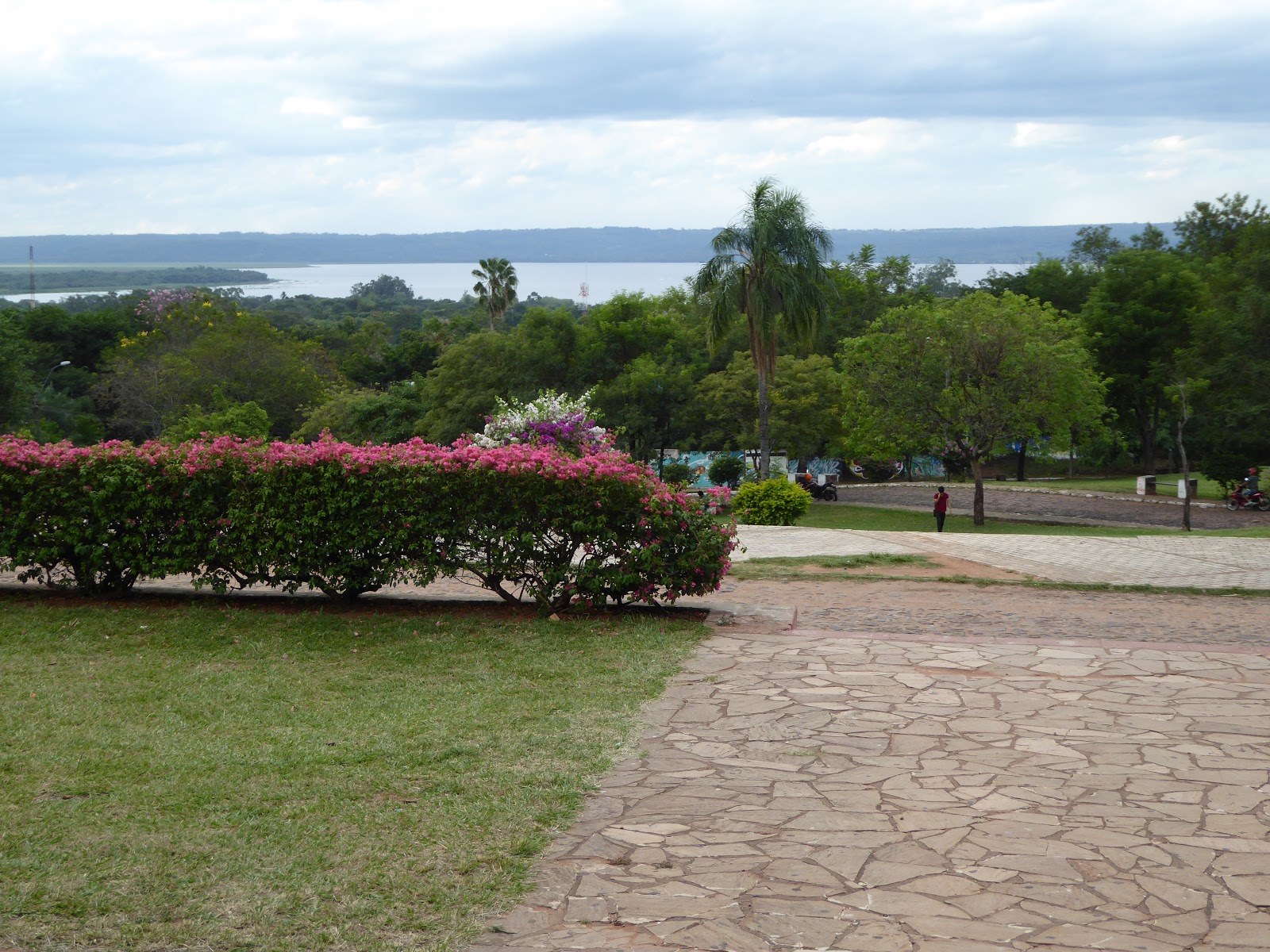
Lake view from Aregua, near Asunción
What we did think would be feasible was visiting one of the country's protected areas of Atlantic forest, the San Rafael National Park and Reserve. This is only a 3 or 4 hour journey from Encarnación, and we had already managed to get in touch with staff at the park and provisionally booked a cabin for a few days. However, when it came to our planned day of departure, circumstances conspired against us. The night before, the horrendously hot and humid weather (39 degrees!) finally broke - there was a big thunderstorm and it rained all night and was still pouring the next morning. The road to San Rafael is unpaved and often becomes impassable in bad weather. We managed to phone the park from our hostel, and were told it would be impossible to go that day. We stayed another night in Encarnación and hoped that the weather would brighten up enough to dry the road by tomorrow. Alas, the downpour continued all day, and park staff told us the next day that the road was still impassable. We really wanted to go, but the forecast wasn't good for the rest of the week either, so we reluctantly gave it up as a bad job and got on a bus to Asunción.

Ceramics for sale in Aregua, near Asunción
About an hour into the journey to Asunción, we went through the small town of Coronel Bogado. We remembered the name from something the friendly old lady at our hostel in Encarnación had said to us - that the best 'chipas' in the country are made there. Chipas are dense, baked rolls made from maize and flavoured with Paraguayan cheese. They are quite an institution in Paraguay and the neighbouring area of Argentina - street vendors carry baskets of them in all sorts of shapes and sizes. When the bus stopped in Coronel Bogado, a couple of sellers got on, and we knew this must indeed be the famous place as literally all the locals on the bus bought some! Obviously we did too, and they were the best we had anywhere. Yum. Another interesting part of Paraguayan culture is the tereré - like Argentinian maté tea, but served cold. Most locals constantly carry around large water flasks in special carry cases with a pocket for their tereré cup!

Palacio de Gobierno, Asunción
Despite being the Paraguayan capital, Asunción doesn't have a lot to see or do. We dutifully spent an afternoon wandering around the centre, but weren't very taken with any of the sites other than the Palacio de Gobierno, an impressive, large colonial building painted pale pink. We thought this was a lot prettier than the famous Casa Rosada in Buenos Aires! The city has bit of a feel of faded glory - there are quite a lot of old buildings but most are very dilapidated and little or no effort has been made to conserve them. Asunción is actually one of the oldest cities in South America, founded in 1537, and in colonial times it was also one of the most important. Since independence however, and after the Paraguayan war in the 1860s, the city lost its importance and the national economy has declined rapidly. The war, also known as the Triple Alliance war (Paraguay against the combined forces of Brazil, Argentina and Uruguay) had a massive impact on Paraguay. It was one of the worst military defeats ever inflicted on a nation - more than 60% of the population died, and 90% of the country's men. Really, Paraguay is still struggling to recover from the effects of the war today.

Modern and old combined, in a courtyard in Asunción
Asunción is built on the Paraguay river, and  few months ago it was hit by some of the worst floods in decades, which you might have seen on the international news. Tens of thousands of people were displaced from their homes, and sadly it seems many of them still have nowhere to live. We walked past a huge, makeshift camp or shanty town, with hundreds of people living in wooden shacks or just tents made from bin bags with no sides. The camp was in one of the city's biggest plazas, right on the doorstep of the presidential buildings - maybe to make a point, as the government is apparently doing little to help. It was sad and quite shocking to see.

Riverfront and very cool sky in Corrientes
We met no other tourists in Encarnación, so were surprised to find a really excellent, sociable hostel in Asunción (El Nomada). We spent a lot of time just hanging out there and chatting. Most people travelling Paraguay are not your ordinary tourist, and we met some great people, including a couple of bikers who'd been travelling the world with their huge bike and sidecar for three years! We also went with another English guy we met to a nearby town, Areguá, which is famous for its ceramics. We reluctantly left this fantastic hostel after 3 nights and embarked on another long bus ride (8 hours) back over the border to Argentina and the cities of Corrientes and Resistencia. The weather had been fine for the previous two days, but a little like our last night in Encarnación, there was a big storm the night before we left Asunción. The temperature dropped literally 20 degrees in a day. After being at temperatures well above 30 degrees for several weeks, 10 degrees was quite a shock! We had to dig out our coats and jumpers again that we'd thought we'd not need for the rest of the trip.

Monastery in Corrientes
For the next couple of days, we stayed in the Argentinian city of Corrientes, the capital of the Corrientes province. It is only a 20 minute drive away from the neighbouring city of Resistencia, across a river which marks the border between provinces. So, strangely, Resistencia is also the capital of a province - the Chaco province! We liked both of these cities as they were just typical Argentinian cities, with no tourists. The locals were super friendly and whenever we sat down in a cafe we'd get engaged in conversation by people curious to see us there! Corrientes is the more historic of the two, while Resistencia is known as Argentina's 'Capital of Sculptures'. Every 2 years the city has a competition that sculptors come from all over the world to take part in - they have 7 days to produce a sculpture. The best ones are displayed either in the museum or on the streets - more than 200 line the streets in the centre already.

Sculptures in Resistencia
From Corrientes we took our first night bus since Colombia - 13 hours up to Salta in the north of Argentina. We had forgotten how expensive buses are in Argentina - £45 a person! We are looking forward to exploring more of this area now, and probably hiring a car.

Sunday, 28 February 2016

Explosive Entertainment in Coffee Country

When we last posted we had just visited the beautiful (and butterfly heavy!) Río Claro. Rather than staying there, we just used it as a two hour stop off to break up the bus journey between Guatapé and Honda. This bus journey was quite interesting, involving 4 different buses in the end and a total of 5 hours travel time. However, all went smoothly in the end and we arrived in Honda in the early evening, not at midnight as we had feared might happen!

The market place in Honda
Honda is not a town on many tourists' itineraries. In fact, it wasn't on ours, until we decided it'd be a good way to get to the coffee region without having to return to Medellín. We were glad we made it here though, as we didn't see a single other Western tourist! This is quite some feat in Colombia, where there is a very set 'Gringo trail' and it can be hard to escape the crowds. We hadn't realised before we got here just how popular Colombia has become as a tourist destination - in South America that we've seen so far it's probably second only to Perú. We've found in this country that we've had to reserve all our accommodation ahead (not something we'd usually do) and a lot of places have been fully booked even a week in advance! So it was nice to get off the beaten track a bit.

Puente Navarro, a famous bridge in Honda 
Lonely Planet has a very small blue box on Honda, entitled 'Hot, Hot Honda'. I kind of imagined this meant 'hot' in the sense of it heating up as a new tourist destination. But as soon as we got out out of the bus we understood that this was in fact to be taken literally. Honda is HOT! One of the hottest towns I've ever been to, including everywhere in Southeast Asia. The average daytime temperature when we were there was around 39 - 40°C, but hotel staff told us it is often up to 45. That's pretty sweltering for us Brits!

View of Honda from the other side of the river
Luckily for us, due to Honda having so few tourists we were able to stay in a lovely hotel complete with terrace, pool and aircon, for a fraction of the price you'd pay elsewhere in Colombia. We spent our one full day here checking out the sleepy colonial town (while getting slowly fried) and then returned to chill out in the pool. The town reminded us a lot of Mompox - it's focused around a river, has a lot of very pretty yet slightly crumbling colonial architecture, and shuts down completely during the hottest hours of the day. It's a pleasant place to wander around, as long as you bring copious amounts of water! We got a lot of glances from locals who were clearly not used to seeing tourists here.

Pretty streets in Honda
On the night we arrived in Honda there was a huge thunderstorm - so big our room got flooded and we had to move upstairs. In fact our arrival heralding rain after a long drought seems to be becoming a theme. In Guatapé they'd had no rain for two months, but when we got there, there was a storm that lasted all night. In Honda they'd had no rain for three months - same story! Thus we weren't too surprised when our bus got to Manizales, our next destination, and lo and behold, the heavens opened. It was torrential! We had to take a taxi from the bus station to our hostel, as our planned method of transport, a cable car, was not operating in the thunder and lightning. Staff at the hostel immediately said to us, 'It's amazing! We've had no rain for three months!'

View of Manizales from our hostel window - this was as clear as it got!
While the rain didn't really affect us in Honda and Guatapé, in Manizales once it started it didn't stop for the whole of our two days there. Therefore a lot of the activities we'd hoped to do - hiking to a viewpoint in the downpour, or climbing a 5000m mountain with zero visibility - didn't appeal so much. We did get out as far as the main square to admire the huge (ugly on the outside, much better on the inside) modern cathedral. But most of our time was spent within our very nice hostel. Manizales is a city in the heart of the coffee region of Colombia, and we'd assumed it'd get plenty of tourists. Actually, not at all - the hostel had only a couple of other people staying, and the restaurants we went to seemed surprised to see us. It was a bonus to find another non-touristy place unexpectedly.

The cathedral in Manizales - the third tallest church building in South America
So where do all the millions of visitors to Colombia's coffee country go? Not to any of the three main cities, it turns out, but to the little town of Salento, a beautiful place surrounded by rolling green hills and several coffee plantations. Salento was a bit of a shock after the last week. From seeing no westerners. suddenly there were big tour groups, souvenir shops everywhere, restaurants with touts outside... it reminded us of San Pedro de Atacama (minus the desert!). But as with many very touristy places, there are good reasons for so many people coming here. In usual style, it was pouring with rain when we first got to Salento, but fortunately after that it only tended to rain heavily in the evenings.

In the Valle de Cocora - note the tall wax palms
Salento is close to the Valle de Cocora, part of the Los Nevados national park. This valley is famous for being the main location in the country where you can find wax palm trees, Colombia's national tree and symbol. We did an excellent 5 hour trek here, starting in cloud forest, climbing up steeply to 3000m and then descending a little to a wonderful hummingbird sanctuary. Here there were hummingbird feeders and so many hummingbirds of all shapes, sizes and colours everywhere! We also saw two 'cusumbos' (coaties) - very furry animals with stripy tails. So cute! From the hummingbird reserve we descended into the valley and finished our walk seeing the wax palms. These are very cool looking - extremely tall, with thin trunks and no branches until right at the top. It was amazing seeing them lining the hillsides, or the tops emerging out of the cloud forest canopy.

Hummingbirds and coatis
View of the wax palm trees along the hills
On our second day in Salento we met up with Ralph and Shehnaaz, our friends from home who we'd seen previously in Taganga. Unfortunately, shortly after we last saw them they were involved in a nasty car accident up on the north coast, and hadn't been able to do much for the past few weeks. We were glad to see them again and see that they were gradually recovering. The four of us spent a day visiting a coffee farm called Ocaso, close to Salento. The tour in English was fantastic - we learnt loads about all aspects of coffee growing and production. As part of the tour we got to pick some of the berries ourselves, see all stages of the process (e.g. de-husking, washing, fermenting, drying, roasting...) and finally of course sample a cup of the freshly brewed final product. I am not the biggest coffee fan, but even to me it tasted pretty good!

Coffee growing - the berries need to be red before they're picked Lady working to sort the coffee beans into 1st and 2nd class Shehnaaz pouring the water ready for our cups of coffee
That evening after a few drinks the four of us decided we had to try a game of Tejo, a traditional sport in Colombia. It's a little like boule, or bowling, but with a twist - explosives are involved! You have to throw a heavy metal disc (2-3 pounds) from a distance of about 10m, aiming at a board angled at 45 degrees and covered in clay. At the centre of the board is a metal ring, and round the ring are placed a few small white triangles which contain gunpowder. The idea is to hit the white targets right on the metal edge so that the impact causes them to explode! The 'explosions' were just a small flame and puff of smoke. Apparently if we'd come during the day the bangs would have been louder - they're not allowed to make too much noise at night (just a thought, shouldn't this rule also apply to Colombian music?!). It was great fun though and we'd have liked to come back for another go.

Ralph playing Tejo
Kev and I needed to get going though so we said goodbye to Ralph and Shehnaaz, who we may or may not see again before we get home in June. Next stop -  south to Popayán.

Friday, 15 January 2016

Birthday on the Caribbean Coast

We left Pasto to fly up to Cartagena, a UNESCO listed colonial city on the Colombian Caribbean coast. We were going as our friends, Cindy and Julien, with whom we'd travelled in Chile and Bolivia, were going to be there having just arrived from Cuba. It was great to see them again and exchanging tales of our travels in the intervening six months. It was also my birthday and we celebrated with Indian food and craft beer, which I enjoyed a lot!

In the craft beer pub for my birthday
Cartagena was a big change on many levels - altitude, heat, people, music, etc. It was almost the first time on our trip that the climate was actually hot. We'd mostly been in the Andes along the length of the continent, and although the days could be quite warm, the evenings and nights were refreshingly cool. Now, the heat was relentless and we were glad for the air conditioning in the room.

Old and new - skyscrapers and city walls in Cartagena
The other marked differences were the ethnicity and the music being played everywhere. There's a much more racially diverse mix than we've seen in the rest of South America, and the music follows on from that. Although you still hear the same stuff as in the rest of the continent, there's more variety here with a lot of Caribbean influence. It makes a nice change!

The main fort in Cartagena
The city itself was the principal Spanish port and access point to South America in colonial times, founded in 1533. As well as exporting gold and precious metals, many slaves were brought there to work in the colony. This made a significant contribution to the diversity seen today. Now it is a beautiful city, with each narrow street making a picture postcard of flowered balconies and cobbled streets, frequently roamed by horse and carts. It is surrounded by large city walls and looked over by an impregnable castle (the British tried to invade several times and were repulsed on each occasion).

Horse and cart on a typical Cartagena street
Cartagena was linked to the interior of the continent by river to the city of Mompox. This river was neglected in the 19th century, and became silted up, which led to the decline of the latter. However, this has left a sleepy town full of streets similar to those in Cartagena, but without the crowds of people and tourists. We spent a couple of days here, adjusting to the slow pace of life and taking a boat trip through matted reed beds with heron's heads poking out of the top.

The Magdalena River in sleepy Mompox
Since Mompox we've returned to the coast to Taganga - in stark contrast to Mompox, it is a hive of backpackers and cheap diving courses.

Wednesday, 11 March 2015

In and Around Puerto Madryn

Our next destination after Sierra de la Ventana was to be Puerto Madryn, home to the UNESCO-listed Península Valdés. The bus route was going to be tricky - we could either stay in Bahía Blanca or Viedma, or both - and we were running low on ready cash.

Sunset over the square in Bahía Blanca
We decided to go for Bahía Blanca - it sounded a bit more interesting than Viedma, was a shorter bus journey, and is a larger city so more chance of finding somewhere to exchange money at a good rate. The incredibly helpful lady in the Sierra de la Ventana tourism office helped us find a cheap room and a list of backup options. On arrival, the cheap room was on a dark, dark street, with unsavoury characters hanging around outside. We went for one of the backup options.

Having survived the night in spite of the 32° heat and the overpowering stench of gas ('no, no, there's no gas here'), we spent the day taking in the sights of Bahía Blanca. It's a pleasant city, with a large tree-filled square and several pedestrianised shopping streets. There isn't a huge amount to do for tourists so we whiled away our time away in several cafes - we did manage to exchange money at a decent rate with the staff in one of these. Our bus to Puerto Madryn was due to leave at 23:40, but was delayed for an hour while the drivers decided what to do with all of the luggage. It was already crammed full of bags, despite there being no one on it, so there was no room for the luggage of the 30 people waiting to get on. We don't know what they did with the first set in the end, or where it had come from.
Drinking maté
After a couple of days exploring the coastal town of Puerto Madryn, we decided that the best way to visit Península Valdés would be on a tour. We were picked up by our friendly and knowledgeable guide, Hugo, and driven in a minibus around the mostly gravel roads of the peninsula. He shared his maté with us, a bitter herby tea that is an institution here and in surrounding countries. It is traditionally drunk from special maté cups with metal filter straws and passed round between friends.
Elephant seals
Burrowing owl
Although it is the wrong season for right whales, and the sea was too rough for seeing orcas, we were still spoilt by the abundance of wildlife across the peninsula. Amongst other things, the highlights were the noisy sea lion colony (they sound a lot like sheep), elephant seals, Magellanic penguins, burrowing owls, guanacos (undomesticated llamas) and hairy armadillos. What a great start to our time in Patagonia!

Penguins!

Sea lions

Friday, 6 March 2015

Climbing Cerro Ventana

We came to Sierra de la Ventana with one main intention - climbing the nearby peak Cerro Ventana (1134m).  Those of you with some knowledge of Spanish will know that Cerro means hill and Ventana window, and as the name implies Cerro Ventana is famous for the spectacular window in the rock near the summit.

First things first - we needed to work out how to get to the provincial park, Parque Provincial Ernesto Tornquist, from where the climb begins. We consulted the local bus timetable and found there was a bus there at 9.50 am and one back at 5 pm - perfect, we thought, as the hike takes around 5-6 hours. We set off the next day but on arrival we were told the only way to do the hike was to arrive before 9 and do it in a group with a guide. Furthermore, according to the rangers at the park, the 5pm bus didn't actually exist and the only bus back was at 7 pm.

On the 'path' to the waterfall
Instead, we spent the day on a great shorter walk, scrambling along a dried-up canyon culminating at a sheer cliff and waterfall. We were lucky to be able to hitch a lift back to Sierra de la Ventana with a friendly couple from Buenos Aires. We bought them a beer to say thank you and enjoyed having a long chat with them in Spanish - fun and very good practice for us.

Gazing across the Pampas
Attempt #2 at the Cerro Ventana climb involved getting up at an unearthly hour in order to catch the 6.45 am bus - the only option for getting to the park on time. We had just over an hour to wait for the park to open but once it did around 20 other people turned up and we duly registered for the climb. It was as amazing as we'd hoped. The route was very tough going in places, with steep sections where we had to scramble up rocks, and there was no shade in the 30 degree heat. The clear skies meant breathtaking views though - panoramic vistas of the surrounding plains for miles and miles around. The hills in this area are the only bulges of any size in the whole of the Buenos Aires province (and bear in mind we were now 500 km south of the capital). The views got better and better as we climbed and the one framed by the window at the top was the best of all - simply stunning. During the course of the climb we saw a couple of guanacos (wild llamas) and while at the top a large bird of prey soared above us, so low that we could see the patterns on its wings - wow!

Made it to the Window!
The guide was friendly, helpful and very well informed. We were the only non-Argentinians on the walk so followed his detailed (and fast) Spanish explanations as best as we could. He kindly gave us a lift back to Sierra de la Ventana that day in his very antique vehicle.

On a sidenote, Sierra de la Ventana has a rather interesting dog population. We initially thought that the countless dogs running around everywhere were strays, but they seem remarkably well fed and most have collars. It seems most likely that dog owners here just let their pets out every morning to go and have fun round the village all day - this would also explain the large number of 'lost dog' signs!