Showing posts with label hotel. Show all posts

Thursday, 19 May 2016

The Fertile Valley in a Desert

We left Cafayate, having a vague plan of heading south towards Mendoza. We had a list of places we might want to stop at to break up the journey, but none sounded that appealing. Instead, we decided to try and make it all the way down to San Juan, just 2 hours north of Mendoza. Importantly, it's a decent base to make a trip to Ischigualasto Provincial Park, a UNESCO world heritage site.

The 'Submarine' - one of the famous rock formations in Ischigualasto
After our 5 hour bus journey from Cafayate to Tucumán, we bought our tickets for the next leg - 11 hours overnight to San Juan. Despite buying the tickets from a company called AndesMar with plenty of time to spare, we still nearly missed it. We stood at the terminal, staring at a lone FlechaBus, thinking that our bus had been delayed. Luckily, I went to find out if anybody knew where our bus was and was told that it was the one that had been sitting there all that time. We should probably have realised that the FlechaBus at the same time, going to the same place and at the same price was ours!

The 'Sphinx' in Ischigualasto
We'd heard about Argentinian buses serving wine with dinner, but hadn't experienced it until now, so had begun to think it was a bit of a myth. We can now confirm that this actually happens! We were served a meal as good if not better than in most restaurants here, with proper metal cutlery and drinks options including red and white wine. The journey was quite comfortable, with large seats that reclined almost horizontally.  But however comfortable a night bus is, we still find that they leave us needing to catch up on sleep the next day. We hadn't booked anywhere to stay and, after looking at a couple of abominable hostels, found a hotel to check in to. Annoyingly, they wouldn't match a price on our favoured hotel-booking website, so we used their wifi while in reception to make a reservation before checking in. This didn't seem the most sensible business decision, as they would now be paying 10%+ commission to the website.

A field of balls in Ischigualasto
San Juan didn't hold much of interest for us, so we soon set off to San Agustín de Valle Fértil. We'd hoped to hire a car, as we knew that it was impossible to get to Ischigualasto park with public transport. Unfortunately, we'd been in San Juan at a weekend and most businesses in Argentina don't open on a Saturday afternoon or Sunday. Luckily, the incredibly helpful owners of the place we were staying in San Agustín helped us to organise a reasonably priced taxi to take us there.

The lake in San Agustín
The park was worth the effort. The main sights are quite spread out, so the standard thing to do is to drive around in a convoy following a guide, then stop at several points to appreciate the landscape from closer up. The park is home to the oldest dinosaur fossils that we have yet discovered, from the Triassic Period around 250 million years ago. The desert-like landscape is sculpted by rain and wind, creating incredible shapes in the layered rocks. Palaeontologists don't need to dig here - they just wait for a rain shower and see what's been uncovered by the erosion.

Layers of rock, just waiting to be eroded to reveal the next dinosaur
After Ischigualasto, we were driven back to San Juan by our hosts, from where we took a bus down to Mendoza. We should be meeting our friends Ralph and Shehnaaz there to explore the famous wine growing region together.

Sunday, 1 May 2016

Why Does Nobody Go To Paraguay?

Paraguay is not somewhere you hear much about when travelling South America. Most people seem to skip it all together, or perhaps just go across for the day from Argentina or Brazil for a cursory country grab. Neither Lonely Planet or Rough Guide even bother to produce a guide for Paraguay - it gets a short mention in the Lonely Planet Shoestring guide that covers the whole continent, but that's it. So unlike most places we've been, we really didn't know anything about this country before we arrived, or have any idea what to expect of it.

Sunset in Encarnación
Paraguay is a landlocked country, bordering Bolivia, Brazil and Argentina. It is home to an amazing variety of different environments and habitats, including the Chaco, the Pantanal, and Atlantic rainforest. A lot of the country is still relatively untouched wilderness, and there are many conservation projects trying to limit deforestation and protect its rich biodiversity.

Street in Asunción
We had hoped to do more than the average tourist in Paraguay and get off the beaten track a little: we'd read that this is difficult to do, but dismissed this as hyperbole. However, once in the country we found that the reports were more accurate than we'd imagined! Paraguay really isn't particularly bothered about attracting tourists so there is very little tourist infrastructure and it is hard to find accurate information about anything other than the urban centres.

The Chaco region, a semi-arid area rich in wildlife, makes up more than 60% of Paraguay's land area, but less than 2% of the country's population lives there. We had wanted to explore this region, but as it so sparsely populated it is somewhat challenging to get around. The Pantanal, a wetland region on the border with Brazil, is also something of a mission to get to. We met an Australian at our hostel in Asuncion who was trying to go there - his journey would involve a 7 hour bus, a public boat for 3 days, and then having to hire another boat himself for the final section. Maybe earlier in our trip we'd have been up for this, but this late on we are trying to push on to see as much of the rest of the continent as we can in our last few weeks.

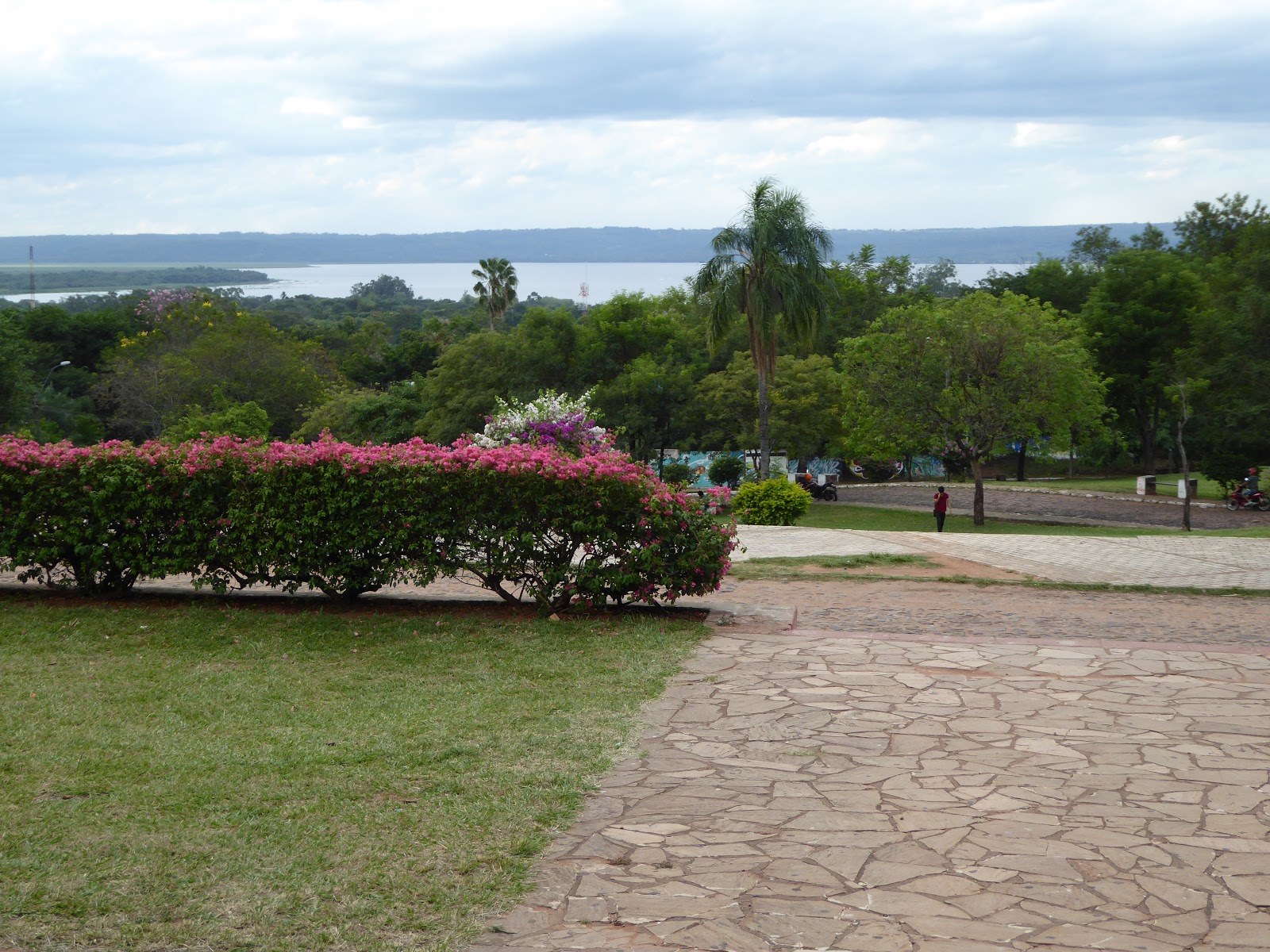
Lake view from Aregua, near Asunción
What we did think would be feasible was visiting one of the country's protected areas of Atlantic forest, the San Rafael National Park and Reserve. This is only a 3 or 4 hour journey from Encarnación, and we had already managed to get in touch with staff at the park and provisionally booked a cabin for a few days. However, when it came to our planned day of departure, circumstances conspired against us. The night before, the horrendously hot and humid weather (39 degrees!) finally broke - there was a big thunderstorm and it rained all night and was still pouring the next morning. The road to San Rafael is unpaved and often becomes impassable in bad weather. We managed to phone the park from our hostel, and were told it would be impossible to go that day. We stayed another night in Encarnación and hoped that the weather would brighten up enough to dry the road by tomorrow. Alas, the downpour continued all day, and park staff told us the next day that the road was still impassable. We really wanted to go, but the forecast wasn't good for the rest of the week either, so we reluctantly gave it up as a bad job and got on a bus to Asunción.

Ceramics for sale in Aregua, near Asunción
About an hour into the journey to Asunción, we went through the small town of Coronel Bogado. We remembered the name from something the friendly old lady at our hostel in Encarnación had said to us - that the best 'chipas' in the country are made there. Chipas are dense, baked rolls made from maize and flavoured with Paraguayan cheese. They are quite an institution in Paraguay and the neighbouring area of Argentina - street vendors carry baskets of them in all sorts of shapes and sizes. When the bus stopped in Coronel Bogado, a couple of sellers got on, and we knew this must indeed be the famous place as literally all the locals on the bus bought some! Obviously we did too, and they were the best we had anywhere. Yum. Another interesting part of Paraguayan culture is the tereré - like Argentinian maté tea, but served cold. Most locals constantly carry around large water flasks in special carry cases with a pocket for their tereré cup!

Palacio de Gobierno, Asunción
Despite being the Paraguayan capital, Asunción doesn't have a lot to see or do. We dutifully spent an afternoon wandering around the centre, but weren't very taken with any of the sites other than the Palacio de Gobierno, an impressive, large colonial building painted pale pink. We thought this was a lot prettier than the famous Casa Rosada in Buenos Aires! The city has bit of a feel of faded glory - there are quite a lot of old buildings but most are very dilapidated and little or no effort has been made to conserve them. Asunción is actually one of the oldest cities in South America, founded in 1537, and in colonial times it was also one of the most important. Since independence however, and after the Paraguayan war in the 1860s, the city lost its importance and the national economy has declined rapidly. The war, also known as the Triple Alliance war (Paraguay against the combined forces of Brazil, Argentina and Uruguay) had a massive impact on Paraguay. It was one of the worst military defeats ever inflicted on a nation - more than 60% of the population died, and 90% of the country's men. Really, Paraguay is still struggling to recover from the effects of the war today.

Modern and old combined, in a courtyard in Asunción
Asunción is built on the Paraguay river, and  few months ago it was hit by some of the worst floods in decades, which you might have seen on the international news. Tens of thousands of people were displaced from their homes, and sadly it seems many of them still have nowhere to live. We walked past a huge, makeshift camp or shanty town, with hundreds of people living in wooden shacks or just tents made from bin bags with no sides. The camp was in one of the city's biggest plazas, right on the doorstep of the presidential buildings - maybe to make a point, as the government is apparently doing little to help. It was sad and quite shocking to see.

Riverfront and very cool sky in Corrientes
We met no other tourists in Encarnación, so were surprised to find a really excellent, sociable hostel in Asunción (El Nomada). We spent a lot of time just hanging out there and chatting. Most people travelling Paraguay are not your ordinary tourist, and we met some great people, including a couple of bikers who'd been travelling the world with their huge bike and sidecar for three years! We also went with another English guy we met to a nearby town, Areguá, which is famous for its ceramics. We reluctantly left this fantastic hostel after 3 nights and embarked on another long bus ride (8 hours) back over the border to Argentina and the cities of Corrientes and Resistencia. The weather had been fine for the previous two days, but a little like our last night in Encarnación, there was a big storm the night before we left Asunción. The temperature dropped literally 20 degrees in a day. After being at temperatures well above 30 degrees for several weeks, 10 degrees was quite a shock! We had to dig out our coats and jumpers again that we'd thought we'd not need for the rest of the trip.

Monastery in Corrientes
For the next couple of days, we stayed in the Argentinian city of Corrientes, the capital of the Corrientes province. It is only a 20 minute drive away from the neighbouring city of Resistencia, across a river which marks the border between provinces. So, strangely, Resistencia is also the capital of a province - the Chaco province! We liked both of these cities as they were just typical Argentinian cities, with no tourists. The locals were super friendly and whenever we sat down in a cafe we'd get engaged in conversation by people curious to see us there! Corrientes is the more historic of the two, while Resistencia is known as Argentina's 'Capital of Sculptures'. Every 2 years the city has a competition that sculptors come from all over the world to take part in - they have 7 days to produce a sculpture. The best ones are displayed either in the museum or on the streets - more than 200 line the streets in the centre already.

Sculptures in Resistencia
From Corrientes we took our first night bus since Colombia - 13 hours up to Salta in the north of Argentina. We had forgotten how expensive buses are in Argentina - £45 a person! We are looking forward to exploring more of this area now, and probably hiring a car.

Sunday, 17 April 2016

The Incredible Iguazú Falls

The Iguazú Falls - maybe one of the most famous sights in South America, and something we'd certainly heard of before we got to this continent! We'd both been looking forward to seeing this amazing set of waterfalls for the whole trip so far. Although we've had to skip most of Brazil in order to see everything else we want to see before June (we'll be returning one day!), Rio and Iguazú were the two places we really wanted to get to this time.

The Iguazú Falls from the Argentine side
The Iguazú Falls are on the Iguazú river, located right on the border between Brazil and Argentina. They are shared between the two countries - both sides have their own Iguazú National Park, and both of these are UNESCO World Heritage sites! The falls are not just one waterfall, but a huge set of 275 drops in total, ranging from 60 - 82m in height and extending for 2.7 km along the river. Two thirds of the falls are in Argentine territory, and the Argentine park is a lot bigger, but there are absolutely spectacular views from both sides. Eleanor Roosevelt is said to have remarked, on her first sight of the falls, 'Poor Niagara', and you can see why.

Panorama from the Brazilian side
When looking at places to stay near Iguazú, we remembered a recommendation we'd had a while ago. The English couple we did our crazy long Machu Picchu trek with, Ivonne and Robin, had mentioned a hotel that was located actually within the Brazilian national park itself, within 2 minutes walk from the falls and even with views of them from some of the rooms. We'd had this in the back of our mind for some time and couldn't resist looking into it. Even when we found it was way, way above our budget, we couldn't quite make ourselves relinquish our dream of staying there, and thus it was that we booked without doubt our biggest accommodation splurge of the trip so far - 3 nights in the 5 star Belmond Hotel Das Cataratas!

Champagne breakfast in front of our hotel
The hotel was amazing. We enjoyed all of its perks - the gym (after which we couldn't walk for days, haha), the beautiful pool, the bar (best pisco sour since Peru), the breakfast time champagne ... and even the room service (ironically because this was the cheapest way to eat - the two onsite restaurants were both quite unaffordable!). But without doubt the biggest perk of all was the proximity to the falls, and the exclusive access in the mornings and evenings when the park was closed to the public. We often had the falls completely to ourselves. We got our first view of the falls the evening we arrived, around sunset. The viewpoint was literally just opposite the hotel, and there were only a few other people around. WOW! I can't even attempt to describe the beauty of this moment - the photos will have to do the talking for me.

Our first view of the falls, from the viewpoint in front of our hotel
The next morning, we got up early and went to see the falls before the park opened to the public. While the day before we'd only seen the view from the first viewpoint, today we followed the path down towards Devil's Throat, the most famous waterfall. In a short 15 minute walk, we were greeted with one spectacular vista after another. It just got better and better! We hadn't really appreciated the sheer size and number of the waterfalls from the hotel viewpoint, and now could see them stretching much further than we'd realised. It was just avalanches of water in all directions. Unbelievable. Near the end of the path, there was a metal walkway out into the river around the top of some of the falls, from where we could look down and see the water suddenly just disappear over the edge of a cliff. We got totally soaked from all the mist! At the very end of the path, we arrived at a stunning view of the Devil's Throat, the biggest waterfall of them all. I could have stood there all day, watching the tons of water come hurtling down and hearing the incredible thundering noise. Again, WOW.

The misty walkway near the Devil's Throat
After three nights, we reluctantly left our nice hotel. We weren't done with the falls yet though and were headed next over the border to Argentina, to see them from the other side. En route, we visited Brazil's Parque das Aves (Bird Park), which is right next to the national park entrance. We'd read mixed reviews of this but loved it and were very glad we went! They have a huge collection of birds, mostly from the Amazon region. Yes, they were in captivity, but most had been rescued from much worse situations, and the enclosures seemed large and not too crowded. We saw so many weird and wonderful birds that we'd never have got to see otherwise. Among my favourites were the three or four different species of toucan, the harpy eagles, and the gigantic walk-in enclosure with eight different types of macaw flying / perching everywhere!

Green-billed toucan in Parque das Aves
We'd been quite looking forward to returning to Argentina. It's a country we feel we know fairly well by now, after spending quite a lot of time here previously. But unfortunately, on our first evening in the country, we had a bad experience that somewhat tarred our formerly positive feeling about returning. As we were walking back to our hostel after dinner, we passed a house with a dog behind a closed gate. It came running, barking, and threw itself at the gate. A lot of dogs here behave like this, so we were unperturbed, until another dog appeared from nowhere, ran at us and bit me on the leg! This dog turned out to belong to the same house, but had been left loose in the street.

Scarlet macaws, with one blue-and-yellow one, in the Parque das Aves
The bite wasn't too bad; it swelled up a bit and looked like a red weal but didn't properly break the skin (now, several days later, it is just a very impressive bruise). However, worse than the bite itself was the attitude of the owner. She would not admit the dog was dangerous, would not agree that it shouldn't be left to roam freely on the street, would not even apologise until the neighbours too, who had seen the whole thing and whose Spanish was obviously a lot better than ours, got involved. What a rude, unpleasant person! The neighbours did not seem to like her either - when she'd gone, they apologised on her behalf even though it was in no way their fault, and told us the same dog had bitten someone before. Fortunately most Argentinians we've met have been super friendly and nice; the opposite of this woman. It was a horrible thing to happen on our first day back in Argentina though.

View of the San Martín waterfall, on the Argentine side of the falls
This incident meant we changed our plans a little and stayed an extra night in Puerto Iguazú so I could get the bite checked by a doctor (various doctor friends at home had advised this just in case of any risk of rabies). It was very easy, and not too expensive, to see a doctor at the private clinic, and she reassured us the bite should be fine, and that rabies is controlled in Argentina. Rather than going to the national park after this, we decided it was too late and instead went to visit an animal rescue sanctuary nearby. All the animals here were from the jungle regions of Argentina and had been rescued from appalling conditions, often being kept as pets in tiny cages. So it was sad seeing some of the birds missing eyes or legs, or unable to fly, but also positive that they are now being looked after well.

Part of the Itaipú Dam in Brazil
On our second day in Argentina, we actually crossed back over the border to Brazil so that we could visit the Itaipu Dam there. The dam is on the river that divides Brazil and Paraguay, and is huge - 7km long and around 200m high. It was built as a joint venture between the two countries, and the hydroelectric power it produces supplies both Brazil and Paraguay with a significant proportion of their electricity. In fact, Brazil is so much bigger than Paraguay that it pays the latter around a million dollars a day to use more of the dam's turbines. So Brazil takes 90% of the power produced, and Paraguay 10%. Despite this, in 2013, the dam supplied 75% of Paraguay's electricity, and 17% of Brazil's. It was cool to see the dam, though I think we got more from reading about if afterwards than from the very touristy open top bus tour we did.

In front of the Devil's Throat, Argentine side
Finally, on our third day in Argentina, we made it to the Argentine side of the falls. We were glad we'd saved this till last, as it was even better than the Brazilian side! The national park is a lot bigger, and we spent the whole day there walking along several different trails. On this side, we could get a lot closer to most of the waterfalls, and see them both from above and below. As it was a sunny day, there were rainbows everywhere! We also got the best panoramic view yet, with the falls continuing as far as we could see. Argentina also seemed to win on the butterfly front. There'd been a few on the Brazilian side, but here was another level! We had to walk through literally clouds of them. It was impossible to escape; they were EVERYWHERE. All shapes, sizes and colours and all, it seemed, constantly wanting to land on human beings! This was a massive challenge for me but my desire to see the falls overcame my fear (mostly); I did spend a lot of time swearing, running through the biggest clouds and flapping my hat / bag at them though!

One of several big clumps of butterflies.These would fly up into the air all around us when we passed!
The highlight of the Argentine side was another view of the Devil's Throat. This time, we got much closer to it, and could hear its roar from several hundred metres away, increasing as we approached. Quite a large proportion of the total volume of water in the falls is funneled down this one narrow chasm, and the sheer force of it is astounding. I can't describe just how exhilarating it was to stand there, getting completely drenched, and marvelling at this gigantic torrent of water throwing itself down right next to us. No other waterfall I've ever seen comes anywhere near the magnificence of this spectacle! Once again, we felt utterly awed by the power of nature.

Panorama of the Devil's Throat and surrounding waterfalls, Argentine side
We've now (unwillingly) left the Iguazú area, and will spend a bit more time in Argentina before we move on to Paraguay. The take home message from this post though is - go to the Iguazú Falls! If it's not on your bucket list, it should be.

Wednesday, 30 December 2015

Celebrating Christmas in Ecuador

Before we left for the Galápagos, we'd thought ahead, done some research and reserved somewhere that sounded social but not a party hostel to stay in Quito for Christmas. Unfortunately, when we returned, and after we'd reconfirmed with them, they'd decided to cancel the reservation and close for Christmas. Thanks BoutiQuito. Luckily for us, that meant that we found KindeHouse instead.

Christmas lunch with our fantastic hostess, Monserrate
Although there weren't many other people staying there, we were welcomed by a very friendly Ecuadorian family. We came back one evening after dinner and joined the daughter and her work colleagues for pre-Christmas drinks and, on Christmas Day, were cooked a fantastic festive lunch - traditional Ecuadorian style with three meats, rice, token salad, a very sweet condensed milk and cake dessert, and Sangria! The next day the mother randomly brought us each a little glass of a homemade cocktail a little like Baileys. The family were really very welcoming and couldn't have been more helpful. Better still was that we were just around the corner from Bandido Brewing, which has by far the best craft beer we've tasted in Ecuador.

The cathedral and main square in Quito
Quito, the capital of Ecuador, is set in a valley so is lined on both sides by high mountains. We were driven to a cable car running up one side of it by our host family one day. From the valley base at around 2800m, the top of the cable car is at 4100m. At the top we did a short hike to a 4700m peak with marvellous views over the city, 2 kilometres below us. The 600m climb to the peak was quite tough - we're not used to that altitude at the moment.

The view 2km down to Quito, from Rucu Pichincha mountain
The real highlight of the city though is just wandering around the UNESCO-listed historic centre. It is filled with grand plazas and beautiful churches. There are picturesque streets filled with artisanal shops and interesting museums. Looking over it all is a statue of the Virgin Mary atop a small hill. Locals claim this is the only statue of the Virgin with wings in the world - it just looks like an angel to us!

The winged Virgin, in the distance, above the city
Close to Quito, an hour's bus ride away, is a monument to the Equator - Ecuador takes its name from the imaginary line running close to the capital. The actual Equator meanders over the course of the year in a 5km wide strip, but I guess they had to choose somewhere to put a monument. It is called the 'Mitad del Mundo', or 'Centre of the World'. This is somewhat ironic - as the Earth bulges slightly at the centre, and Ecuador is at around 3000m above sea level, this point is one of the furthest places you can actually be from the centre of the Earth.

The Equator line at the Mitad del Mundo monument
We've now said goodbye to the family in Quito and have come to the cloud forest of Mindo to celebrate New Year. From here, we'll soon be heading into Colombia.

Sunday, 16 August 2015

From Bolivia Into Peru - Lake Titicaca From Both Sides of the Border

We left La Paz wishing we'd had a bit more time there, but also excited about the thought of a new country before too long. First, we wanted to stop in Copacabana, 7km from the Peruvian border, to see Lake Titicaca and Isla del Sol.

Our bus to Copacabana - it got on its own little boat for some of the way!
We decided to treat ourselves again in Copacabana as we'd heard great things about a rather unusual hotel there, Las Olas. The hotel is made up of several 'suites' that are in fact little freestanding houses, all with very quirky designs. Our suite was the Sea Tower, three floors high and with a fantastic view of the lake from our top tower room. All the floors were circular and we even had a specially designed circular bed! We also had a little fireplace, which kept the place cosy during the freezing Copacabana evenings.

Our Sea Tower home in Copacabana
Lake Titicaca is the highest navigable lake in the world at 3800m, and even before arriving in South America we'd intended to stay a night on its largest island, Isla del Sol (the Sun Island). However, it turned out this was not meant to be. Having been talking in La Paz about how we always have good luck with the weather, we appeared to have jinxed it... Storms, heavy rain and snow put paid to any plan to head across the lake by boat. The first time either of us have seen snow in August!

The Basilica of Our Lady of Copacabanca, in a very grey Copacabana
Despite the weather, we still enjoyed our time in Copacabana. We visited the town's basilica, which is very grand - completely out of proportion to the size of the town! The church contains a famous 16th century icon of the Virgin of Copacabana, the patron saint of Bolivia, who is traditionally worshipped on the 5th August. Although we were there a week later there were still queues and queues of vans and buses arriving from across Peru and Bolivia to see the icon. We also managed between snow showers to climb the steep hill behind our hotel, for a wonderful vista of Lake Titicaca and the town spread out below. This hill was another pilgrimage site, with stone crosses marking the stations of the cross and another icon at the top. Sadly though, everywhere was completely strewn with litter after a lot of people came up here for the festival on the 5th.

Looking down on Copacabana and Lake Titicaca
We decided not to waste any time waiting for the weather to improve and after two nights in Copacabana took a bus over to Puno, in Peru. Puno is also on Lake Titicaca and is the main entry town from the Peruvian side, so there are a LOT of tourists here! Quite a shock for us. On the plus side however, we have already noticed a dramatic improvement in the food here compared with any of the previous countries. It's great seeing dishes with sauces, spices, herbs... we are feeling quite positive about Peruvian cuisine!

The beautiful Lake Umayo, at Sillustani
Near Puno there is an interesting archaeological site at Sillustani; it is a hillside scattered with 'chullpas' - huge funerary towers or urns varying from around 4 to 12 metres in height. These stone, cylindrical structures were used as tombs by pre-Inca cultures from this region and then by the Inca themselves, dating from around the 12th to the 15th centuries. They are now in varying conditions, with some remaining almost perfect and others reduced to piles of rubble. There were other remains to see, including stone circles used by the Inca for sacrifices. The complex is in a beautiful location, on the shores of Lake Umayo where we even saw a couple of flamingoes.

Local ladies sitting outside one of the Inca chullpas
While in Puno we also paid the mandatory visit to the Uros Islands, which are artificial islands built entirely of reeds. Despite taking a ferry rather than taking a tour, the experience was still massively touristy - think floating souvenir shops. However, it was still worth doing to learn how the islands were built and to see what life is like for people living in such an unusual place. The islands are tethered but still move slightly with the wind and with the movement of people walking around; it felt a little like being on a boat.

Uros islands - reed islands in Lake Titicaca, near Puno
We are leaving Puno tomorrow for Arequipa, Peru's second largest city, and renowned for its cuisine.


Thursday, 30 July 2015

Exploring Inca Ruins Around Samaipata

After the Missions circuit, we decided to spend a few days away from the heat of the lowlands, in the higher valleys around Samaipata. This is a small village, but has become popular with tourists recently, particularly the hippy crowd.

The square in El Pueblito
We stayed in a small resort, as a bit of a treat to ourselves, outside the town on a hill with a wonderful view of the town and valley below. It's called El Pueblito, or Small Town, and is designed like a traditional village with themed rooms set around a central square. Our room was styled as a florist's, which meant fresh flowers and garden tools adorning the walls. Although slightly kitsch, it was something a bit different and a great place to relax.

Our room - the florist's - in El Pueblito
The main draw in the area is a UNESCO world heritage archaeological site known as El Fuerte, The Fort. It consists of a large rock protruding from a hilltop, used by the Inca and earlier cultures for religious carvings and ceremonies, and the accompanying village ruins. When the Spanish arrived, it had already been abandoned for some time, and they presumed it had been a fort, hence the name. Later research into the carvings on the rock suggests that it was of more religious significance; carved jaguars and pumas were symbols of power, while several large niches in the rock are thought to have held idols or mummified ancestors.

El Fuerte de Samaipata
We have now returned to Santa Cruz once again, before flying to Rurrenabaque in the remote north of the country for our first experience of the Amazon rainforest.