Showing posts with label Brazil. Show all posts

Sunday, 10 July 2016

Our Highlights of South America

We have now been back in the UK for two or three weeks, and are gradually adjusting to quite a different kind of lifestyle from the last 16 months! Having spent a few days with families, we are now in London, staying with some friends while we attempt to get ourselves sorted (looking for jobs, houses etc.).

As Kev mentioned in his final post about Uruguay a couple of weeks ago, we have been planning for a while to do a few summary style blog posts. These might include some of our highlights from the entire trip, favourite cities, best places we stayed / restaurants we ate in etc, as well as some general tips for travelling South America.  I've finally got round to writing the first of these posts, on our top highlights  - enjoy, and please feel free to share among anyone you think might be interested.

All of the Lonely Planet guidebooks have a few pages at the start devoted to a selection of photos and short descriptions of the top places to visit - the absolute must sees. Lonely Planet's 'South America on a Shoestring' guidebook, which covers the whole continent, is no exception. Some of the standouts are obvious, and also on our own list - Macchu Picchu, the Galápagos Islands, Torres del Paine National Park... However, we think that Lonely Planet has also made some significant omissions. So, in chronological order, here is our very own 'South America Top 30'.

1. Punta Tombo, Southern Argentina
Colony of over half a million Magellanic penguins. They were everywhere!


2. Cueva de las Manos,  Southern Argentina
9,000 - 13,000 year old cave paintings, in an absolutely stunning setting. The famous handprints in the paintings are actually silhouettes, created by blowing paint using pipes made out of bone. Pretty amazing!


3. Hiking around El Chaltén, Southern Argentina
This tiny, colourful village is known as Argentina's capital of trekking, and rightfully so. We spent a week here near the start of our trek, and came back 6 months later when my family was visiting. Some spectacular day hikes, all free to do and easily accessible - you just walk out of your hostel!


4. Perito Moreno Glacier, near El Calafate, Southern Argentina
Where else can you stand within a few metres of a 60 m high monster of ice, listen to it constantly shifting, creaking and cracking, and watch chunks the size of a house fall off? We visited Perito Moreno twice, and would love to go again.


5. Driving south through Tierra del Fuego towards Ushuaia, in the Far South of Argentina
We didn't think much of Ushuaia itself, which is a very touristy and expensive town most famous for being the 'most southerly town in the world' (this is not in fact true; there's a town further south in Chile!). However, the long bus ride down through the island of Tierra del Fuego was an unforgettable experience. We gazed out of the window at mist clad lakes, forests and mountains that really felt untouched by humanity. It was magical.


6. Hiking around Puerto Williams and Isla Navarino, in the Far South of Chile
We took the last boat of the season across the Beagle Channel from Ushuaia, to get to the Chilean town of Puerto Williams. This really felt like the end of the world, unlike Ushuaia. Kev was still on crutches at this point, but we still managed to climb Cerro Bandera, which has to be one of the most spectacular day hikes of all time. The views of the Beagle Channel in one direction, and the stunning Dientes de Navarino mountain range in the other, would be hard to beat.


7. Seeing Calbuco Volcano Erupt, from Chiloé, Chile
We were out for a walk on the beautiful island of Chiloé, and saw an unusual cloud in the sky at sunset. It was so strange-looking that we took a photo of it (luckily). A few minutes later, we arrived back at our homestay to find the main story on the TV was the eruption of Calbuco Volcano, on the mainland!


8. Conguillío National Park, Southern Chile
Possibly our favourite national park in Chile. It has everything - beautiful lakes, perfectly conical volcanoes, monkey puzzle trees ... and virtually no tourists.


9. El Enladrillado, Reserva Nacional Altos de Lircay, Middle Chile
Epic day hike up to an unbelievably flat volcanic plateau. We walked across to the other side, and were greeted with a stupendous view down into the valley and across to the opposite mountain range.


10. Wine Tasting in the Colchagua Valley, Middle Chile
Colchagua is Chile's most famous wine region, and deservedly so. This was our favourite of the three sets of wine tasting we did in Chile. Incredibly friendly, helpful and well informed people at the wineries, and world class wines. Colchagua is geared up more to luxury / package tourists than backpackers, but with some research we still managed it on a reasonable budget.


11. Stargazing in the Atacama Desert, Northern Chile
We were not fans of the extremely touristy town of San Pedro de Atacama, and found places in northern Argentina with equally impressive scenery. For us, the real highlight of the Atacama Desert was the stargazing, We saw Saturn through a telescope, other galaxies with the naked eye, and we even learnt how to take a decent photo of the night sky (and yes, it was freezing cold!).


12. The Salar de Uyuni, Bolivia
This one is obvious - the Bolivian Salt Flats were just as amazing as we'd hoped! We did the standard three day jeep tour, beginning in San Pedro de Atacama and finishing in Uyuni in Bolivia. We went up to nearly 5000m so it was very cold at night - our first experience of sleeping in temperatures of -15°C...


13. The Amazon Jungle and the Pampas, near Rurrenabaque, Bolivia
We opted to visit the Amazon from Bolivia, as it was a lot cheaper than anywhere else we'd read about. Our 6 day trip with Mashaquipe Ecotours was pretty special, despite Kev getting horribly ill for two days of it. We spent 3 days in the jungle, followed by 3 days in the Pampas (a wetland savannah area). The highlight was swimming with pink dolphins!


14. Trekking to Macchu Picchu via Choquequirao, Perú
We wanted to hike to Macchu Picchu. We also wanted to see the Choquequirao Inca site. And we did not want to be in a group of 20 plus tourists. The solution? A 9 day trek. The hardest either of us had ever done, but also the most rewarding. The scenery was unbelievable, we saw several less-visited Inca ruins, several condors, and no other people apart from the others in our (small) group for days. For us, this was so much preferable to hiking the Inca trail with 500 others!


15. Macchu Picchu, Perú
Oh, and Macchu Picchu was incredible, of course. We stayed later than most tourists, who all seemed to leave around lunchtime. At 7 am, we were there with 2000 other people - by 3 pm, we had the place nearly to ourselves.


16. Flying over the Nazca Lines, Perú
I had read various horror stories about the tiny aircraft that take tourists on short flights over the Nazca Lines. But this is really the only way to get a panoramic view of the area. In the end, we felt perfectly safe, and we were in complete awe of these mysterious, centuries old lines and figures drawn in the desert.


17. The Huacas del Sol and de la Luna (Temples of the Sun and Moon), near Trujillo, Perú
Perú is full of wonderful examples of pre-Inca architecture. These pyramid temples, built by the Moche culture (around 100 - 800 AD) were some of our favourites. 1500 year old colourful murals, incredibly detailed and still in fantastic condition.


18. Trekking near Huaraz, Perú
The mountain town of Huaraz, in central Perú, has a wealth of nearby opportunities for trekking, We opted for the 4 day Santa Cruz trek, which took us to the highest I'd ever hiked to (a pass at 4750m) and the highest I'd ever camped (4250m). The views were stupendous throughout the trek - it reminded us of Patagonia.


19. Torres del Paine National Park, Southern Chile
Talking of Patagonia ... we missed this national park when we were first in the south of Chile, due to Kev's injured leg. 6 months later, we returned at the start of the trekking season (October) to undertake the 5 day 'W' trek. WOW. Like El Chaltén, but even better - and not too busy at this time of year.


20. The Galápagos Islands, Ecuador
Our 8 day cruise around the Galápagos was by far the biggest splash out of our trip. It was worth it! These volcanic islands support such a bewildering array of life, a lot of it found nowhere else on the planet. Blue footed boobies, frigate birds, iguanas, giant tortoises ... not to mention the great diversity of the underwater environment.


21. Pailon del Diablo Waterfall, Baños, Ecuador
One of our favourite waterfalls (although we'd not been to Iguazú at this point!). The sheer power and noise of the water crashing down right next to us was overwhelming. Baños is also a very good place for adventure sports - we had our first go at canyoning here and loved it.


22. Learning to Dive in Taganga, Colombia
Taganga is a nice enough place to chill out - a beachy, backpacker place with lovely sunsets - but what it is really known for is diving. It's one of the cheapest places in the world to learn, which I duly did. We had a great time hanging out with fellow divers and ended up staying a lot longer than intended (and getting 3 PADI dive certifications between us)!


23. The Gold Museum, Bogotá, Colombia
One of the best museums in South America - a fascinating insight into the history and symbolism of gold in indigenous and colonial times.


24. Kaieteur Falls, Guyana
We flew deep into the jungle in Guyana (the flight itself was amazing) to see this waterfall. What made it most special was how remote it was - an hour plane ride or a 5 day hike from the capital, Georgetown. The only people there were us and the other 10 people from our (tiny) plane. It's the highest single drop waterfall in the world, and we felt privileged to have seen it.


25. Watching Sea Turtles Laying their Eggs, Suriname
On the border between Suriname and French Guyana are some beaches where sea turtles lay their eggs. We saw all stages of the process - turtles coming out of the water, clearing an area, digging a hole, laying their eggs, and eventually dragging themselves back out to sea. An amazing opportunity to see nature in action.


26. Rio de Janeiro, Brazil
One of our favourite cities in South America, and it has to be one of the most beautiful cities on the planet. Rio has it all - beaches, mountains, nightlife, colonial buildings, great museums... and Christ the Redeemer of course.


27. The Iguazú Falls, Brazil / Argentina
You've probably already seen our photos - there's not much more to add! Iguazú made every other waterfall we've ever seen look pretty insignificant. One of the absolutely unmissable sights of the continent.


28. The Hornocal and Other Coloured Mountains, Northern Argentina
We hired a car for a week or two in northern Argentina, to drive around the Quebrada de Humahuaca. The whole area is full of mountains and rock formations in unbelievable shapes and colours. Best of all was the Hornocal, the 'mountain of 14 colours' - which doesn't even make it into the Lonely Planet book!


29. Condors in Quebrada del Condorito National Park, Argentina
We'd seen a few condors in Patagonia and when hiking in Perú, but only a long way in the distance. Here however, we saw some a lot closer up and could really appreciate their colossal size.


30. Wine tasting in Carmelo, Uruguay
We didn't have any great expectations for Uruguayan wine, so were pleasantly surprised when we did some tasting at a tiny boutique winery in Carmelo. Some of the best red wine either of us had ever had, and such a lovely family place. We bought some to take home, and can report that it is still excellent!


Friday, 10 June 2016

The Only Meat Factory With UNESCO Status

When Kev last posted, we were just about to leave Córdoba (Argentina's second city) to head towards Uruguay. The simplest way to do this would probably have been an overnight bus to Buenos Aires, then a boat across the river to the Uruguayan town of Colonia de Sacramento, which lies directly opposite Buenos Aires. However, we decided to take a less simple route. Firstly because we tend not to be people who do things the easy way, and secondly because we wanted to visit a town further north in Uruguay, Fray Bentos, before heading down to Colonia.

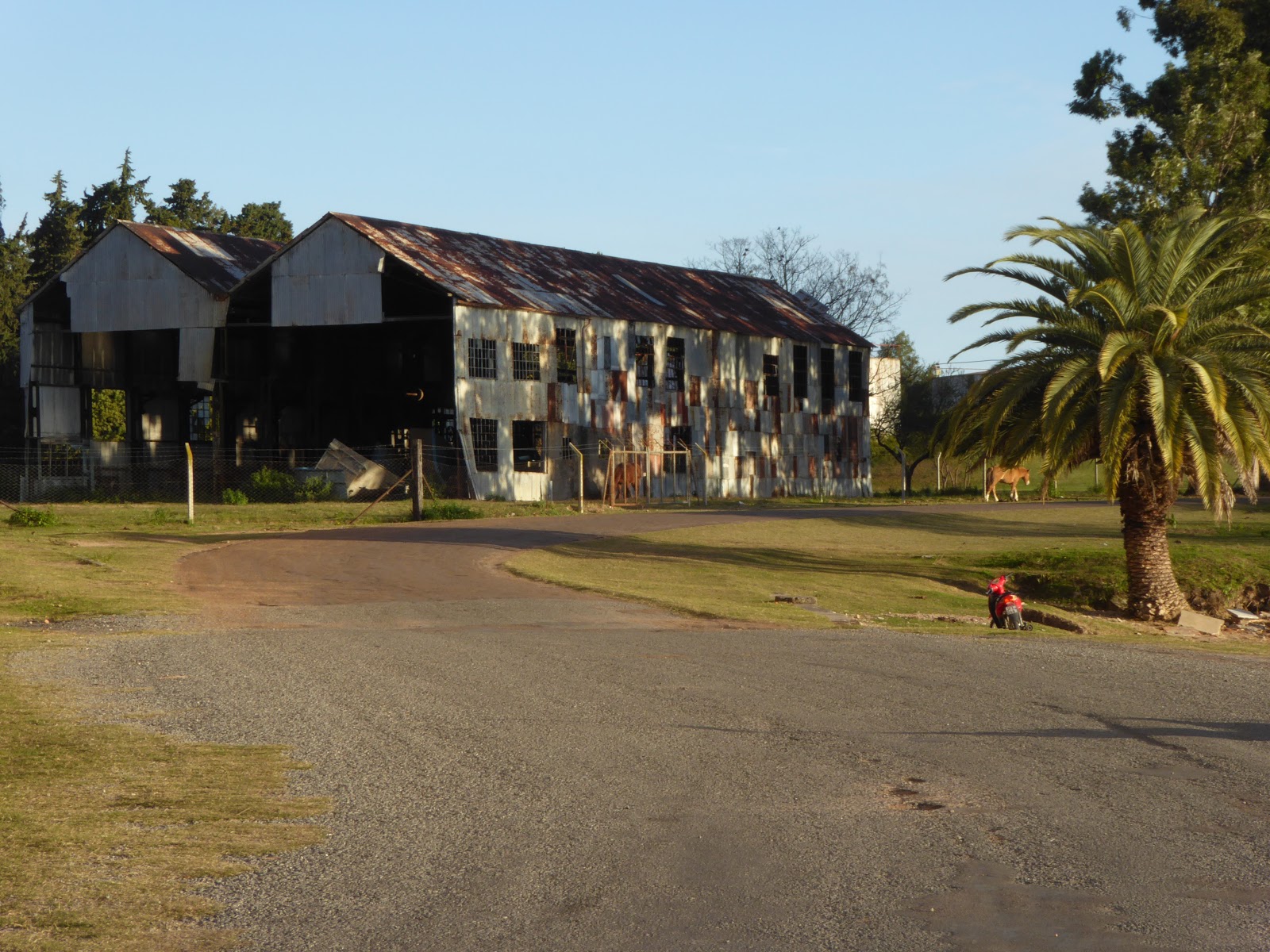
Electricity generator in the old Fray Bentos factory
Our route to Fray Bentos took us two and a half days from Córdoba. We began with a 6 hour bus to the city of Paraná, where we spent a night. The next day we proceeded for another 4 hours to Gualeguaychú, which is right on the river that marks the border with Uruguay. We had hoped to get a bus straight over to Fray Bentos, only 50km from here, so as soon as we arrived in Gualeguaychú we went to ask in the tourist information office about bus times. Weirdly, the lady there looked at us like we were mad, and told us to ask in the comedor (restaurant), as if that were the obvious thing to do! The man there also looked at us like we were mad, and told us to go to the Flechabus office. We finally got the information we required, which was that there was only ONE bus a day to Fray Bentos, at 1pm, and we were too late for today's.  Great. So off we went to check into one of Gualeguaychú's plentiful yet somewhat uninspiring hotels for the night. The city is a popular resort for Argentinians in the summer, and also famous for its carnival. But in this season it was very cold, and completely dead. It was slightly surreal sitting in a large restaurant on the touristic riverfront, totally devoid of other customers.

View across the rusting rooftops of the old Fray Bentos factory
The following day, we duly got on the 1pm bus, which only took an hour or so, and finally made it into Uruguay! Fray Bentos, on first impressions, looked like any other nondescript Argentinian town - the only way you'd know you were in a new country were the Uruguayan flags flying. So why, might you ask, had we made all this effort to come to this town in particular? UNESCO, of course. Yep, Fray Bentos is home to one of Uruguay's two World Heritage sites.  You may have heard the name before - it's best known in the UK in relation to a line of meat products (Fray Bentos Steak and Kidney Pie, for example). The UNESCO status was awarded due to the remains of the famous meat factory that operated here during the 19th and 20th centuries, and all the cultural heritage that went with it.

Machinery in the old Fray Bentos factory
I have to say, I had not expected an old meat factory to be the most interesting place to visit, but I was proved completely wrong, and we were very glad we made the effort to come here. Since it was low season, we got a (free) private tour around the old industrial buildings, many still with rusting machinery etc. It was fascinating. We learnt that the company began in the 1860s, the project of a German chemist called Liebig. He had invented a way to 'condense' meat so that the nutrition provided from 33 cows could be concentrated into a single lump of a molasses-like essence, dissolvable in water to form a broth. It was basically the first ever stock cube! Liebig industrialised this process, building his factory in Fray Bentos and exporting his meat extract all over the world. It was particularly successful during war times. when soldiers relied on Liebig's Extract of Meat for nutrition. In the late 19th century the factory started making other meat products, including tinned corned beef, sold under the Fray Bentos label (still produced today). It also began a line called OXO cubes - sound familiar?

Dials on machinery - note that this was made in Bradford, England!
After WWI, the factory was bought by the English and renamed Anglo. It still produced the meat essence, but also diversified, with a huge refrigeration building being constructed capable of storing up to 1800 tons of meat. More than 60 different tinned products were sold under the Anglo label, including canned vegetables as well as meat in every form you can imagine. The factory went into decline during the 1960s and finally closed in the 1979, but the Fray Bentos brand lives on, now owned by the Scottish company Baxters. Our included visits to the machinery / engine room, the refrigeration building, the admin area, and even the slaughterhouse (not for the fainthearted... but also very impressive in its efficiency - they had invented the basis of a production line here before motor companies had laid claim to this idea!).  All of the buildings are extremely run-down and dilapidated, with falling down ceilings and asbestos covered pipes. They hope to restore things gradually, but our guide told us UNESCO status hasn't quite brought the millions they need for this yet. It's quite an experience as it is though - very ghostlike and a bit creepy a little like the ghost salt mining towns we went to in Chile.

More Fray Bentos factory buildings
From Fray Bentos, we discovered there isn't a great selection of buses to elsewhere in Uruguay. We had planned to go down to Colonia del Sacramento, but instead ended up opting to head straight to Montevideo, the capital, since there was nothing to Colonia until 7.45pm! There isn't a great deal to do in the capital, but it's a pleasant enough city. It was extremely cold when we were there - we were told unseasonably so, even for winter here. This must be true as we have found that in general Uruguay is not at all geared up for cold weather! Hardly anywhere has heating of any kind. Montevideo's 22km long Rambla (coastal promenade) must be pleasant in the summer but we were glad after a freezing 10km walk to get out of the wind and into a café.

Montevideo's seafront, which it has to be said isn't the most attractive!
We did manage to visit four museums in the capital. In the national museum, we learnt something of Uruguay's interesting history. During colonial times this area was originally part of a region called the Banda Oriental (the east bank of the River Uruguay). Both the Portuguese and the Spanish made claims to the region - the Portuguese founded the city of Colonia in 1680, and the Spanish then responded by founding Montevideo further south along the river in 1726. Later, ongoing Spanish pressure meant Colonia was eventually ceded to Spain in the 1770s. During the time of the wars of independence, Portugal once again invaded and occupied the Banda Oriental region several times, fearing that republicanism spreading here from Buenos Aires would stir similar sentiment in Brazil. Even after Brazil became independent from Portugal, Banda Oriental remained a part of the Empire of Brazil. It only became an independent state in 1828, after a war between Brazil and revolutionaries who wanted it to become part of the Rio de la Plata provinces (Argentina).  Brazil and Argentina finally agreed in an 1828 treaty to allow the region to be an independent territory, a sort of buffer zone between the two countries. Hence Uruguay was born.

Uruguay's national football stadium, in Montevideo
One of the other museums we went to was on football! This was attached to the Montevideo stadium, so we got to have a quick look inside, as well as seeing a ton of football trophies and memorabilia. Uruguay has quite a proud footballing history - it was the first country ever to win the World Cup (1930) and won it again in 1950; it also has won the Copa América more times than any other country (Argentina is only one behind on the latter count though, and the 2016 competition is currently taking place!).  We also visited the gaucho museum - gauchos (cowboys) are a fundamental part of Uruguay's culture, as in Argentina. On our last night in Montevideo we treated ourselves to a posh meal out at a restaurant. The chef had trained in France and Asia, and so a lot of the food had some Asian styles and flavours. It was quite a revolution for our taste buds after the past few months!

The 1930 World Cup trophy, in the football museum in Montevideo
We have now left Montevideo and arrived at last in the aforementioned Colonia del Sacramento, Uruguay's other UNESCO site. More on that (and Uruguayan wine tasting!) in our next blog.

Sunday, 17 April 2016

The Incredible Iguazú Falls

The Iguazú Falls - maybe one of the most famous sights in South America, and something we'd certainly heard of before we got to this continent! We'd both been looking forward to seeing this amazing set of waterfalls for the whole trip so far. Although we've had to skip most of Brazil in order to see everything else we want to see before June (we'll be returning one day!), Rio and Iguazú were the two places we really wanted to get to this time.

The Iguazú Falls from the Argentine side
The Iguazú Falls are on the Iguazú river, located right on the border between Brazil and Argentina. They are shared between the two countries - both sides have their own Iguazú National Park, and both of these are UNESCO World Heritage sites! The falls are not just one waterfall, but a huge set of 275 drops in total, ranging from 60 - 82m in height and extending for 2.7 km along the river. Two thirds of the falls are in Argentine territory, and the Argentine park is a lot bigger, but there are absolutely spectacular views from both sides. Eleanor Roosevelt is said to have remarked, on her first sight of the falls, 'Poor Niagara', and you can see why.

Panorama from the Brazilian side
When looking at places to stay near Iguazú, we remembered a recommendation we'd had a while ago. The English couple we did our crazy long Machu Picchu trek with, Ivonne and Robin, had mentioned a hotel that was located actually within the Brazilian national park itself, within 2 minutes walk from the falls and even with views of them from some of the rooms. We'd had this in the back of our mind for some time and couldn't resist looking into it. Even when we found it was way, way above our budget, we couldn't quite make ourselves relinquish our dream of staying there, and thus it was that we booked without doubt our biggest accommodation splurge of the trip so far - 3 nights in the 5 star Belmond Hotel Das Cataratas!

Champagne breakfast in front of our hotel
The hotel was amazing. We enjoyed all of its perks - the gym (after which we couldn't walk for days, haha), the beautiful pool, the bar (best pisco sour since Peru), the breakfast time champagne ... and even the room service (ironically because this was the cheapest way to eat - the two onsite restaurants were both quite unaffordable!). But without doubt the biggest perk of all was the proximity to the falls, and the exclusive access in the mornings and evenings when the park was closed to the public. We often had the falls completely to ourselves. We got our first view of the falls the evening we arrived, around sunset. The viewpoint was literally just opposite the hotel, and there were only a few other people around. WOW! I can't even attempt to describe the beauty of this moment - the photos will have to do the talking for me.

Our first view of the falls, from the viewpoint in front of our hotel
The next morning, we got up early and went to see the falls before the park opened to the public. While the day before we'd only seen the view from the first viewpoint, today we followed the path down towards Devil's Throat, the most famous waterfall. In a short 15 minute walk, we were greeted with one spectacular vista after another. It just got better and better! We hadn't really appreciated the sheer size and number of the waterfalls from the hotel viewpoint, and now could see them stretching much further than we'd realised. It was just avalanches of water in all directions. Unbelievable. Near the end of the path, there was a metal walkway out into the river around the top of some of the falls, from where we could look down and see the water suddenly just disappear over the edge of a cliff. We got totally soaked from all the mist! At the very end of the path, we arrived at a stunning view of the Devil's Throat, the biggest waterfall of them all. I could have stood there all day, watching the tons of water come hurtling down and hearing the incredible thundering noise. Again, WOW.

The misty walkway near the Devil's Throat
After three nights, we reluctantly left our nice hotel. We weren't done with the falls yet though and were headed next over the border to Argentina, to see them from the other side. En route, we visited Brazil's Parque das Aves (Bird Park), which is right next to the national park entrance. We'd read mixed reviews of this but loved it and were very glad we went! They have a huge collection of birds, mostly from the Amazon region. Yes, they were in captivity, but most had been rescued from much worse situations, and the enclosures seemed large and not too crowded. We saw so many weird and wonderful birds that we'd never have got to see otherwise. Among my favourites were the three or four different species of toucan, the harpy eagles, and the gigantic walk-in enclosure with eight different types of macaw flying / perching everywhere!

Green-billed toucan in Parque das Aves
We'd been quite looking forward to returning to Argentina. It's a country we feel we know fairly well by now, after spending quite a lot of time here previously. But unfortunately, on our first evening in the country, we had a bad experience that somewhat tarred our formerly positive feeling about returning. As we were walking back to our hostel after dinner, we passed a house with a dog behind a closed gate. It came running, barking, and threw itself at the gate. A lot of dogs here behave like this, so we were unperturbed, until another dog appeared from nowhere, ran at us and bit me on the leg! This dog turned out to belong to the same house, but had been left loose in the street.

Scarlet macaws, with one blue-and-yellow one, in the Parque das Aves
The bite wasn't too bad; it swelled up a bit and looked like a red weal but didn't properly break the skin (now, several days later, it is just a very impressive bruise). However, worse than the bite itself was the attitude of the owner. She would not admit the dog was dangerous, would not agree that it shouldn't be left to roam freely on the street, would not even apologise until the neighbours too, who had seen the whole thing and whose Spanish was obviously a lot better than ours, got involved. What a rude, unpleasant person! The neighbours did not seem to like her either - when she'd gone, they apologised on her behalf even though it was in no way their fault, and told us the same dog had bitten someone before. Fortunately most Argentinians we've met have been super friendly and nice; the opposite of this woman. It was a horrible thing to happen on our first day back in Argentina though.

View of the San Martín waterfall, on the Argentine side of the falls
This incident meant we changed our plans a little and stayed an extra night in Puerto Iguazú so I could get the bite checked by a doctor (various doctor friends at home had advised this just in case of any risk of rabies). It was very easy, and not too expensive, to see a doctor at the private clinic, and she reassured us the bite should be fine, and that rabies is controlled in Argentina. Rather than going to the national park after this, we decided it was too late and instead went to visit an animal rescue sanctuary nearby. All the animals here were from the jungle regions of Argentina and had been rescued from appalling conditions, often being kept as pets in tiny cages. So it was sad seeing some of the birds missing eyes or legs, or unable to fly, but also positive that they are now being looked after well.

Part of the Itaipú Dam in Brazil
On our second day in Argentina, we actually crossed back over the border to Brazil so that we could visit the Itaipu Dam there. The dam is on the river that divides Brazil and Paraguay, and is huge - 7km long and around 200m high. It was built as a joint venture between the two countries, and the hydroelectric power it produces supplies both Brazil and Paraguay with a significant proportion of their electricity. In fact, Brazil is so much bigger than Paraguay that it pays the latter around a million dollars a day to use more of the dam's turbines. So Brazil takes 90% of the power produced, and Paraguay 10%. Despite this, in 2013, the dam supplied 75% of Paraguay's electricity, and 17% of Brazil's. It was cool to see the dam, though I think we got more from reading about if afterwards than from the very touristy open top bus tour we did.

In front of the Devil's Throat, Argentine side
Finally, on our third day in Argentina, we made it to the Argentine side of the falls. We were glad we'd saved this till last, as it was even better than the Brazilian side! The national park is a lot bigger, and we spent the whole day there walking along several different trails. On this side, we could get a lot closer to most of the waterfalls, and see them both from above and below. As it was a sunny day, there were rainbows everywhere! We also got the best panoramic view yet, with the falls continuing as far as we could see. Argentina also seemed to win on the butterfly front. There'd been a few on the Brazilian side, but here was another level! We had to walk through literally clouds of them. It was impossible to escape; they were EVERYWHERE. All shapes, sizes and colours and all, it seemed, constantly wanting to land on human beings! This was a massive challenge for me but my desire to see the falls overcame my fear (mostly); I did spend a lot of time swearing, running through the biggest clouds and flapping my hat / bag at them though!

One of several big clumps of butterflies.These would fly up into the air all around us when we passed!
The highlight of the Argentine side was another view of the Devil's Throat. This time, we got much closer to it, and could hear its roar from several hundred metres away, increasing as we approached. Quite a large proportion of the total volume of water in the falls is funneled down this one narrow chasm, and the sheer force of it is astounding. I can't describe just how exhilarating it was to stand there, getting completely drenched, and marvelling at this gigantic torrent of water throwing itself down right next to us. No other waterfall I've ever seen comes anywhere near the magnificence of this spectacle! Once again, we felt utterly awed by the power of nature.

Panorama of the Devil's Throat and surrounding waterfalls, Argentine side
We've now (unwillingly) left the Iguazú area, and will spend a bit more time in Argentina before we move on to Paraguay. The take home message from this post though is - go to the Iguazú Falls! If it's not on your bucket list, it should be.