Showing posts with label AirBnB. Show all posts

Sunday, 3 April 2016

A Nice Slice of France - In South America

As you may have noticed from previous posts we have recently been travelling, for us, relatively quickly. After four nights in Guyana and five in Suriname, the final stop on our fleeting visit to these smaller countries was French Guiana, or just 'Guyane', as its inhabitants call it. We entered the country by crossing the river from Suriname, which marks the border.

The river border between Suriname and French Guiana
French Guiana is not actually a country in its own right, but an overseas territory of France, originally a penal colony. While Guyana (formerly British) and Suriname (formerly Dutch) both fought hard to gain their independence in the 1960s and 1970s, French Guiana shows no sign of following suit any time soon! The population is tiny, with only around 300,000 people, and is a mix of Creole (mixed French and African ancestry), French, Asian and Amerindian ethnic groups. The currency is the Euro, and the official language is, of course, French.  We didn't have great expectations for here, but as it turned out, we spent more time here than either of the other two countries and were pleasantly surprised by how much we enjoyed it. The roads are good, everyone has cars, the food is excellent, as is the (French) wine, you can drink the tap water, and can even throw the toilet paper in the toilet (quite novel for us now!). It really felt a lot like being in France, except with a tropical climate and a LOT of mosquitoes. Quite surreal.

Old prison cells at the Camp de la Transportation in St Laurent
French Guiana isn't really cut out for budget travellers. Most tourists are French people on holiday, and they are either on organised tours or have rented cars. There is a real dearth of public transport - everyone has their own car - so it was quite challenging for us to get around. As an example, to get from where we were staying in Cayenne to the airport (10 km or so), we had no other option than to take a taxi, which cost 40 Euros! No buses. There are also no hostels and very few cheap hotels, and food is super expensive, whether you're eating out or cooking at home.

Beautiful orchids in the Guyane Botanical Garden, between Kourou and Cayenne
We decided AirBnB was our best option for accommodation, and were very lucky with our hosts here. We've found that increasingly often these days, hostels and guesthouses list themselves on AirBnB, and you have to look closely to work out if you will actually be in someone's house, or just in a hotel. But all three places we stayed here were in the original spirit of the concept, i.e. just someone's spare room. At each place we stayed, the people were extremely friendly and welcoming, and spoke at least a little English or Spanish (our French is practically non-existent)! We found ourselves frequently being offered free food, wine, or cocktails, and even lifts from place to place. I'm not sure how we'd ever have got from Kourou to Cayenne on Easter Sunday if it weren't for our fantastic hosts in Kourou offering to drive us! They stopped in the Guyane Botanical Garden on the way too, which was a bonus.

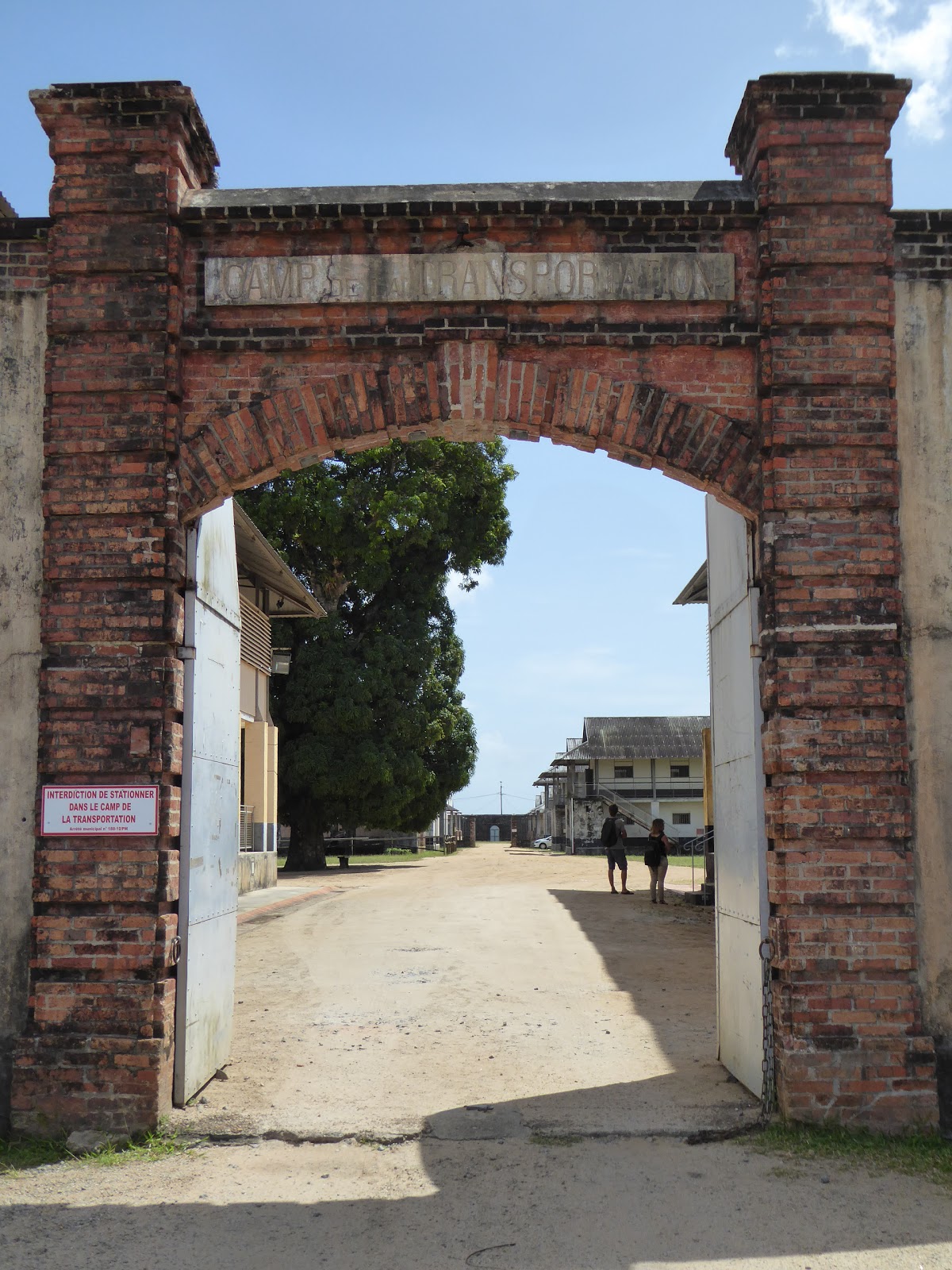
The entrance to the Camp de la Transportation, in St Laurent
Our first stop in French Guiana was St Laurent du Maroni, the town on the border with Suriname. There is actually a fairly large number of Surinamese people living here; many choose to have children here in order to try and get French citizenship for their kids. Our AirBnB host, Florence, picked us up from the port and also kindly offered to drive us to the big supermarket in town - we had decided to cook every night in this country in order to try and save money. The supermarket, SuperU, was AMAZING. I wandered around with eyes like saucers, marvelling at all the items that are impossible to find in most of South America but were miraculously here. There was fresh bread of all kinds, even wholemeal bread with chorizo in it. French cakes and pastries. Pure orange juice. Fresh fruit and vegetables. Herbs and spices of every kind. Salad, even rocket! The only downside was the prices. As I mentioned, food is expensive here. It was still a shock just how expensive though. One pepper cost 2 Euros. 4 mushrooms cost 4 Euros, or if you preferred a 500g packet, this was 15 Euros. It wasn't anything in particular, it was just uniformly sky high prices, regardless of the shop or town we were in. The only cheap thing was the wine - you can get a decent bottle for less than two peppers!

Shackled to the very uncomfortable bed at the Camp de la Transportation
We only spent one night in St Laurent, just enough time to visit the Camp de la Transportation, a former prison here. A tour is compulsory, but we were the only English-speaking people and managed to get a guide to ourselves rather than having to go around with the big French group. The prison operated for 100 years, only closing in the 1950s, and it was an eye-opening experience to walk around the buildings and get an idea of what life was like for the prisoners (pretty awful). Overcrowded, disease-ridden conditions, forced labour in the heat every day, horrific punishments including being kept in isolation in the dark for months... One of the worst parts was that even when a prisoner was freed having completed his sentence, he was legally required to remain in French Guiana for the same length of time as he had already served in jail. So 10 years in the prison meant 10 years more still living in the colony. Many of these 'freed' prisoners would just end up returning to the prison as they had no money and nowhere else to go.

View of Devil's Island, from Ile Royale in the Iles du Salut View from Ile Royale (St Joseph's island is in the background)
Our next stop was the coastal town of Kourou, about 200 km west of St Laurent. Kourou is famous for two things - the Iles du Salut (prison islands a few km off the coast), and the Centre Spatial Guyanais. The latter is a space centre and a major base for European rocket launches. Interestingly, the Kourou rocket launch site is one of the closest in the world to the equator, only 500 km or so away, which makes it a particularly good location as the earth's spin gives the rocket an extra boost. There are launches from here every month or two, but sadly we arrived at the wrong time to witness one, which must be an incredible sight. Ah well, maybe when we travel to Florida or Kazakhstan...!

Former prison building on Ile Royale
We did however continue the prison theme in Kourou and visit the Iles du Salut. This involved a 2 hour, very rough ride in a catamaran. Most people on the boat were quite ill; I was glad I took a seasickness tablet beforehand! There are three islands, all formerly used as prison camps, and we were only able to visit the biggest one, Ile Royale. Perhaps the most famous of the three is Devil's Island, which we could see from Ile Royale but visits are not permitted. Papillon (Henry Charriere) was imprisoned here, as well as at the prison in St Laurent (NB We discovered that most of his book is made up or actually happened to other people; read it with a pinch of salt!). Most of the prison is now ruined and people just come to the island for a day trip. You can sunbathe, swim, windsurf... there is even a hotel and restaurant. For us, the best part was just exploring the island ourselves - a lot of it is just jungle, and we saw monkeys and agoutis (large rodents) while also spotting the remains of various prison buildings.

A monkey and an agouti, in the jungle on Ile Royale
While we enjoyed St Laurent and Kourou a lot, Cayenne was a bit of a let down. We had read there was not a lot to do there, but, silly us, didn't believe this (it's a capital city!). Perhaps our impressions were tainted by the weather - it rained almost constantly for 3 of the 4 days we were there. We had ostensibly been in the 'rainy season' throughout our time in the Guyanas and Suriname, but this would usually mean just a couple of showers! In the city centre we only managed to have a quick look at the main square and cathedral, before taking shelter in the central market, which did have an excellent fruit juice stall at least! On the one day it didn't rain, we went for a jungle walk nearby where we were staying. It was pretty cool to feel in the middle of the rainforest, despite being right near a city. The circuit took 2 hours or so, and we saw more monkeys, plus a large iguana, and heard a lot of birds and frogs. We failed to spot a sloth though, which was disappointing as sightings are apparently very common on this trail.

Cool looking thicket of bamboo, along the Sentier du Rorota jungle trail near Cayenne
From French Guiana we are heading down into Brazil, ending our short break from Latin America. Brazil will feel different again to everywhere else we've been though, as the language is Portuguese rather than Spanish and we speak even less Portuguese than we can French! We considered going overland to Brazil, but this looked quite challenging. The relations between the two countries aren't great - there has been a bridge built across the river border since 2013, but Brazil hasn't bothered to build an immigration building or even a paved road to get there, so the bridge remains closed. The journey would thus involve getting to the border somehow from Cayenne (difficult), getting a boat over, and then a journey of anything from 10 hours to 3 days along a dirt road to the nearest proper town in Brazil. Hmm. It wasn't that difficult a decision to opt to fly instead, even though the journey to Rio de Janeiro would involve a ridiculous overnight journey of 3 flights and an 8 hour stopover! More on that next time...

Saturday, 12 March 2016

Golden Showers - Well, Gold and Showers

We had enjoyed our time in San Agustín and Tierradentro as they're a little further off the gringo trail (especially Tierradentro). However, now it was time to head firmly back into tourist central - Bogotá, Colombia's capital. We took a nightbus from San Agustín that arrived at 5am, and spent a lot of time drinking coffee until we could check in to our AirBnB later on. We'd chosen to base ourselves in the historical district, La Candelaria, which is where most of the attractions are, and the AirBnB was great - run by a very friendly French-Colombian family.

The main square, Plaza de Bolívar, in Bogotá
So, Bogotá. Bogotá is big.Very big. In terms of population, it is the fourth largest city in all of South America and the second largest we've been to behind Buenos Aires, with nearly 10 million people. It is also high, at about 2650m - the third highest capital city in the world after La Paz and Quito. And based on our experience, Bogotá is also rainy. It rained every day while were here, including some enormous thunderstorms that flooded some streets and caused delays at the airport when the control tower was struck by lightning! The weather liked to fool us by appearing beautifully sunny every morning. Thus without fail we'd say, 'shall we take the raincoats? Nah, we won't need them.' And without fail we'd get soaked. Apparently this much rain is unusual for the time of year, and probably due to the El Niño phenomenon.

Incredibly detailed figures in the Gold Museum
There's plenty to do in Bogotá, and we duly visited the majority of its major tourist sites. One of the highlights was the Museo de Oro (Gold Museum), which is one of the best museums we've been to in South America so far. It tells the history of gold in Colombia, focusing on pre-Columbian times and explaining how gold was obtained, what was made with it, the indigenous mythologies surrounding it, and so on. There were plenty of stunning gold items on display, some dating from over 2000 years ago yet incredibly complex, intricate and beautiful in their designs.

Street art on the graffiti tour
Aside from the Gold Museum, we spent one morning doing the popular graffiti tour around La Candelaria and the city centre. This was quite interesting but the group was huge - over 30 people! - and the guide focused more on the artists' styles than on the actual content / meaning behind the street art. We'd have liked to know WHY a given artist had chosen to portray a toucan with a halo, rather than how he'd done it! We also took the cable car (so many cities in South America have cable cars!) to the top of Cerro Monserrate, up at 3100m. The view of the city was quite nice, but sadly the clouds rolled in, the vista deteriorated extremely quickly and the torrential rain began anew. Another day we visited the Police Museum, which included quite a lot of interesting information on the hunt for Pablo Escobar in the early 1990s. On display there was even a desk Escobar owned, which on first sight looks normal, but when kicked in a certain way reveals a false back and false bottom, with several secret compartments. There was also a sophisticated machine Escobar had used for counting banknotes; the only other one of these in the country at the time was in the national bank!

Somewhat hazy view of Bogotá from Cerro Monserrate Wanted poster for Pablo Escobar, in the Police Museum
We had heard a lot about the Salt Cathedral in the town of Zipaquirá, which is often described as 'the marvel of Colombia'. Understandably, we were keen to visit, and as Zipaquirá is not far from Bogotá, we made a day trip. It took us an hour and a half from La Candelaria using the Transmilenio bus-metro thing (more on that to follow!) and then a local bus. On arrival, we were horrified to find the ticket price for extranjeros (foreigners) was 50,000 pesos. That is, £10. Which is a LOT in Colombia! For reference, the Gold Museum cost 3,000. Even for Colombians the price was 28,000, which would definitely price a lot of locals out of coming here. Pretty ridiculous. Still, we thought, we're here now, and we reluctantly paid up.

The main nave in the Salt Cathedral
The Salt Cathedral is basically a huge church built underground in a salt mine, complete with the stations of the cross, also made of salt, on the way. I have to say that the cathedral itself was pretty cool - it was incredible to be in this huge chamber with high ceilings and massive pillars, all deep underground and mostly built of salt, granite and marble. The stations of the cross were also well done, we thought - mostly very understated and simple. However, what we didn't like was the way the entire experience had been made into a massive tourist trap. You had to go round with a guide (totally unnecessary), there was cheesy music playing, and at the end we were greeted with rows of the usual artesania shops. Yes, souvenir shops. And a coffee shop. Down a salt mine! On top of this, anything extra had to be paid for on top of the crazy first price; extra if you wanted to go in the museum, extra to see more of the mine, extra even for toilet paper...! We were very disappointed overall as we felt the whole place was a bit of a farce and a complete rip off. But ho hum, we had to see it really.

One of the Stations of the Cross
Our spirits that day weren't improved by the arduous journey back to Bogotá from Zipaquira. This was our first experience of the Bogotá traffic, which is quite legendary. You'd think in the late afternoon the traffic would be okay coming back into the city, just bad leaving it. You'd think wrong. It took us 3.5 hours to get back. As I mentioned before, part of the journey involved the Transmilenio, which is Bogotá's equivalent of a metro. But rather than a train, it is a bendy bus, 2 or 3 carriages long. Many things about this bus challenged our brains. For example, why have an 'express' bus when it can only go at the same speed as the non-express buses? They all go in the same lane and can't overtake. Or, why not let all the people leaving the bus at the stop get off before everyone else shoves their way on? And, why plan your rush hour schedule so that 90% of the buses coming through the busiest platform at 6.30 pm are 'en transito' (in transit) and not stopping?! Maybe we were just in a bad mood, but we were tearing our hair out a little! Oh for the good old Tube.

View of Bogotá from our AirBnB
On our last day in the city, we decided to treat ourselves to a posh restaurant as a belated celebration of our being away for one year. Said restaurant, Matiz, was 8 or 9 km from where we were staying. Given our experience of the traffic, we left nearly an hour to get there (by taxi). It took us an hour and a half. The taxi driver seemed determined to use the big main road, despite it being completely rammed with traffic. At one point he turned off, and we breathed a sigh of relief, thinking he'd finally seen sense and was going to go via the nearly empty side roads instead. But no, after a few blocks it became clear he was instead just heading across to the other big main road. Which, surprise surprise, was almost stationary. Dare we suggest that if more drivers were willing to use non main roads, the traffic problem might be slightly less bad?!

More street art around La Candelaria
Anyway, end of traffic related ranting! Luckily the restaurant had kept our table and we enjoyed a fantastic meal - a tasting menu of I don't know how many courses that has to be one of the best meals of the trip so far. Cocktails and then wine pairings with each course meant we soon forgot our frustration with the journey. It was a nice way to say goodbye to Colombia, and to Latin America for a while as we move on to destinations more Caribbean in their nature. Next, the island of Curaçao, before we head to the Guyanas.

Tuesday, 5 January 2016

New Year in Ecuador and on into Colombia

We were sad to leave our lovely hostel in Quito but we had decided to spend New Year in Mindo, a backpackery little town in the cloud forest. The bus from Quito took about 2 hours, winding down through beautiful scenery with tree covered slopes.

Hummingbirds around Mindo
Mindo is down at 1200m and the climate is completely different to what we've got used to recently - very humid and pretty hot during the day. The town is mostly unpaved roads and has quite an outpost, jungly feel, with cloud forest all around. This feeling was enhanced by the amazing diversity of birds (and insects!) everywhere. Most cafes and hostels have hummingbird feeders outside and we saw so many beautiful examples of this tiny bird. We'd expected Mindo to be full of backpackers, but actually it was quite a mix of people, including a lot of older tourists here for birdwatching.

Peering in at one of the very large owl butterflies (they can have a wingspan of up to 16cm!)
We arrived in Mindo mid-afternoon but still managed to fit in two activities that day - a butterfly farm, and a chocolate tour. We started with the former. You might ask, why on earth would someone with a butterfly phobia possibly want to visit a butterfly farm?
 Well, I guess I thought it might be good for me - after all, I would actually like one day not to be in mortal fear when a butterfly or moth is in my vicinity. I braved entering the big netted off section with the butterflies once, and did okay until some of the gigantic owl butterflies started flying around. After that I made do with sticking my head through the entrance and withdrawing it whenever one came near. I think it did help, a little. Exposure therapy! But my bravery diminished rapidly that evening when we were confronted with the biggest moth I have ever seen, just casually sitting on the hostel wall. That was truly something out of my worst nightmares and it took a while for me even to pluck up the courage to run past it back to our room.

Cocoa beans drying, part of the chocolate making process

Immediately after the butterfly farm we did the aforementioned chocolate tour, which felt like a reward for surviving the house of horrors. Mindo has its own chocolate company, and over the hour or so of the tour we saw all stages of the chocolate making process, from the cocoa pods on the tree, to the finished bar. We also got to sample several of their chocolate products, including the (amazing) chocolate brownies, sea salt chocolate, and liquid 100% chocolate (added sugar required!).


We spent the first of our two full days here hiking in the jungle around Casa Amarilla. This, as you might expect from the Spanish, is a yellow house, owned by a friendly local lady. She also seems to own the surrounding jungle for miles around; at least, if you pay her a small entrance fee you can spend several hours exploring the paths she's made. We think it's great that she's chosen to open the area for hikers and birdwatchers, rather than getting rid of the trees to make room for cows, or digging for oil. The circuit we did took about 3 or 4 hours and included an enchanting viewpoint, looking down on tiny Mindo surrounded by cloud forest for miles in all directions. We met a Dutch guy and chatted with him for most of the hike; maybe we were making too much noise as we failed to see many birds!

View of Mindo (in the distance) from viewpoint during our jungle hike
Our second day in Mindo was New Year's Eve. In the morning we had a go at ziplining - zooming high above the trees along cables. For $20 we got to do an hour or two's circuit of 10 different ziplines ranging from 75 - 400m in length. It was great fun! Especially trying the 'Butterfly' position - literally upside down, with your legs in the air! Absolutely terrifying, but awesome. We spent the evening hanging out with some fellow travellers, enjoying free cocktails courtesy of our hostel, and then plenty of beers outside watching the festivities in the square. It is traditional in Ecuador to make sort of large dolls, a bit like the 'guys' on Guy Fawkes' Night, and burn them in the street at midnight. Often the dolls have masks representing unpopular politicians or celebrities. There were also kids running around everywhere in masks, and the odd guy or two wearing drag (another tradition apparently)! It felt more like Halloween than New Year! Really fun though, and interesting to see another culture's completely different style of celebration.

Ziplining and the 'Butterfly'
New Year's celebrations in Mindo
We returned from Mindo to Quito on the 1st, feeling a little the worse for wear after the night before (the twisty bus ride didn't help) and spent that afternoon in our hostel recovering. We had intended to proceed to Colombia the next day, but we'd not bargained on the city we were heading to in Colombia, Pasto, being so booked up and expensive! It turns out that Pasto has its annual carnival on the days we were planning to be there. It's so popular that Colombians book up all the places to stay months in advance. The only place we could find to stay was an (expensive) AirBnB, so we ended up prolonging our stay in Quito by a day so as to just spend the one night in Pasto. We were pretty happy to have an extra day in Quito at our favourite hostel, anyway! That day we visited the Basilica del Voto Nacional, a huge neo-Gothic church, and climbed up to the top of one of the towers. The ascent began like normal stairs but ended with some quite scary vertical metal ladders! The view from the top over the historic centre was worth it though.

On our way up the Basilica in Quito
On the Sunday we finally left Kinde House for good and proceeded 5 hours north to the Colombian border by bus. The Ecuador side of the border had a horribly long queue, due to mainly to Ecuadorian citizens returning from a weekend in Colombia. Anything in Ecuador that is imported carries a huge tax. Thus a lot of locals hop across to Colombia at the weekend to buy things like electronics and toiletries there - it's so much cheaper it's worth the journey! Luckily the queue moved quickly and within an hour we were through both Ecuadorian and Colombian immigration.

The Las Lajas church in the daylight...
Our first stop in Colombia was the small village of Las Lajas, only a few km from the border. The main reason for visiting here was to see the famous church, El Santuario de Las Lajas, which is literally built across a gorge. We expected this place to be very quiet but actually it was heaving with crowds of local tourists - it's something of a pilgrimage site for Colombians, it seems. The only place to stay was a sort of convent converted into a very basic hotel and run by nuns. The room was like a cell and the bed might as well have been a rock. I'm not sure being a nun is for me... The one consolation was that it cost £5.60 for the night.

...and by night
In the evening the church was lit up with neon lighting, constantly changing colour, which we found somewhat tacky but quite amusing. We got up early the next day and had a better look in the daylight with fewer tourists. It's certainly a spectacular setting - hopefully the photos demonstrate this better than I can describe. We have now arrived in Pasto for our night in an AirBnB around 10 times the price of last night - about 10 times nicer too. Tomorrow we are flying to Cartagena, on the Caribbean coast, and excited to be meeting up with our old travelling buddies Cindy and Julien again there.

Friday, 11 December 2015

The Galápagos Islands - Enchanted Isles

The Galápagos - just the name evokes a sense of magic and wonder. From the start of our trip, this was one of the things we'd been looking forward to most, and somewhere we'd both wanted to visit for years. So we were pretty excited as we boarded our plane from Guayaquil, 1000 km and a 2 hour flight away from our destination.

At the cliffs at Floreana island
The Galápagos islands were first officially discovered in 1535 by a Spanish ship that was blown off course en route to Peru from Panama. Later the islands were used as a stop off point by pirates, as well as visited by whalers and fur seal hunters. In 1832, Ecuador took possession of the islands, and made several attempts to establish prison colonies there during the 19th and 20th centuries, most of which were unsuccessful. Famously, HMS Beagle, with the young naturalist Charles Darwin on board, spent several days surveying the Galápagos in 1835. Darwin visited four different islands and noted how the species of certain animals varied between the islands - one of the key observations that later led him to develop his theory of evolution by natural selection.

The famous view of the Galápagos (shame about the weather!), from Bartolomé island.
 Pinnacle rock is on the right.
Nowadays, the Galápagos islands are mostly inhabited by Ecuadoreans and the descendants of European settlers that moved out there in the 1920s and 1930s. Tourism is a key industry, but fishing and agriculture are also important components of the economy. Four of the islands are inhabited - Santa Cruz (the most populous), San Cristóbal, Isabela (the largest) and Floreana. The main settlement is Puerto Ayora, on Santa Cruz, which seems much like any other town in Ecuador - the Galápagos islands aren't quite so untouched by humans as you might think.

Blue footed boobies - perhaps the most iconic birds of the Galápagos
Our plane landed at Baltra, a small island very close to Santa Cruz. During WW2 the US air force used Baltra as a base to protect the Panama canal; when the war ended it was returned to the Ecuadorean government and nowadays it is solely used as an airport for tourists and locals. We were met at the airport by our guide for the next few days, Mari, and we also met all our fellow cruise passengers (13 of them!)

Flamingoes, at Floreana island
There are various ways of travelling round the Galápagos. Whatever you choose, it is going to be expensive! We did consider doing the whole thing independently, staying on one or two of the inhabited islands and doing day trips out, but in the end decided a cruise was really going to make the most sense in order to see as much as possible - several of the more remote islands can only be accessed as part of a cruise. Most cruises are 4 - 8 days, and as we'd read that the first and last days usually consist of very little, we wanted to go for an 8 day one. We booked fairly last minute, about 2 weeks beforehand, and were lucky to find an excellent deal on the Galaxy boat, with an itinerary that perfectly fitted what we wanted to do.

The Galaxy, our home for a week
We didn't really know what to expect when we first boarded the ship, but within minutes we knew we'd made a good decision. The boat was large, extremely comfortable and far nicer than most of the others we saw in the port. Our cabin was roomy, had a double bed, air conditioning and was cleaned every day! We discovered later that the Galaxy is usually contracted out to an American tour company, but they had cancelled this time at short notice. Hence most of our fellow passengers had found a great last minute deal like us, and we ended up on an amazing boat, with plenty of like-minded tourists of our own age. Lucky us!

Sea lions chilling out at beautiful Mosquera
The first days of the cruise took us to the tiny sand bar islet of Mosquera, and then onto the strikingly harsh and volcanic islands of Santiago and Bartolomé. Getting off the boat for the first time at Mosquera, we were greeted by a stunning white sand beach, sea lions everywhere (including tiny pups always noisily demanding food), black lava rocks covered in huge red Sally Lightfoot crabs and marine iguanas, and even the skeleton of a whale. Sights like this became familiar over the next few days - particularly the sea lions and marine iguanas, which are abundant on nearly all of the islands. As well as the spectacular wildlife on land, there was also equally, if not more, impressive marine life. We snorkelled around the lava rocks at the edge of Santiago and Bartolomé islands on day 2, among schools of brightly coloured tropical fish, plus the odd sea lion, penguin, or shark.

Rocks covered in Sally Lightfoot crabs, at Mosquera
Something that became apparent to us as we cruised through the islands was just how volcanic they are. The archipelago was formed by the eruptions of massive submarine volcanoes, and most of the islands are only around 2 or 3 million years old. This makes it all the more remarkable how life has flourished and adapted perfectly to the conditions here.  On day 2, at Santiago island, we walked across an incredible plain of solidified lava flows. The smooth black surface had amazing contortions, rope like patterns and large bubbles of lava. This lava flow only dates back 200 years, yet already the colonisation by life has begun - lava cacti grow here and there, locusts and lava lizards hide in the rocks and crabs live at the water's edge. It's amazing to think that this harsh, barren landscape was how the other islands, now so full of life, also looked to start with.

Lava flows at Santiago island
Our schedule tended to follow a pattern - a walk on an island in the morning, followed by snorkelling nearby; then after lunch the same thing on a different part of the island. The long crossings between islands were mostly at night, so we could make the most of all the time during the day. On the morning of day 3, after a very choppy 7 hour trip during the night (I was glad I'd brought seasickness pills!), we arrived at the island of Genovesa. This is one of the more northern islands, and was one of the reasons we liked this itinerary - lots of boats don't bother going out this far.

Nazca boobies doing their mating dance
Genovesa is a birdwatcher's paradise and our first experience of some of the most unique birds of the Galápagos. We'd seen blue footed boobies on day 2, but here red footed boobies nested in the trees and Nazca boobies (which have green feet!) were everywhere. We saw two Nazca boobies doing a mating dance - they present gifts like twigs and small stones to each other, and click beaks - and learnt that the males whistle, while the females honk. As well as the boobies, there were frigate birds, which look a little like large vultures perching in the trees. The males have a massive red throat pouch, which they inflate to impress females during mating season. We were lucky enough to see some inflated despte it being the wrong season - it looks absolutely insane! Frigate birds have the largest wingspan of any birds in the Galápagos, up to 2.5m, and are the pirates of the skies - they don't hunt, just steal food from other birds.  Also on Genovesa, perhaps coolest of all, we saw a short eared owl, which is a rare sight in the daylight. There are only 3 predators on the islands - owls, hawks, and snakes.

Male frigate bird with inflated pouch, and baby frigate
Red footed booby in a tree Short eared owl
Not all of our fellow passengers were 8 day travellers like us. On day 4 we docked at San Cristobál island and spent a lot of the day waiting for a change around. 9 people left, and later were replaced by 10 new people, so we were up to the boat's full capacity of 16 passengers. We therefore had a quiet morning, but in the afternoon went over to nearby Lobos Island. 'Lobos Marino' is the word for sea lion in Spanish and, sure enough, there were tons here - we even had to try and sidle past an aggressive female with a pup, sitting right in our path. The highlight of the day was snorkelling later at a site called Kicker Rock, which is famous in the Galápagos. Bobbing up and down in some pretty big waves, we spotted sea turtles, tons of fish, and quite a few reef sharks.

Albatrosses at Española island
Days 5 and 6 of the cruise went to the southern islands of Española and Floreana. Española was one of the islands I'd most been looking forward to and it did not disappoint. It's the only island where you can see the waved albatross, and we saw plenty of these huge birds nesting on the ground as well as flying around the steep cliffs of the island. There was also a large nesting colony of Nazca boobies, some of the biggest marine iguanas we've seen, and a couple of Galápagos hawks. We've noticed that a lot of species here have names that start either 'Galápagos' or 'lava', e.g. lava lizards, lava herons, Galápagos hawks, Galápagos sharks - inventive, huh?

Galápagos hawks Blue footed booby and baby
Floreana island was also fascinating. This island has perhaps the most intriguing (and tragic) human history of any of the islands here: it involves murder and intrigue between two families of German settlers, plus the mysterious 'Baroness' and her two lovers. If you're interested, look up a documentary called 'The Galapagos Affair: Satan Came to Eden' - it's well worth a watch. The island has been continuously inhabited for the longest time of any of the Galápagos islands and still has its own postal system - a barrel in which passers by (tourists, these days!) can leave post. The next people check the post barrel and pick up any post addressed to someone living in their own country, to deliver on their return home - so we picked up a couple of UK postcards! The recipients will have to wait until June when we return to receive them... The wildlife on Floreana included flamingoes, and best of all a sea turtle nesting site. There were 3 turtles half buried in the shallows and lots of others swimming around nearby. They just dig a hole, lay the eggs, bury them and leave them to hatch - that's as far as turtle parenting goes!

Turtle buried in the sand, at the nesting site, Floreana Mari, our guide, at the post box in Post Office Bay, Floreana
Near to Floreana is a sort of rough circle of rocks known as Devil's Crown, which is another famous snorkelling site. We spent an hour here and it was the highlight of all the snorkelling of the cruise: first, the biggest school of fish I've ever seen - the water was absolutely black with millions of tiny fish; second, a penguin swam right past us; and third, we saw around 30 or 40 reef sharks about 2m long all together at once, coming in and out of caves deeper down where they live. Wow doesn't cover it!

View of the Devil's Crown snorkelling site, at sunset
On day 7, the last proper day of the cruise, we visited the small islands of Santa Fe and South Plaza, both fairly near the main island of Santa Cruz. This was a day all about the iguanas: we'd seen lots of marine ones (they swim using their tails, amazing!) but now saw lots of land iguanas. Santa Fe has its own unique species that are more greenish colour than the typical red and yellow ones at South Plaza. As well as the iguanas, we saw a lot of nesting birds in the cliffs at South Plaza, particularly tropic birds and swallow tailed gulls. These gulls are interesting in that they are nocturnal - sometimes we'd see them flying alongside the boat at night.

Iguana at South Plaza Swallow tailed (nocturnal) gulls in the cliffs at South Plaza
The cruise ended at Santa Cruz island and here a few of us took a taxi to go and see some giant tortoises at a private ranch. This was awesome - wandering around in wellies in the rain, spotting giant tortoises everywhere. If you get too close they hiss and withdraw their head into their shell! One of the major problems for the Galápagos is introduced, non-native species that compete with the local animals and plants for resources, or act as direct predators. When people first settled here, they brought with them dogs, cats, donkeys, cattle - all of which thrived and threatened local species. The giant tortoises were hunted nearly to extinction by humans for their meat (supposed to be some of the tastiest in the world), while dogs and cats liked to eat their eggs. Thus most tortoise eggs now hatch in breeding shelters, the only safe place for them really. Most people think that there are giant tortoises everywhere in the Galápagos, but there are only a few places where they survive in the wild and many of them are not accessible. Today there are strict regulations on what enters and leave the Galápagos, but the damage has been done and it is doubtful that we will ever see the islands as full of life again as they were before humans arrived.

With a giant tortoise at Manzanilla Ranch, Santa Cruz island
We hadn't had enough of the Galápagos after the cruise, so spent another four days staying in an Air B&B on one of the other islands, Isabela. As it happened, two of our friends from the cruise, Sabina and Lucas, had had exactly the same idea as us and we enjoyed hanging out with them around Isabela. We had even booked the exact same flight as them back to the mainland! Isabela is the largest island of the archipelago and the most significant that the cruise hadn't visited. The main town, Puerto Villamil, is nothing like Puerto Ayora (the big town on Santa Cruz island) - it has a very relaxed and sleepy feeling to it, with dirt roads, friendly locals, coconuts for sale, and more motorbikes and bicycles than cars. With the humidity and palm trees and buildings in various stages of construction it felt the most like south east Asia of anywhere we've been on our trip. We liked it a lot.
The beautiful, Galápagos themed church in Puerto Villamil. The walls have waves and
the windows are stained with pictures of animals from the islands!
Most of the wildlife on Isabela we had seen before, but we still enjoyed seeing a few giant tortoises in the wild, plus a breeding centre with very very small baby tortoises. They start off about 10 cm long but can reach 1.3m and 150+ years old! We also did a snorkelling trip where we saw sea horses for the first time - very cool. And we hired bikes and cycled out to the 'Wall of Tears' - a wall that prisoners at a penal colony here between 1946-59 were forced to build in horrible conditions. The only bad thing about staying on Isabela was the 2 hr speedboat ride there and back from Santa Cruz, which I hated. Those who know me well know how I love boat rides (not) and this was a crazy bumpy ride from hell, across very rough seas especially on the return to Santa Cruz. I was once again glad of the seasickness pills! (Kev was fine - must be in the genes!)

Giant tortoise in the wild (a rarity)
We ended our time in the Galápagos with one night in Puerto Ayora on Santa Cruz island, where we ate freshly caught lobster at a fraction of the price you'd pay in the UK. Yum. We wished we had more time, but alas, the next day we had to fly back to Guayaquil. Farewell Galápagos, it was great! From here we will be continuing our travelling back in mainland Ecuador, beginning with Riobamba.

'Baby' giant tortoises trying to escape from a breeding centre - these are actually about 15 years old!