Showing posts with label rainforest. Show all posts

Sunday, 3 April 2016

A Nice Slice of France - In South America

As you may have noticed from previous posts we have recently been travelling, for us, relatively quickly. After four nights in Guyana and five in Suriname, the final stop on our fleeting visit to these smaller countries was French Guiana, or just 'Guyane', as its inhabitants call it. We entered the country by crossing the river from Suriname, which marks the border.

The river border between Suriname and French Guiana
French Guiana is not actually a country in its own right, but an overseas territory of France, originally a penal colony. While Guyana (formerly British) and Suriname (formerly Dutch) both fought hard to gain their independence in the 1960s and 1970s, French Guiana shows no sign of following suit any time soon! The population is tiny, with only around 300,000 people, and is a mix of Creole (mixed French and African ancestry), French, Asian and Amerindian ethnic groups. The currency is the Euro, and the official language is, of course, French.  We didn't have great expectations for here, but as it turned out, we spent more time here than either of the other two countries and were pleasantly surprised by how much we enjoyed it. The roads are good, everyone has cars, the food is excellent, as is the (French) wine, you can drink the tap water, and can even throw the toilet paper in the toilet (quite novel for us now!). It really felt a lot like being in France, except with a tropical climate and a LOT of mosquitoes. Quite surreal.

Old prison cells at the Camp de la Transportation in St Laurent
French Guiana isn't really cut out for budget travellers. Most tourists are French people on holiday, and they are either on organised tours or have rented cars. There is a real dearth of public transport - everyone has their own car - so it was quite challenging for us to get around. As an example, to get from where we were staying in Cayenne to the airport (10 km or so), we had no other option than to take a taxi, which cost 40 Euros! No buses. There are also no hostels and very few cheap hotels, and food is super expensive, whether you're eating out or cooking at home.

Beautiful orchids in the Guyane Botanical Garden, between Kourou and Cayenne
We decided AirBnB was our best option for accommodation, and were very lucky with our hosts here. We've found that increasingly often these days, hostels and guesthouses list themselves on AirBnB, and you have to look closely to work out if you will actually be in someone's house, or just in a hotel. But all three places we stayed here were in the original spirit of the concept, i.e. just someone's spare room. At each place we stayed, the people were extremely friendly and welcoming, and spoke at least a little English or Spanish (our French is practically non-existent)! We found ourselves frequently being offered free food, wine, or cocktails, and even lifts from place to place. I'm not sure how we'd ever have got from Kourou to Cayenne on Easter Sunday if it weren't for our fantastic hosts in Kourou offering to drive us! They stopped in the Guyane Botanical Garden on the way too, which was a bonus.

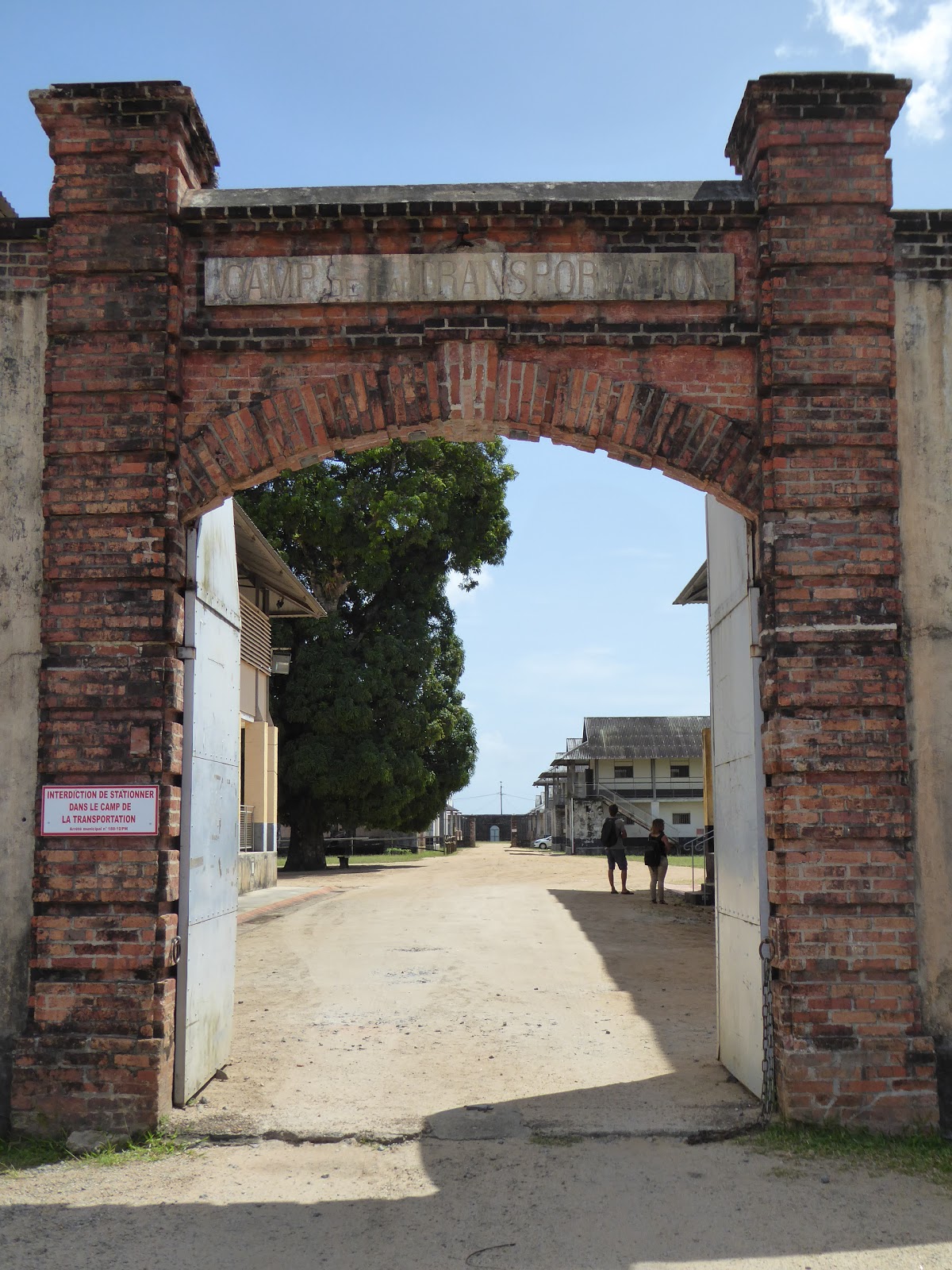
The entrance to the Camp de la Transportation, in St Laurent
Our first stop in French Guiana was St Laurent du Maroni, the town on the border with Suriname. There is actually a fairly large number of Surinamese people living here; many choose to have children here in order to try and get French citizenship for their kids. Our AirBnB host, Florence, picked us up from the port and also kindly offered to drive us to the big supermarket in town - we had decided to cook every night in this country in order to try and save money. The supermarket, SuperU, was AMAZING. I wandered around with eyes like saucers, marvelling at all the items that are impossible to find in most of South America but were miraculously here. There was fresh bread of all kinds, even wholemeal bread with chorizo in it. French cakes and pastries. Pure orange juice. Fresh fruit and vegetables. Herbs and spices of every kind. Salad, even rocket! The only downside was the prices. As I mentioned, food is expensive here. It was still a shock just how expensive though. One pepper cost 2 Euros. 4 mushrooms cost 4 Euros, or if you preferred a 500g packet, this was 15 Euros. It wasn't anything in particular, it was just uniformly sky high prices, regardless of the shop or town we were in. The only cheap thing was the wine - you can get a decent bottle for less than two peppers!

Shackled to the very uncomfortable bed at the Camp de la Transportation
We only spent one night in St Laurent, just enough time to visit the Camp de la Transportation, a former prison here. A tour is compulsory, but we were the only English-speaking people and managed to get a guide to ourselves rather than having to go around with the big French group. The prison operated for 100 years, only closing in the 1950s, and it was an eye-opening experience to walk around the buildings and get an idea of what life was like for the prisoners (pretty awful). Overcrowded, disease-ridden conditions, forced labour in the heat every day, horrific punishments including being kept in isolation in the dark for months... One of the worst parts was that even when a prisoner was freed having completed his sentence, he was legally required to remain in French Guiana for the same length of time as he had already served in jail. So 10 years in the prison meant 10 years more still living in the colony. Many of these 'freed' prisoners would just end up returning to the prison as they had no money and nowhere else to go.

View of Devil's Island, from Ile Royale in the Iles du Salut View from Ile Royale (St Joseph's island is in the background)
Our next stop was the coastal town of Kourou, about 200 km west of St Laurent. Kourou is famous for two things - the Iles du Salut (prison islands a few km off the coast), and the Centre Spatial Guyanais. The latter is a space centre and a major base for European rocket launches. Interestingly, the Kourou rocket launch site is one of the closest in the world to the equator, only 500 km or so away, which makes it a particularly good location as the earth's spin gives the rocket an extra boost. There are launches from here every month or two, but sadly we arrived at the wrong time to witness one, which must be an incredible sight. Ah well, maybe when we travel to Florida or Kazakhstan...!

Former prison building on Ile Royale
We did however continue the prison theme in Kourou and visit the Iles du Salut. This involved a 2 hour, very rough ride in a catamaran. Most people on the boat were quite ill; I was glad I took a seasickness tablet beforehand! There are three islands, all formerly used as prison camps, and we were only able to visit the biggest one, Ile Royale. Perhaps the most famous of the three is Devil's Island, which we could see from Ile Royale but visits are not permitted. Papillon (Henry Charriere) was imprisoned here, as well as at the prison in St Laurent (NB We discovered that most of his book is made up or actually happened to other people; read it with a pinch of salt!). Most of the prison is now ruined and people just come to the island for a day trip. You can sunbathe, swim, windsurf... there is even a hotel and restaurant. For us, the best part was just exploring the island ourselves - a lot of it is just jungle, and we saw monkeys and agoutis (large rodents) while also spotting the remains of various prison buildings.

A monkey and an agouti, in the jungle on Ile Royale
While we enjoyed St Laurent and Kourou a lot, Cayenne was a bit of a let down. We had read there was not a lot to do there, but, silly us, didn't believe this (it's a capital city!). Perhaps our impressions were tainted by the weather - it rained almost constantly for 3 of the 4 days we were there. We had ostensibly been in the 'rainy season' throughout our time in the Guyanas and Suriname, but this would usually mean just a couple of showers! In the city centre we only managed to have a quick look at the main square and cathedral, before taking shelter in the central market, which did have an excellent fruit juice stall at least! On the one day it didn't rain, we went for a jungle walk nearby where we were staying. It was pretty cool to feel in the middle of the rainforest, despite being right near a city. The circuit took 2 hours or so, and we saw more monkeys, plus a large iguana, and heard a lot of birds and frogs. We failed to spot a sloth though, which was disappointing as sightings are apparently very common on this trail.

Cool looking thicket of bamboo, along the Sentier du Rorota jungle trail near Cayenne
From French Guiana we are heading down into Brazil, ending our short break from Latin America. Brazil will feel different again to everywhere else we've been though, as the language is Portuguese rather than Spanish and we speak even less Portuguese than we can French! We considered going overland to Brazil, but this looked quite challenging. The relations between the two countries aren't great - there has been a bridge built across the river border since 2013, but Brazil hasn't bothered to build an immigration building or even a paved road to get there, so the bridge remains closed. The journey would thus involve getting to the border somehow from Cayenne (difficult), getting a boat over, and then a journey of anything from 10 hours to 3 days along a dirt road to the nearest proper town in Brazil. Hmm. It wasn't that difficult a decision to opt to fly instead, even though the journey to Rio de Janeiro would involve a ridiculous overnight journey of 3 flights and an 8 hour stopover! More on that next time...

Monday, 21 March 2016

A Very Smelly City

We departed Curaçao late in the evening, after a great few days there. As we mentioned previously, one of our main reasons for visiting was to use it as a stop off point between Colombia and Guyana, thus avoiding Venezuela. We found there was a cheap daily flight from Curaçao to Georgetown, the Guyanese capital, with InselAir.

Georgetown, viewed from the air
What we didn't realise when we booked this flight, was how notoriously bad InselAir is. As it is one of the only carriers offering short hops around the Caribbean and the north coast of South America, it has a bit of a monopoly. It seems this means it can run its flights whenever it wants, and the scheduled times mostly bore no resemblance to the actual departures!  Our flight was meant to leave at 9:30 pm, the last of the evening from Curaçao. It actually went at 11:10 pm, from a different departure gate. The time and departure was announced suddenly - up till then we'd heard nothing about it. We were quite fortunate it seems, as three other InselAir flights scheduled to leave before ours had not even arrived when we were boarding. Art, our host in Curaçao, told us the InselAir flights are always like this!

St George's Cathedral, in Georgetown
Anyway, we eventually arrived safely in Georgetown at 1am. We had been a little worried that our taxi pick up would not be there, or the driver would be an axe-murderer (safety is quite an issue in Georgetown, especially late at night). However, all went smoothly. Other than the fact that the airport is not in fact in Georgetown but out in the jungle nearly an hour's drive away... hence it was full of moths. BIG ones. Like, the biggest moths I've ever seen, all at once. It was a complete nightmare for me, and when we got in the taxi and there was one inside, I nearly had a heart attack! Luckily, once in the city, moth sizes / numbers became a lot more manageable.

Interior of St George's Cathedral
Guyana is probably the least well known and the least travelled country in all of South America. This little nation, with a population of only 750,000 people, used to be a British colony and only became independent in 1966. The British influence is evident in several respects: the official language is English (it's the only country on the continent that speaks English as its first language), they drive on the left hand side of the road, they are passionate about cricket, and they are fond of tea (in teapots). Oh, and the local beer, Banks Beer, first brewed while Guyana was still a British colony, is probably the best national lager we've had in South America. The country is also very multicultural - another legacy of the British, who brought slaves over from Africa and indentured labourers from India. The largest ethnic groups today are East Indian and African. It is the poorest country in South America, behind Bolivia and Paraguay, and the local currency is the Guyanese dollar, of which there are about 300 to a pound. It's quite entertaining when you hear that your dinner will be 1000 dollars! Given that it is so poor, it seems strange how expensive it is - just a few days here will severely dent a backpacker's budget, we found out.

The City Hall in Georgetown
When we arrived in Georgetown itself, the first thing that hit us was the smell... not in a good way! The city has open sewers, is very dirty, and all water channels / rivers are literally black. Everywhere stinks of poo. However, we got used to this fairly quickly! Georgetown also has a reputation for being unsafe, as I mentioned - there is a high incidence of petty crime and certain areas are definite no-go zones for tourists. We were a little nervous at first to just walk around on our own, but our host said it would be fine, so we spent a lot of time just strolling round the city absorbing the atmosphere. We had no problems at all; in fact. on the contrary, people were mostly pretty friendly and curious to see white faces. While Georgetown has quite a gritty feel to it, we enjoyed it, as it is just so completely different to anywhere else in South America. It was great seeing Asian shops everywhere, hearing English spoken (albeit in a Caribbean accent we often couldn't understand!), watching cricket with locals, and hearing Indian-influenced styles of music.

The 1763 Monument, in Revolution Square
We explored the city over 2 days. There aren't many attractions, but the huge wooden cathedral, St George's, was quite impressive. It is apparently the largest wooden church in the world - the locals are quite proud of this! We also visited the City Hall, another colonial wooden structure, decaying somewhat but still very nice; the National Library; and the National Museum. The museum's main exhibition was about Guyana's big festival here, Mashramani, which takes place in February every year to commemorate the anniversary of the country becoming a republic. The photos and costumes on display, and the excitement of local people when discussing this, suggested this country does have one thing in common with the rest of the continent - it loves its carnival! Another day, we walked over to Revolution Square, where there is an interesting African themed memorial to a slave revolt that took place here in 1763. Passing the Botanical Gardens and Zoo en route here we randomly saw two beautiful macaws flying right overhead, reminding us just how close to the jungle Georgetown really is.

Old fashioned adverts lining Georgetown's sea wall... They even had a Marmite advert!
We had planned to go straight from Georgetown over the border to Suriname. Suriname is the only country for which we need a visa - well, a 'tourist card' for us as UK citizens. The process of applying for this was a little complicated. First we had to go to the Surinamese embassy, which was cunningly concealed in a posh residential area of Georgetown. We spent a while walking around looking for it, and eventually located it with the help of some locals. The security guard at the embassy asked us, did we have a photocopy of our passport photo pages? Forewarned about this, we said yes. Did we have a photocopy of our Guyana entry stamp page? Erm, no. Did we have 35 US dollars each? Erm no, but we had $25, which was what it had cost last week. The lady packed us off to change some more Guyanese dollars into USD, and get the other photocopy. We later found out the charge for the tourist card had gone up only 2 days ago - doh!

Aerial view of the jungle near Kaieteur Falls
When we returned to the embassy with all we needed, the security lady finally let us into the office itself. The lady at the desk there told us we'd need to leave our passports and come and pick them up again that afternoon. We couldn't do that, we said, as we had a tour booked that afternoon. We asked if we could come back the following morning instead (Friday). Well, the office MIGHT be closed, she said, as there MIGHT be a national holiday. Could she find out, we asked. No, no-one knew, apparently. There were some local elections happening and the embassy staff didn't yet know if they'd be working or not! We grew steadily more frustrated as we knew the embassy would definitely be shut at the weekend. Eventually we pestered her enough that she managed to get our tourist cards issued straight away! Not sure why you normally have to wait until the afternoon...

At Kaieteur Falls
The reason we couldn't go back to the embassy that afternoon was that we had booked ourselves on a trip to Kaieteur Falls, perhaps Guyana's most spectacular natural attraction. The majority of the country is pristine jungle (well, with the odd gold mine), and the Kaieteur waterfall is deep in the interior, hidden in the rainforest. The only option for getting there, other than a 5 day hike, is a short flight in a small 12 seater plane. It was an expensive tour, but 100% worth it! We flew for an hour over a sea of trees, seeing nothing but this huge expanse of green for miles and miles, interrupted only by the muddy brown rivers snaking their way across the country. As we neared our landing point, the pilot made a big turn, and we had our first sight of the Kaieteur Falls. Wow!

The beautiful Kaieteur Falls
We landed at an airstrip literally in the middle of the jungle, and had 2 hours on a guided walk that took us to three different viewpoints of the falls. It has to be one of the most spectacular in the world, not just for its size (the highest single drop waterfall in the world) but for its stunning setting. The waterfall drops from a rocky outcrop, and all around is rainforest. The power of the water was incredible, even though our guide told us it was currently only about 60% full due to the recent dry weather. In the mist around the falls we could see rainbows. I'm so glad we made it here, as it was really something special. We didn't want to leave, and wished the other tourists who accompanied us on the flight would stop taking photos occasionally so we could just gaze in peace for longer!

Rainbows in the mist
While there is doubtless plenty more to see and do in Guyana, chiefly jungle-based adventures, we are trying to push on through these three little countries at the top of the continent. The prices here are high, and we still have a lot more to squeeze in before we return home in June. So for now, it's goodbye Guyana, as we head on to Suriname (a gruelling 12 hour bus-boat-bus-bus journey, more on that next entry!)

View down the valley from the bottom of the falls

Friday, 7 August 2015

In the Jungle and Pampas (With a Butterfly Phobia)

We flew from Santa Cruz to Rurrenabaque, down in the lowlands in the Amazon Basin. It's a pleasant, if very touristy, little town right on the bank of the Beni River, and felt the most like Asia of anywhere we've been so far. The humidity, the motorbikes carrying four people, the bamboo bars, the wide, muddy river and the beautiful sunsets - we liked it! We didn't have long to explore Rurre though as we'd booked ourselves onto a 6 day trip to the nearby areas of jungle and pampas with Mashaquipe, a local tour company that came highly recommended by some travelling friends.

The tiny airport in Rurrenabaque
The first three days of the adventure were spent in the jungle, more specifically in Madidi National Park, a huge protected region including part of the Amazon rainforest.We were joined by a Belgian couple for these three days, forming a group of five with our amazing local guide, Ismael, who actually grew up in the jungle and was therefore a fount of knowledge about all aspects of jungle life.

Our guide, Ismael, with the boat along the Beni river
We travelled from Rurre by boat for around three hours to our base for the next few days, Mashaquipe Ecolodge. En route we stopped at a local village to taste fresh sugar cane juice - Ismael cut the canes with his machete and we pressed the juice ourselves using a rustic wooden contraption! The lodge was great: despite being in the middle of the jungle, it was a comfortable place, with a dining room, running water, mosquito nets and even electricity (from 6-10 pm each day). The food was delicious too - 3 course meals that were better than most we've had in Bolivia.

It's thirsty work making sugar cane juice
Over the next two days we spent most of our time walking in different areas of the jungle, spotting animals and learning a lot too about the trees and plants that local tribes use medicinally or for cooking. The craziest thing was possibly when Ismael extracted a maggot like white larva from a seed pod and ate it! In fact we tried the larvae ourselves later on, toasted, and they were rather tasty.

To eat or not to eat? Larva from a seed pod
We saw plenty of animals - capuchin monkeys, lion monkeys, squirrel monkeys and howler monkeys, a boa constrictor snake, plus a lot of birds and the footprints of jaguar, tapir and ocelot. The monkeys and birds were mostly high in the trees and Ismael was fantastic at spotting them; he could even make noises like most of the monkeys and birds to encourage them to come out. We spent quite a while following him through dense jungle in search of a peccary, or wild pig, that he could hear walking along nearby (none of us could hear anything!). Eventually we were rewarded by seeing not one but a whole herd of peccaries, around 30-40 of them, marching with intent through the jungle. Early in the morning one day we hiked up to a viewpoint at the edge of the cliff and watched the canopy emerge from the mists, with scarlet and green macaws flying by and making an incredible amount of noise.

Jaguar footprints This boa constrictor snake appeared right next to our dining room!

View of the jungle canopy and Beni river below
Of course, the Amazon rainforest is full not only of animals but insects. Thus you can guess that it was quite challenging for me trying to cope with my phobia of butterflies and moths; we saw some of the largest butterflies I have ever seen. Fortunately Ismael soon got the idea of the problem and protected me from anything flying too close. He also cleared the dining room and bathrooms of moths every night! We also saw a huge tarantula and of course were hounded by mosquitoes and ants of all sizes. We were warned not to leave anything on the floor or we might find it in pieces later due to the industrious leaf cutter ants!

Tarantula just sitting on a tree next to our cabin
Unfortunately Kev came down with a severe case of food poisoning again during day 2 and spent most of that afternoon and the next day in bed - we think it must have been something he ate prior to the trip, as the rest of us were fine. Thank goodness Ismael was brillliant and supplied us with antibiotics plus his own homemade herbal tea made from a leaf in the jungle. The latter was incredibly bitter but definitely and he was feeling a lot better by the time we arrived in the Pampas.

Capybaras grazing next to the river in the Pampas
The Pampas was a different experience from the jungle but still fantastic. The area is mainly wetlands and we spent most of the three days cruising along the river with Ismael and our new Canadian companions, looking for animals. While there is less biodiversity here overall, the animals are a lot easier to spot than in the jungle. We saw caimans, one 4 metres long, alligators, turtles, capybaras, more monkeys and best of all, pink Amazon river dolphins (yes, they really are pink!) The highlight was swimming among the dolphins; they were playful and curious and liked to play or to nibble your leg at times.

Squirrel monkey jumping across our boat One of the many alligators in the Pampas
We were assured that the area in which we swam with the dolphins was not frequented by caimans or piranhas. One evening however we went to a shallower area and fished for piranhas using raw meat as bait. The Canadians caught a couple, but we failed - I did however catch a catfish of reasonable size, which we ate for dinner along with one of the piranhas.

Piranha for dinner - look at its teeth!
On the last day I had an interesting time - Ismael was worried about a couple of my mosquito bites and on examining them decided that they were not ordinary bites but had mosquito larvae growing in them - eurgh! He treated this by extracting nicotine from a cigarette and leaving the nicotine on the bites overnight. The next morning he checked and proclaimed the larvae were 'muertissimo' (very dead). In fact he extracted the head of one of the larvae. It was too small for me to see, but I'm sure he knew what he was doing...

Turtles basking in the sun 
Overall we had an unforgettable few days, regardless of illness, bites and butterflies. Waking up to the sounds of the jungle or Pampas, learning about living in the jungle from an indigenous guide, and seeing such a variety of wildlife was amazing . Furthermore, Mashaquipe give a large proportion of their proceeds to the local community - Ismael told us they are supporting 48 different families in the jungle at the moment -  and we were happy to be giving something back.  It's certainly one of the high points of our trip so far.

Our Pampas group, with Ismael and the boat