As you may have noticed from previous posts we have recently been travelling, for us, relatively quickly. After four nights in Guyana and five in Suriname, the final stop on our fleeting visit to these smaller countries was French Guiana, or just 'Guyane', as its inhabitants call it. We entered the country by crossing the river from Suriname, which marks the border.
 |
| The river border between Suriname and French Guiana |
French Guiana is not actually a country in its own right, but an overseas territory of France, originally a penal colony. While Guyana (formerly British) and Suriname (formerly Dutch) both fought hard to gain their independence in the 1960s and 1970s, French Guiana shows no sign of following suit any time soon! The population is tiny, with only around 300,000 people, and is a mix of Creole (mixed French and African ancestry), French, Asian and Amerindian ethnic groups. The currency is the Euro, and the official language is, of course, French. We didn't have great expectations for here, but as it turned out, we spent more time here than either of the other two countries and were pleasantly surprised by how much we enjoyed it. The roads are good, everyone has cars, the food is excellent, as is the (French) wine, you can drink the tap water, and can even throw the toilet paper in the toilet (quite novel for us now!). It really felt a lot like being in France, except with a tropical climate and a LOT of mosquitoes. Quite surreal.
 |
| Old prison cells at the Camp de la Transportation in St Laurent |
French Guiana isn't really cut out for budget travellers. Most tourists are French people on holiday, and they are either on organised tours or have rented cars. There is a real dearth of public transport - everyone has their own car - so it was quite challenging for us to get around. As an example, to get from where we were staying in Cayenne to the airport (10 km or so), we had no other option than to take a taxi, which cost 40 Euros! No buses. There are also no hostels and very few cheap hotels, and food is super expensive, whether you're eating out or cooking at home.
 |
 |
| Beautiful orchids in the Guyane Botanical Garden, between Kourou and Cayenne |
We decided AirBnB was our best option for accommodation, and were very lucky with our hosts here. We've found that increasingly often these days, hostels and guesthouses list themselves on AirBnB, and you have to look closely to work out if you will actually be in someone's house, or just in a hotel. But all three places we stayed here were in the original spirit of the concept, i.e. just someone's spare room. At each place we stayed, the people were extremely friendly and welcoming, and spoke at least a little English or Spanish (our French is practically non-existent)! We found ourselves frequently being offered free food, wine, or cocktails, and even lifts from place to place. I'm not sure how we'd ever have got from Kourou to Cayenne on Easter Sunday if it weren't for our fantastic hosts in Kourou offering to drive us! They stopped in the Guyane Botanical Garden on the way too, which was a bonus.
 |
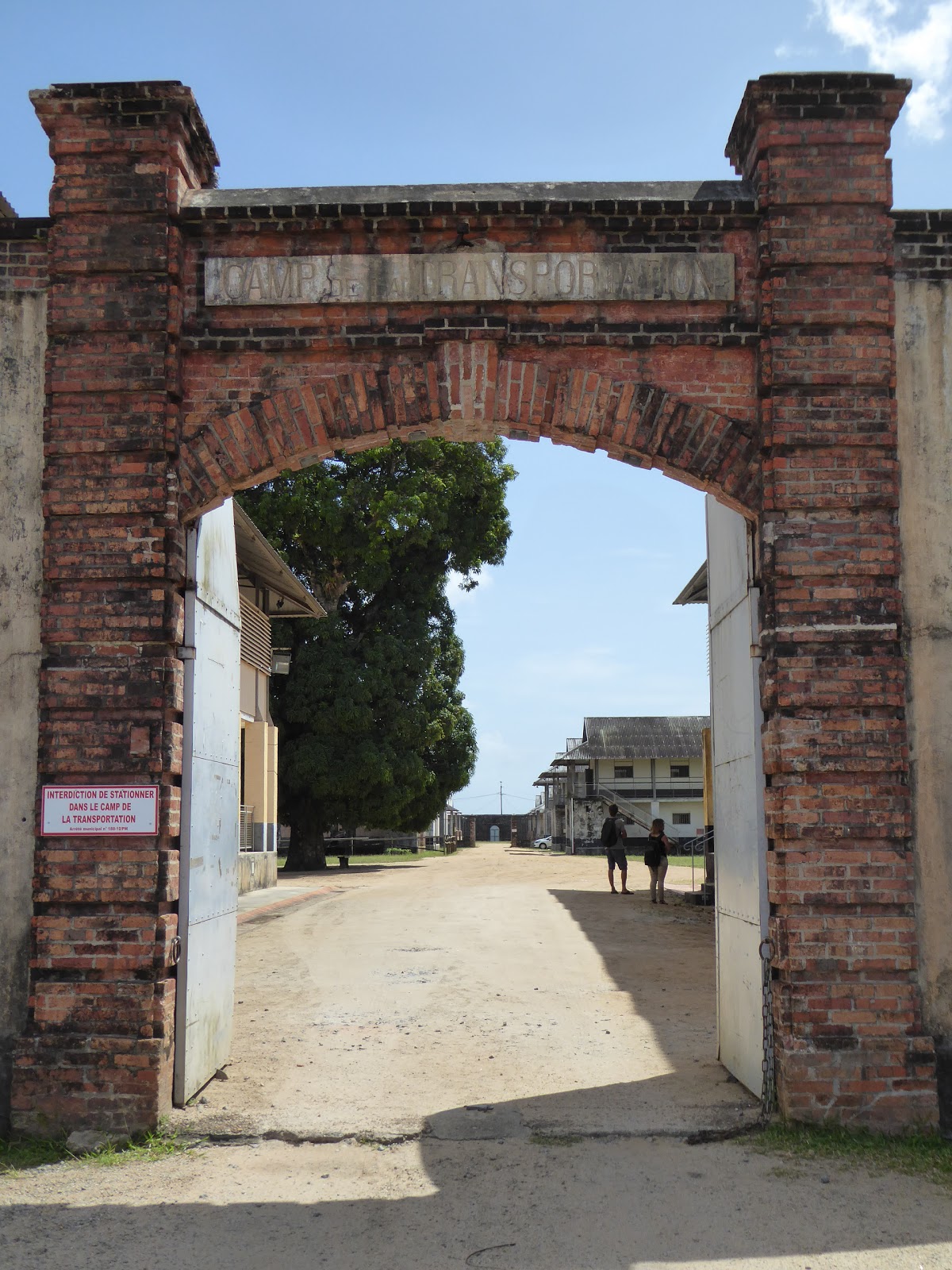
| The entrance to the Camp de la Transportation, in St Laurent |
Our first stop in French Guiana was St Laurent du Maroni, the town on the border with Suriname. There is actually a fairly large number of Surinamese people living here; many choose to have children here in order to try and get French citizenship for their kids. Our AirBnB host, Florence, picked us up from the port and also kindly offered to drive us to the big supermarket in town - we had decided to cook every night in this country in order to try and save money. The supermarket, SuperU, was AMAZING. I wandered around with eyes like saucers, marvelling at all the items that are impossible to find in most of South America but were miraculously here. There was fresh bread of all kinds, even wholemeal bread with chorizo in it. French cakes and pastries. Pure orange juice. Fresh fruit and vegetables. Herbs and spices of every kind. Salad, even rocket! The only downside was the prices. As I mentioned, food is expensive here. It was still a shock just
how expensive though. One pepper cost 2 Euros. 4 mushrooms cost 4 Euros, or if you preferred a 500g packet, this was 15 Euros. It wasn't anything in particular, it was just uniformly sky high prices, regardless of the shop or town we were in. The only cheap thing was the wine - you can get a decent bottle for less than two peppers!
 |
| Shackled to the very uncomfortable bed at the Camp de la Transportation |
We only spent one night in St Laurent, just enough time to visit the Camp de la Transportation, a former prison here. A tour is compulsory, but we were the only English-speaking people and managed to get a guide to ourselves rather than having to go around with the big French group. The prison operated for 100 years, only closing in the 1950s, and it was an eye-opening experience to walk around the buildings and get an idea of what life was like for the prisoners (pretty awful). Overcrowded, disease-ridden conditions, forced labour in the heat every day, horrific punishments including being kept in isolation in the dark for months... One of the worst parts was that even when a prisoner was freed having completed his sentence, he was legally required to remain in French Guiana for the same length of time as he had already served in jail. So 10 years in the prison meant 10 years more still living in the colony. Many of these 'freed' prisoners would just end up returning to the prison as they had no money and nowhere else to go.
 |
 |
| View of Devil's Island, from Ile Royale in the Iles du Salut |
View from Ile Royale (St Joseph's island is in the background) |
Our next stop was the coastal town of Kourou, about 200 km west of St Laurent. Kourou is famous for two things - the Iles du Salut (prison islands a few km off the coast), and the Centre Spatial Guyanais. The latter is a space centre and a major base for European rocket launches. Interestingly, the Kourou rocket launch site is one of the closest in the world to the equator, only 500 km or so away, which makes it a particularly good location as the earth's spin gives the rocket an extra boost. There are launches from here every month or two, but sadly we arrived at the wrong time to witness one, which must be an incredible sight. Ah well, maybe when we travel to Florida or Kazakhstan...!
 |
| Former prison building on Ile Royale |
We did however continue the prison theme in Kourou and visit the Iles du Salut. This involved a 2 hour, very rough ride in a catamaran. Most people on the boat were quite ill; I was glad I took a seasickness tablet beforehand! There are three islands, all formerly used as prison camps, and we were only able to visit the biggest one, Ile Royale. Perhaps the most famous of the three is Devil's Island, which we could see from Ile Royale but visits are not permitted. Papillon (Henry Charriere) was imprisoned here, as well as at the prison in St Laurent (NB We discovered that most of his book is made up or actually happened to other people; read it with a pinch of salt!). Most of the prison is now ruined and people just come to the island for a day trip. You can sunbathe, swim, windsurf... there is even a hotel and restaurant. For us, the best part was just exploring the island ourselves - a lot of it is just jungle, and we saw monkeys and agoutis (large rodents) while also spotting the remains of various prison buildings.
 |
 |
| A monkey and an agouti, in the jungle on Ile Royale |
While we enjoyed St Laurent and Kourou a lot, Cayenne was a bit of a let down. We had read there was not a lot to do there, but, silly us, didn't believe this (it's a capital city!). Perhaps our impressions were tainted by the weather - it rained almost constantly for 3 of the 4 days we were there. We had ostensibly been in the 'rainy season' throughout our time in the Guyanas and Suriname, but this would usually mean just a couple of showers! In the city centre we only managed to have a quick look at the main square and cathedral, before taking shelter in the central market, which did have an excellent fruit juice stall at least! On the one day it didn't rain, we went for a jungle walk nearby where we were staying. It was pretty cool to feel in the middle of the rainforest, despite being right near a city. The circuit took 2 hours or so, and we saw more monkeys, plus a large iguana, and heard a lot of birds and frogs. We failed to spot a sloth though, which was disappointing as sightings are apparently very common on this trail.
 |
| Cool looking thicket of bamboo, along the Sentier du Rorota jungle trail near Cayenne |
From French Guiana we are heading down into Brazil, ending our short break from Latin America. Brazil will feel different again to everywhere else we've been though, as the language is Portuguese rather than Spanish and we speak even less Portuguese than we can French! We considered going overland to Brazil, but this looked quite challenging. The relations between the two countries aren't great - there has been a bridge built across the river border since 2013, but Brazil hasn't bothered to build an immigration building or even a paved road to get there, so the bridge remains closed. The journey would thus involve getting to the border somehow from Cayenne (difficult), getting a boat over, and then a journey of anything from 10 hours to 3 days along a dirt road to the nearest proper town in Brazil. Hmm. It wasn't that difficult a decision to opt to fly instead, even though the journey to Rio de Janeiro would involve a ridiculous overnight journey of 3 flights and an 8 hour stopover! More on that next time...