Showing posts with label forts. Show all posts

Monday, 12 October 2015

The Third Highest Waterfall in the World

After leaving the mountains of Huaraz, we continued zigzagging north through Peru. This first took us to some ancient ruins near Trujillo on the coast then, back in the sierra, to Chachapoyas, with more ruins and the third highest waterfall in the world.

The foot of the Gocta Waterfall - note the tiny people!
We wanted to visit Trujillo as it is close to the UNESCO site of Chan Chan. This was the capital of the Chimu culture that was built around 850 CE. It consists of ten huge citadels, although only one has been restored enough to be worth visiting. As the culture lived by the sea, the walls are covered in designs of fishing nets, fish and sea birds.

Fishing net decorations on the walls at Chan Chan
The highlight of the area around Trujillo was some other, earlier, ruins from the Moche culture (approx CE 100 - 800). Now called the Temples of the Sun and Moon, they are two massive pyramids that are still being excavated. Only the Moon temple can be visited, and the excavations have revealed, amazingly, still intact wall paintings.

Painted walls at the Huaca de la Luna
Continuing on to Chachapoyas, we climbed back up into the mountains to see some more ruins - those at Kuelap. This is an enormous fortress that, like Machu Picchu, is on top of a mountain, giving it fantastic views of the surrounding area. It's the largest pre-Colombian structure in the Americas, with huge outer walls 20m high. The construction was begun in 600 CE by the Chachapoyas culture, and was later occupied by the Inca. It's a fascinating site, and many of the remains are still covered by cloud forest. In fact, Chachapoyas is a Quechua word meaning 'cloud forest'.

Trees covering the ruins at Kuelap
Also close to Chachapoyas are a series of incredibly tall waterfalls. We visited the one at Gocta, which is claimed to be the third highest in the world at 771m. It's an astounding sight seeing it from a the nearby village, then getting closer and seeing the water turn into mist as it falls.

On the way to the Gocta waterfall
We're now heading back south towards Lima, breaking up the journey by visiting some more ruins along the coast.

Sunday, 30 August 2015

Cusco - Historic Inca Capital (And Tourist Capital Of South America)

We took a nightbus from Arequipa to Cusco, where we've spent the last five days. Although best known as the tourist hub for the thousands of visitors that flock to Machu Picchu each year, it is also a fascinating place in its own right, with some amazing Inca sites to check out in the city and surrounding area.

Inca walls in Cusco
Cusco was the capital of the Inca empire, founded in the 13th century. It's now a world heritage site and is an interesting mix of Incan and colonial architecture. Inca walls built with huge blocks of stone line many of the streets; the blocks, despite being all shapes and sizes (one is 12 sided!), fit together like a jigsaw so well that you cannot see any sign of mortar holding them together. Alongside the Inca features, you see plenty of evidence of the Spanish conquest - the main square with its Catholic cathedral and Jesuit church, for example. Despite being full of tourists, it's a beautiful city and we've enjoyed exploring it.

The cathedral in Cusco's main square
On our second day here, we met up with our German friends from the Colca Canyon and took a bus out to Tambomachay, one of four Inca sites within a few km of the city. We walked back, taking in all the other sites and managing to avoid tour groups in the main. The largest of these sites is Sachsaywaman ('sexy woman' is the best way to remember the name!), which was an enormous fortress guarding Cusco. Some of the stone blocks here were simply gigantic - the largest weighed around 300 tons. It's hard to imagine how such might could have fallen to a Spanish force of around 50 horsemen.  

The Inca ruins of Sachsaywaman
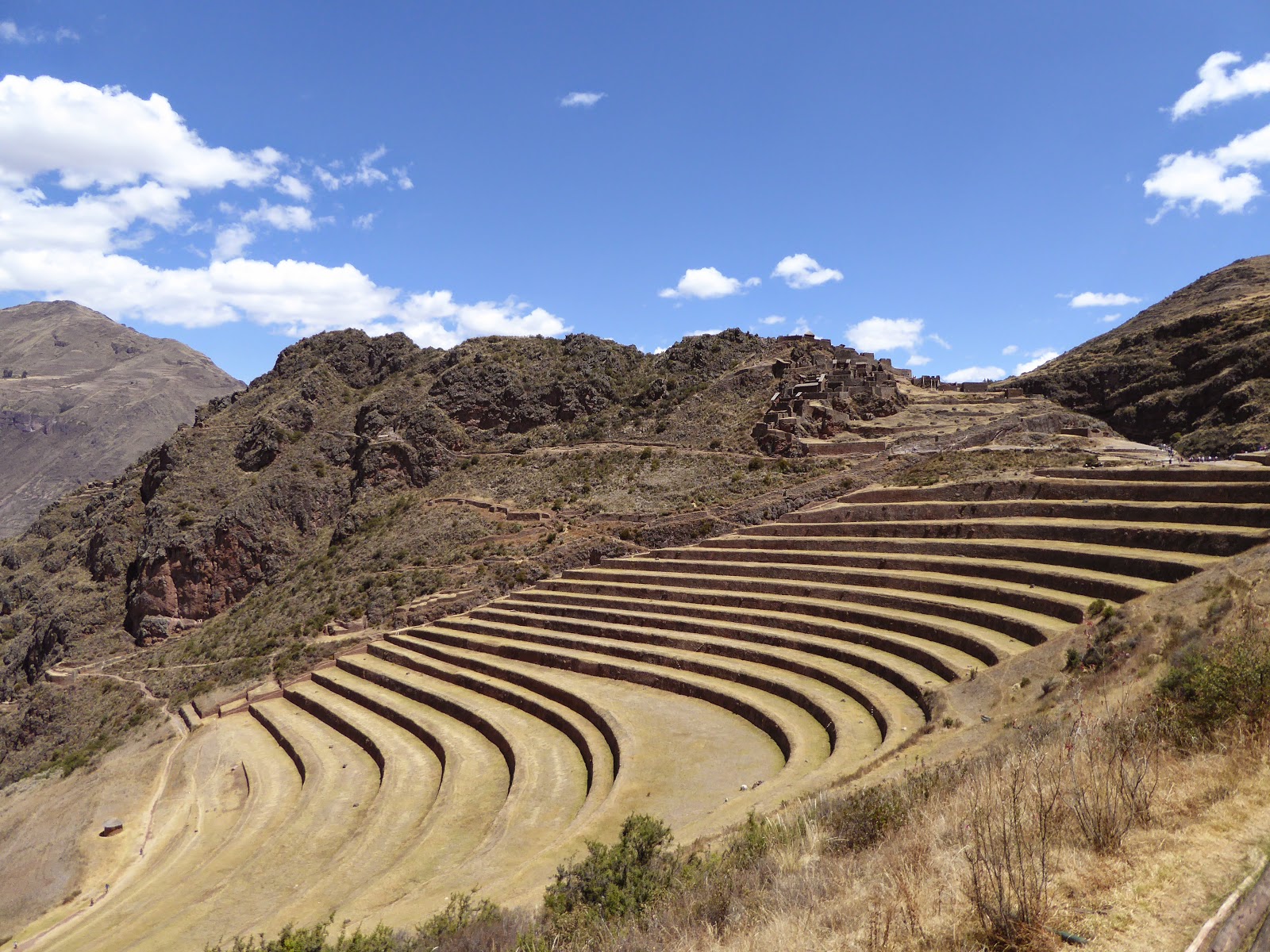
Other Incan ruins around Cusco include those at Pisac, an insanely touristy town nearby. We took a taxi up to the ruins from the town centre and were dismayed to find at least twenty tour buses outside, while inside were umbrella carrying tour guides and megaphones galore. Fortunately most groups seemed to be on their way out, so within an hour or so we had the place almost to ourselves. The site is a citadel and small town, with impressive agricultural terraces carved out of the steep hillside right down into the valley.

Inca terraces at Pisac
We saw more agricultural terraces at Moray, another Inca site nearby. The terraces here are unusual in that they are deep and circular - very striking. Research has shown a temperature variation of 15°C or more between the top and bottom, and it seems that the Incas used the area as a kind of laboratory to test the effects of different microclimates on crops.

Circular agricultural terraces at Moray
Perhaps my favourite of all the sites we visited here was the salt pans or Salinas near the village of Maras. This is a set of several hundred rectangular ponds on several levels, into which salt water flows from a subterranean source and evaporates to form salt. The view from above is quite stunning - a patchwork of rectangles, punctuated by local people harvesting the salt in buckets and bags. The pans vary in colour depending on how long they've been evaporating, from brown to sparkling white. You can walk across the whitest ones, which reminded us of the salt flats in Bolivia.

The Salinas (salt pans) near Maras
While in Cusco we've met up with several friends from the last couple of weeks in Peru. It's been lovely catching up over craft beer and pisco sours. Most of these have already visited Machu Picchu, but we have decided not to rush things... Instead we have booked ourselves on an epic 9 day trek to get there! We leave tomorrow and trek first to Choquequirao, another Inca city, before heading onto Machu Picchu. We look forward to telling you all about it in ten days time...

Thursday, 7 May 2015

Volcanoes, Forts and Beer

From Chiloé we took a bus to Puerto Varas, a touristy town close to Volcán Calbuco. En route the volcano erupted for a third time and we could see the ensuing ash cloud from the bus window. Sadly, once in Puerto Varas itself the weather was too bad to see any more of the volcano, despite it being just over the lake. Since most activities in the town were suspended due to the Calbuco situation, we decided to move on after one night.

Hazy view across from Puerto Varas to Volcán Osorno (left) and Calbuco (right)
Our next stop was Valdivia, a pretty city towards the west coast, with tame sea lions and pelicans frequenting the big riverside fish market. We were lucky to find a fantastic hostel to stay in - it was very eco-friendly, had a resident pet cat (adorable) and duck (vicious!) and was very sociable, with a delicious communal fish barbecue on our first night.

Resident sea lions at the fish market in Valdivia
Valdivia is located at the junction of three rivers and has some wonderful scenery just out of town. On our second day we visited the remains of several forts around Corral Bay. These were built by the Spanish in the 17th century to defend their territories from the threat of attacks from the Pacific, especially pirate raids which were becoming an increasing problem at the time. After going round the recently renovated and very well done fort at Niebla, we took a ferry across the bay to the town of Corral and went to see two more forts there. Corral seemed to be the store for the whole country's supply of wood chippings - the town was dominated by two absolutely enormous piles!

Guns at the fort in Niebla, near Valdivia
Valdivia is also known for its breweries and after a washed out attempt to go to a national park one day, we spent an enjoyable afternoon sampling beers. It is the base for one of Chile's largest brewing companies, Kunstmann, but we decided to give the very touristy trip there a miss and instead checked out two microbreweries. We particularly liked the first of these, El Duende (The Gnome), which had a wood burning stove, free herb bread and lovely river views even in the rain. Not to mention very decent beer on tap!

Fishing boats and pelicans
After three days in Valdivia we moved on to Pucón, a lakeside town adjacent to Volcán Villarrica. We only intended to stay here for one night since a) it is very touristy; b) the top activity, climbing Villarrica, has been impossible since it erupted in March; and c) we'd heard the town was badly affected by volcanic ash blown across from Calbuco. However, on arrival we swiftly reversed this decision. The air was perfectly clear, there weren't many people around, and there was plenty to do! Our hostel in Pucón is on the lakefront and also has a great view of Volcán Villarrica. There's still a plume of smoke from time to time and on a clear night you can see the top glowing red - it's pretty awesome.

Glowing Volcán Villarrica, from Pucón
The forecast for the day after we arrived was clear, so we took the opportunity to climb another of the volcanoes in the area. Not Villarrica of course, but a much less active one. We left the hostel at 7 am and made the ascent in a group of ten with two local guides. The walk started in the forest but most was out on the mountain and the snow cover increased as went up. We were carrying lots of gear and in the course of the walk up our bags lightened considerably as we donned crampons, helmets and began using ice picks. This was the best part of the whole experience - neither of us had ever done any serious hiking in snow and ice before, and the scenery blanketed in white was spectacular. As were the views from the top, from where we could see down to the snow filled crater, and across to Volcan Villarrica on one side and numerous other volcanoes in the other direction.

Ascending Volcán Quetrupillán, with Volcán Villarrica in the distance
We have another couple of days here, with lots more outdoor activity planned, including a waterfall and a national park.