Tuesday, 21 June 2016

Last Days in South America

We are now back in the UK, having travelled from Uruguay back into Argentina, flown to Belgium via Spain, attended a wedding in the Netherlands and returned home via Belgium (again) and France. Therefore, this will be our last blog post about new places, although we do have some summaries lined up.

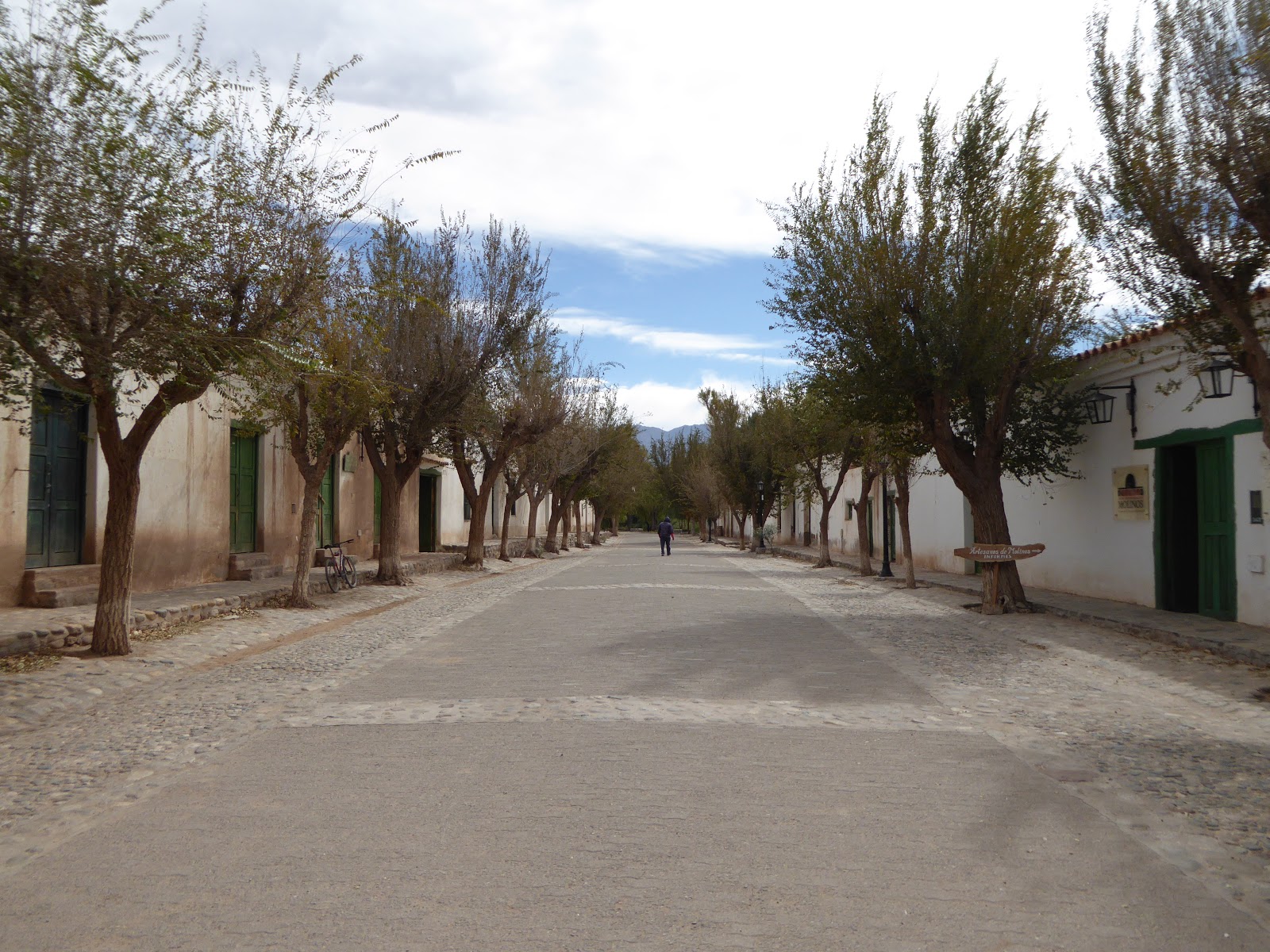
Tree-lined avenue in Colonia del Sacramento
I'll pick the story up in Uruguay, where we had just arrived in Colonia del Sacramento. This is one of the oldest towns in Uruguay, originally founded by the Portuguese in 1680, but changed hands between them and the Spanish continuously (much like the country itself) until Uruguay's independence in 1830. Some of the cobbled streets are from the original Portuguese settlement and the historic centre is a UNESCO world heritage site. The tree-lined avenues and old buildings are very beautiful, especially when illuminated by colourful sunsets.

Lighthouse, built inside an old monastery in Colonia del Sacramento
Although Colonia is just over the Rio de la Plata river from Buenos Aires, and there is a rapid ferry connecting the two cities, we wanted to visit Carmelo before making the crossing. This town is famous in Uruguay, but unfortunately not the world, for its wine - especially the tannat variety. We visited a small, family-run bodega, which was superb. It was started by the current owner's grandfather and his brother, but they then had to sell a lot of the land in an economic crisis. It's now been bought back and they've started producing wine again, hence the name 'El Legado' - 'The Legacy'. Not only were the family very friendly and excited about their wine, but we got to enjoy several refills and even drew a glass from a barrel using a large pipette.

Pipetting wine from the barrel
From Carmelo, we returned to Buenos Aires via a short ferry ride across to the northern suburb of Tigre. This time, we stayed in the upmarket area of Palermo to get a different feel for the city to the more touristy San Telmo. The area is a lot greener, with lots of big parks, and also with many cafes and bars. We met up with a friend from home who has been living there for nearly a year, so it was good to get a more local perspective of the rewards and the challenges of living in Argentina.

The Floralis Generica sculpture in Buenos Aires - opening and closing with sunrise and sunset
This was our last stop in South America, after spending nearly 16 months on the continent. We flew back to Brussels via Madrid and spent a night in Bruges. This was a good stop before crossing into the Netherlands for the wonderful wedding of one of my best friends, before taking the ferry from Dunkirk back to Dover. For all of these stories, you'll just have to meet up and speak to us.

Friday, 10 June 2016

The Only Meat Factory With UNESCO Status

When Kev last posted, we were just about to leave Córdoba (Argentina's second city) to head towards Uruguay. The simplest way to do this would probably have been an overnight bus to Buenos Aires, then a boat across the river to the Uruguayan town of Colonia de Sacramento, which lies directly opposite Buenos Aires. However, we decided to take a less simple route. Firstly because we tend not to be people who do things the easy way, and secondly because we wanted to visit a town further north in Uruguay, Fray Bentos, before heading down to Colonia.

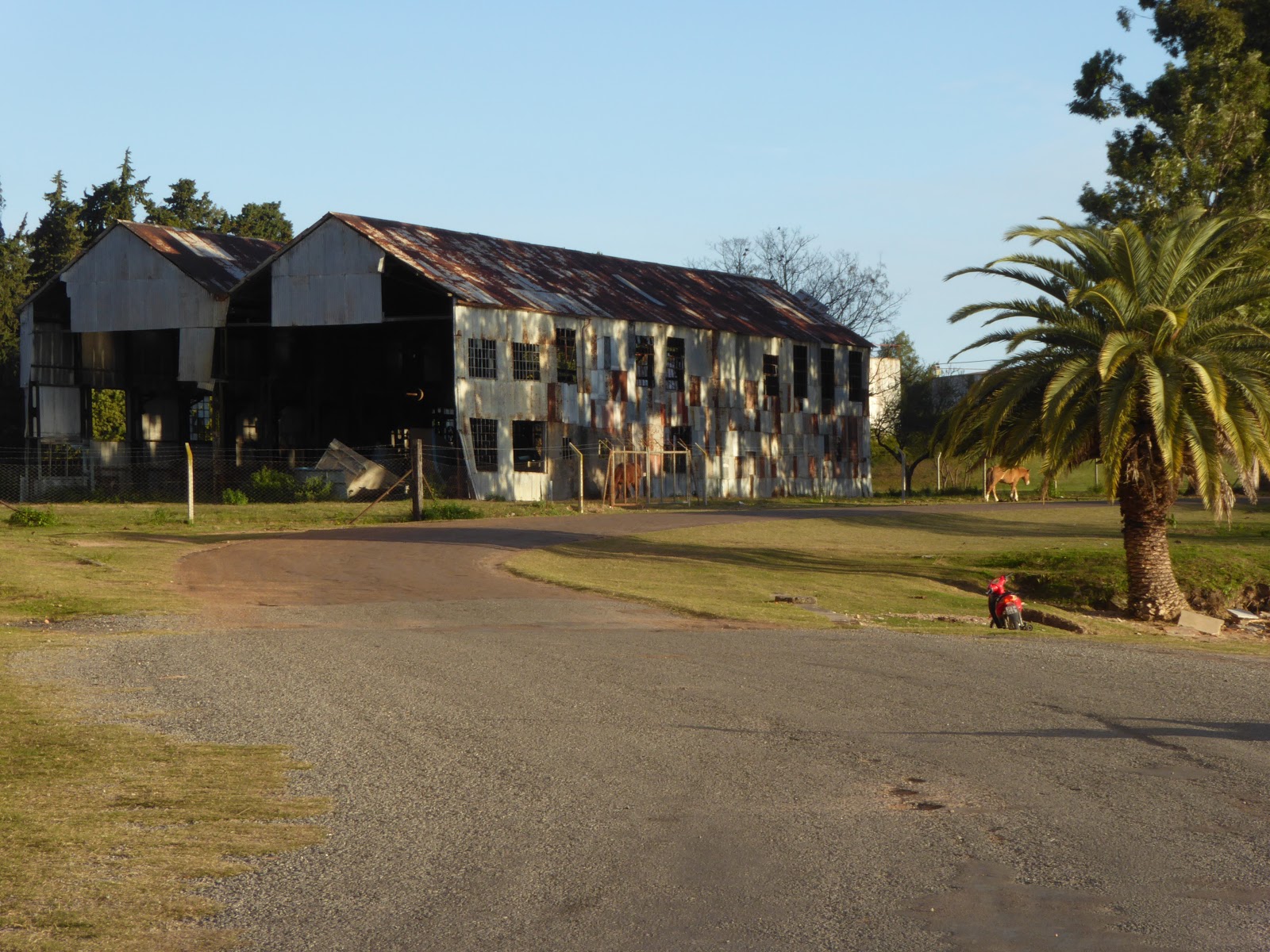
Electricity generator in the old Fray Bentos factory
Our route to Fray Bentos took us two and a half days from Córdoba. We began with a 6 hour bus to the city of Paraná, where we spent a night. The next day we proceeded for another 4 hours to Gualeguaychú, which is right on the river that marks the border with Uruguay. We had hoped to get a bus straight over to Fray Bentos, only 50km from here, so as soon as we arrived in Gualeguaychú we went to ask in the tourist information office about bus times. Weirdly, the lady there looked at us like we were mad, and told us to ask in the comedor (restaurant), as if that were the obvious thing to do! The man there also looked at us like we were mad, and told us to go to the Flechabus office. We finally got the information we required, which was that there was only ONE bus a day to Fray Bentos, at 1pm, and we were too late for today's.  Great. So off we went to check into one of Gualeguaychú's plentiful yet somewhat uninspiring hotels for the night. The city is a popular resort for Argentinians in the summer, and also famous for its carnival. But in this season it was very cold, and completely dead. It was slightly surreal sitting in a large restaurant on the touristic riverfront, totally devoid of other customers.

View across the rusting rooftops of the old Fray Bentos factory
The following day, we duly got on the 1pm bus, which only took an hour or so, and finally made it into Uruguay! Fray Bentos, on first impressions, looked like any other nondescript Argentinian town - the only way you'd know you were in a new country were the Uruguayan flags flying. So why, might you ask, had we made all this effort to come to this town in particular? UNESCO, of course. Yep, Fray Bentos is home to one of Uruguay's two World Heritage sites.  You may have heard the name before - it's best known in the UK in relation to a line of meat products (Fray Bentos Steak and Kidney Pie, for example). The UNESCO status was awarded due to the remains of the famous meat factory that operated here during the 19th and 20th centuries, and all the cultural heritage that went with it.

Machinery in the old Fray Bentos factory
I have to say, I had not expected an old meat factory to be the most interesting place to visit, but I was proved completely wrong, and we were very glad we made the effort to come here. Since it was low season, we got a (free) private tour around the old industrial buildings, many still with rusting machinery etc. It was fascinating. We learnt that the company began in the 1860s, the project of a German chemist called Liebig. He had invented a way to 'condense' meat so that the nutrition provided from 33 cows could be concentrated into a single lump of a molasses-like essence, dissolvable in water to form a broth. It was basically the first ever stock cube! Liebig industrialised this process, building his factory in Fray Bentos and exporting his meat extract all over the world. It was particularly successful during war times. when soldiers relied on Liebig's Extract of Meat for nutrition. In the late 19th century the factory started making other meat products, including tinned corned beef, sold under the Fray Bentos label (still produced today). It also began a line called OXO cubes - sound familiar?

Dials on machinery - note that this was made in Bradford, England!
After WWI, the factory was bought by the English and renamed Anglo. It still produced the meat essence, but also diversified, with a huge refrigeration building being constructed capable of storing up to 1800 tons of meat. More than 60 different tinned products were sold under the Anglo label, including canned vegetables as well as meat in every form you can imagine. The factory went into decline during the 1960s and finally closed in the 1979, but the Fray Bentos brand lives on, now owned by the Scottish company Baxters. Our included visits to the machinery / engine room, the refrigeration building, the admin area, and even the slaughterhouse (not for the fainthearted... but also very impressive in its efficiency - they had invented the basis of a production line here before motor companies had laid claim to this idea!).  All of the buildings are extremely run-down and dilapidated, with falling down ceilings and asbestos covered pipes. They hope to restore things gradually, but our guide told us UNESCO status hasn't quite brought the millions they need for this yet. It's quite an experience as it is though - very ghostlike and a bit creepy a little like the ghost salt mining towns we went to in Chile.

More Fray Bentos factory buildings
From Fray Bentos, we discovered there isn't a great selection of buses to elsewhere in Uruguay. We had planned to go down to Colonia del Sacramento, but instead ended up opting to head straight to Montevideo, the capital, since there was nothing to Colonia until 7.45pm! There isn't a great deal to do in the capital, but it's a pleasant enough city. It was extremely cold when we were there - we were told unseasonably so, even for winter here. This must be true as we have found that in general Uruguay is not at all geared up for cold weather! Hardly anywhere has heating of any kind. Montevideo's 22km long Rambla (coastal promenade) must be pleasant in the summer but we were glad after a freezing 10km walk to get out of the wind and into a café.

Montevideo's seafront, which it has to be said isn't the most attractive!
We did manage to visit four museums in the capital. In the national museum, we learnt something of Uruguay's interesting history. During colonial times this area was originally part of a region called the Banda Oriental (the east bank of the River Uruguay). Both the Portuguese and the Spanish made claims to the region - the Portuguese founded the city of Colonia in 1680, and the Spanish then responded by founding Montevideo further south along the river in 1726. Later, ongoing Spanish pressure meant Colonia was eventually ceded to Spain in the 1770s. During the time of the wars of independence, Portugal once again invaded and occupied the Banda Oriental region several times, fearing that republicanism spreading here from Buenos Aires would stir similar sentiment in Brazil. Even after Brazil became independent from Portugal, Banda Oriental remained a part of the Empire of Brazil. It only became an independent state in 1828, after a war between Brazil and revolutionaries who wanted it to become part of the Rio de la Plata provinces (Argentina).  Brazil and Argentina finally agreed in an 1828 treaty to allow the region to be an independent territory, a sort of buffer zone between the two countries. Hence Uruguay was born.

Uruguay's national football stadium, in Montevideo
One of the other museums we went to was on football! This was attached to the Montevideo stadium, so we got to have a quick look inside, as well as seeing a ton of football trophies and memorabilia. Uruguay has quite a proud footballing history - it was the first country ever to win the World Cup (1930) and won it again in 1950; it also has won the Copa América more times than any other country (Argentina is only one behind on the latter count though, and the 2016 competition is currently taking place!).  We also visited the gaucho museum - gauchos (cowboys) are a fundamental part of Uruguay's culture, as in Argentina. On our last night in Montevideo we treated ourselves to a posh meal out at a restaurant. The chef had trained in France and Asia, and so a lot of the food had some Asian styles and flavours. It was quite a revolution for our taste buds after the past few months!

The 1930 World Cup trophy, in the football museum in Montevideo
We have now left Montevideo and arrived at last in the aforementioned Colonia del Sacramento, Uruguay's other UNESCO site. More on that (and Uruguayan wine tasting!) in our next blog.

Thursday, 2 June 2016

The Biggest Bird You'll Ever See?

We'd seen several condors before on our trip, most notably during our trek towards Machu Picchu and several around El Chaltén, but never close enough to really appreciate their size. This time, while walking early in the morning, all alone in the Quebrada del Condorito national park, we saw two figures on a nearby hill. At first, we thought they were two more people, detracting from our uniqueness, but then they spread their wings and took off! They were enormous. They can have a wingspan of up to 3.3m and weigh up to 15kg.

Condor flying overhead at Quebrada del Condorito
This wasn't our last encounter with condors for the day. When we reached the quebrada (canyon), we saw several more circling overhead and some landing on the opposite cliff. Then, a group of about 15-20 decided to pass right above us before flying into the distance. It was an incredible experience to see them swoop over us one by one before disappearing behind the mountain.

The Quebrada del Condorito
The national park was our highlight of our time in and around Córdoba, Argentina's second city. We liked the city itself - it's an old colonial city and is home to our final World Heritage Site for Argentina. Of course, it was another Jesuit mission. We did a short tour around the church, and discovered that the surrounding buildings are home to the country's oldest university. As a major university city, it was home to many of the 'Disappeared' - those who were killed by the military dictatorship during the '70s and '80s.

The entrance to the Jesuit church
After a lot of time sitting in cars and wine tasting, we wanted to do some hiking, and handily there are several small mountain ranges just outside Córdoba - the Sierras. We visited the small town of Capilla del Monte in the Sierras Chicas (Small Sierras), home to Uritorco Hill. This was perfect for our needs - a day long hike with pleasant views over the town and the nearby reservoir. Before we arrived, we hadn't done much more research than that, and we soon found that the town is full of UFO spotters, 'magical' rocks and plastic pyramids full of 'mysteries'. In 1986, a scorched patch of ground was found and this was subsequently blamed on aliens. You can now watch some incredibly unrealistic videos online, or buy plenty of little green man dolls.

A 'mystical' pyramid in Capilla del Monte
After Córdoba, we set off for our final country on this continent - Uruguay. We'll stop in a couple of places on the way to break up the journey, but not spend much time there, before crossing the border to Fray Bentos.

Wednesday, 25 May 2016

Wine Tasting (and a Run In with the Police)

We had been looking forward to visiting Mendoza for a while, for several reasons. Firstly, we'd arranged to reunite with our London friends Ralph and Shehnaaz there. Secondly, we hoped the climate might be a bit more forgiving - it's been pretty cold and grey for us recently but Mendoza is known for its sunny skies and lack of rain. And thirdly, it is of course Argentina's capital of wine. Buy any Argentinian wine in the UK, and the chances are pretty high that it's from Mendoza (and that it's a Malbec)! Arriving in the city in the late afternoon, alas, we were to be disappointed on the second of these counts - it was 8 degrees and tipping it down with rain. Ah well. Unfortunately, this weather continued for the majority of our time round Mendoza, but this did not impact too much on our enjoyment.

Wine tasting at Tempus Alba winery, in Maipú
Ralph and Shehnaaz met us on our first evening in Mendoza - we'd not realised they were intending to stay at the same hostel as us, so were surprised to hear familiar English voices downstairs! It was great to see them again and exchange stories of our very different last three months or so since we were last together in Colombia. While we'd been making haste through the Guyanas, Brazil and Paraguay, Ralph and Shehnaaz had spent the majority of their time driving through Patagonia in a van they'd hired and then converted themselves into a camper van. We had a look at the inside of the van (very impressive) and even had a ride in the back several times, slightly illegally!

We spent a day in Mendoza itself, wandering around chatting and avoiding the enormous holes in the road. Mendoza has huge drainage channels going down either side of its roads, and they aren't covered at all, so you frequently find yourself having to jump quite a distance to avoid falling in! There isn't actually a lot to see or do in the city - it's a pleasant enough place, with tree lined avenues and lots of squares, but few major sights to see. We did climb up to the top floor of the city hall, where there was a terrace with a view of the city. This was nice despite the grey skies. While we couldn't see much of the surrounding mountains (we're assured they do exist!) the view of the city itself helped to emphasise just how green (well, more yellow, orange and red, in this season) Mendoza is - there really are a lot more trees than your average city.

The two wines we managed to taste in Trapiche winery, Maipú
Of course, Mendoza's main draw is the surrounding wine growing region, and we duly spent most of our time in a couple of nearby towns that had plenty of bodegas for wine tasting. We made a point of avoiding the ridiculously overpriced tours that most people take to visit wineries near here, as it is perfectly possible to go independently to a lot of places. Our wine tasting adventures began with a day trip to the Maipú area (not to be confused with Chile's Maipo valley, also a wine region) an hour or so outside the city. Kev and I took the bus, while Ralph and Shehnaaz drove. Our hostel had recommended a winery called Trapiche, so we headed there first. Unfortunately, the man at the gatehouse told us we couldn't go in until 3pm, even though we only wanted to do a tasting, not the scheduled 3pm tour. We sat eating lunch in the back of the others' van for the required half an hour, and on entering the winery were told, oh, you only wanted to do a tasting, you could have come in straight away! Slightly frustrating!

A flock of geese in the grounds behind Trapiche winery
The winery was lovely, with a cool glass floor through which you could see barrels and barrels of maturing wine, some of them absolutely enormous, on the floor below. But sadly the tasting experience wasn't so good. The guy who'd let us in showed us to a table, plonked 2 bottles of wine and some glasses in front of us, and just left us to it! We weren't offered any information about the wines or the winery whatsoever, and both wines were straight out of a store cupboard so the white was too warm and the red too cold. We were a bit disappointed as we'd hoped for a better tasting experience here than in Cafayate, but again it seemed that staff could not really be bothered at all... unless you'd paid twice as much to do the guided tour as well as the tasting. We saw a group finishing their tour, upon which they got to try three wines, all well kept, with pourers on the bottles, and all introduced beforehand by a member of staff.  Still, maybe this was just bad luck, we thought, and drove on in the van to a different winery a few km down the road.

The next winery we tried was called El Cerno, and we arrived just as a lady from the winery was welcoming a tour group. The four of us stood awkwardly at the back, and were completely ignored by the staff - it was as if we didn't exist! Rude, we thought, and eventually decided to go across the road to a different place, leaving the van at El Cerno. This third winery, Tempus Alba, was much more of a success. We got to try six different reds, including a Merlot, Syrah and Tempranillo, which are a bit more unusual in Argentina. We had fun trying to identify them in a blind taste test, at which we all did surprisingly well. All the wines were very good, although the staff again just poured out the glasses and left us to it!

Autumnal vineyards under cloudy skies in Maipú
When we returned to El Cerno just before 6pm we had a shock: as we walked down the drive, we saw all the staff standing outside in their coats, clearly waiting for us to come back. Worse, we were overtaken on the drive by a police car! The winery closes at 6pm, and the staff, not knowing where the van had come from, had called the police. It seemed, to us, a bit premature to call them before it was even closing time... but there you go. Embarrassed, we did our best to explain (in Spanish of course) that we'd planned to come back for a tasting here and hadn't known it would be closed. The staff denied ignoring us when we first arrived - a complete lie! Luckily, the police seemed more amused than anything else, and we were able to leave with no problems (Kev and I thought it wise not to get in the back of the van this time though!).

Ralph and Shehnaaz camped in their van that night, while we returned to the hostel in Mendoza, and we reconvened the next day in Tupungato, in the Valle del Uco area. Lonely Planet, in typical style, states that the Valle del Uco is 'best visited on a guided tour' - or you can rent a car 'if you've got the time and patience'. It neglects to mention that there are frequent public buses from Mendoza to Tupungato, which is a town right in the heart of the region! We stayed in the appropriately named Hotel Chardonnay, from where it was easy to organise a taxi for winery visits.

Vineyards and the snowy Andes, from Tupungato on a sunny day
By this time we'd had enough of being treated like second class customers for only doing tastings, so we decided to push the boat out and go for lunch at Domaine Bousquet, an organic winery - in fact the 'world's most awarded organic wine producer', according to their website! This turned out to be an excellent plan. For less than £30 each, we feasted on a 6 course lunch, each course served with a paired wine. All of the wines were fantastic, and the food was pretty good too. To my surprise, my favourite wine of the day (and possibly of the whole Mendoza region) was the Pinot Noir from here. I normally find Pinot Noir to be nothing special, a bit light for a red, but this one had been aged in oak for a year and was amazing! Best of all, the service here was so much better. We ran out of time to visit any more wineries in Tupungato, but we drank plenty more of the local wine that evening at our hotel!

The next day, feeling slightly the worse for wear, we spent a relaxed morning around Tupungato, which turns out to have one of the most incredible settings for a town we've seen since Patagonia. That day, the sun had finally come out and suddenly we could see the Andes! In the distance behind the town, there were snowcapped mountains stretching for miles and miles. It was beautiful, especially with the vineyards in their autumnal colours all around too. Ralph and Shehnaaz had to leave that afternoon to begin their journey towards Santiago, where they needed to drop their van off in a day or two. We had a great time with them, and will now not see them again until we both return to the UK in a month or so.

And another beautiful view from Tupungato
Kev and I stayed another night in Tupungato before returning to Mendoza. The weather was still nice and we were excited to be able to see Aconcagua, South America's highest peak (6960m), from our bus! We had thought about going south for one more look at Patagonia, but in the end thought the 18 hour bus and the forecast of rain and snow down there made it probably not worth it. Instead, we took a nightbus from Mendoza to Córdoba, Argentina's second city, where we will spend a week or so before heading towards Uruguay.

Thursday, 19 May 2016

The Fertile Valley in a Desert

We left Cafayate, having a vague plan of heading south towards Mendoza. We had a list of places we might want to stop at to break up the journey, but none sounded that appealing. Instead, we decided to try and make it all the way down to San Juan, just 2 hours north of Mendoza. Importantly, it's a decent base to make a trip to Ischigualasto Provincial Park, a UNESCO world heritage site.

The 'Submarine' - one of the famous rock formations in Ischigualasto
After our 5 hour bus journey from Cafayate to Tucumán, we bought our tickets for the next leg - 11 hours overnight to San Juan. Despite buying the tickets from a company called AndesMar with plenty of time to spare, we still nearly missed it. We stood at the terminal, staring at a lone FlechaBus, thinking that our bus had been delayed. Luckily, I went to find out if anybody knew where our bus was and was told that it was the one that had been sitting there all that time. We should probably have realised that the FlechaBus at the same time, going to the same place and at the same price was ours!

The 'Sphinx' in Ischigualasto
We'd heard about Argentinian buses serving wine with dinner, but hadn't experienced it until now, so had begun to think it was a bit of a myth. We can now confirm that this actually happens! We were served a meal as good if not better than in most restaurants here, with proper metal cutlery and drinks options including red and white wine. The journey was quite comfortable, with large seats that reclined almost horizontally.  But however comfortable a night bus is, we still find that they leave us needing to catch up on sleep the next day. We hadn't booked anywhere to stay and, after looking at a couple of abominable hostels, found a hotel to check in to. Annoyingly, they wouldn't match a price on our favoured hotel-booking website, so we used their wifi while in reception to make a reservation before checking in. This didn't seem the most sensible business decision, as they would now be paying 10%+ commission to the website.

A field of balls in Ischigualasto
San Juan didn't hold much of interest for us, so we soon set off to San Agustín de Valle Fértil. We'd hoped to hire a car, as we knew that it was impossible to get to Ischigualasto park with public transport. Unfortunately, we'd been in San Juan at a weekend and most businesses in Argentina don't open on a Saturday afternoon or Sunday. Luckily, the incredibly helpful owners of the place we were staying in San Agustín helped us to organise a reasonably priced taxi to take us there.

The lake in San Agustín
The park was worth the effort. The main sights are quite spread out, so the standard thing to do is to drive around in a convoy following a guide, then stop at several points to appreciate the landscape from closer up. The park is home to the oldest dinosaur fossils that we have yet discovered, from the Triassic Period around 250 million years ago. The desert-like landscape is sculpted by rain and wind, creating incredible shapes in the layered rocks. Palaeontologists don't need to dig here - they just wait for a rain shower and see what's been uncovered by the erosion.

Layers of rock, just waiting to be eroded to reveal the next dinosaur
After Ischigualasto, we were driven back to San Juan by our hosts, from where we took a bus down to Mendoza. We should be meeting our friends Ralph and Shehnaaz there to explore the famous wine growing region together.

Thursday, 12 May 2016

Manoeuvre, Mirror, (Maybe) Signal

Driving in Argentina is ...interesting. While not as crazy as, say, Colombia (let alone Asia), we have quickly learnt that things are quite different here than at home. Firstly, normal road rules don't really apply. At roundabouts and so on, the general rule seems to be whoever goes fastest, or is most pushy, has the right of way. And for Argentinian drivers, it isn't the usual mirror, signal, manoeuvre, but manoeuvre first, then have a look in the mirror and signal if you feel like it.

Galloping horse and llama! On the way to Cachi
Secondly, nearly all of the towns in the country (and in fact the whole continent) use a grid system of roads, but there are virtually no traffic lights. So every time you come to a junction, you have to slow down dramatically in case something comes shooting out in front of you. It's quite frustrating! Instead, the authorities opt to put traffic lights at seemingly random places where they are totally unnecessary. We got stopped at 10 different sets on a 5km stretch on the way out of Calilegua, all of them interminably long and completely redundant!

Roads / rivers, from the top of the pass going to Cachi
Thirdly, Argentina is FULL of police checks. We've noticed this on buses before - every so often, your bus will be stopped and police will come on board, search the bus, ask a few people for ID, etc. In the car, we realised just how many police stops there are! Literally every few km there would be police in the road, signalling at us to slow down. On 90% of occasions, they would wave us straight on again just as we'd nearly come to a halt, obviously recognising the standard tourist rental car (everyone renting a car here has exactly the same one - a Chevrolet Classic). We got stopped properly twice, and only once asked for any documents. The silly thing is, they didn't even want to see Kev's driving licence, only the rental car stuff and his passport! We met another English couple who'd shown the police their UK licences and been met with total confusion and asked for their passports instead. It would doubtless have been fine for me to drive then!

One of the many little chapels we passed along the roads in the north
The even more stupid thing police-wise is that at siesta time (roughly 12.30 - 4pm),  and any time after 7pm, the police all shut up shop and the roads are totally clear. It would thus seem obvious that if you were planning any dodgy dealings, you would just need to drive at siesta time or at night. How many drug smugglers, or whatever it is they are looking for, do they actually catch with these checks? We wonder why they bother with all this at all - perhaps it is just to provide lots of people with employment as roadside police officers!

Colourful mountains and lots of cacti! In Los Cardones National Park
Another issue that has made driving interesting, of course, is the road surfaces. A lot of places we've wanted to visit have been down pretty dodgy, unpaved gravel roads. On a couple of occasions, we heard a loud clank and got out, fearing the worst - massive dent, burst tyre, etc. One time we drove through a huge patch of mud, and the mud then gradually dried and came off the wheels, making a continuous spattering noise so we were we convinced we'd got something stuck in the wheel. Another time, we noticed a petrol smell inside the car, and after two days of this thought we must have got a small hole in the petrol tank. We took the car to a mechanic, who said it was just that the petrol tank had been overfilled. Phew. And on our last day with the car, we suddenly noticed two little clear marks, like water drops, on the windscreen, that weren't coming off with the windscreen wipers... Alarm bells rang - we were convinced we'd managed to chip the windscreen! Fortunately, when we got out to look, we discovered they were in fact just some tree sap that we could clean off. Big relief! The car is being picked up today, and as far as we can tell has survived its time with us unscathed. Let's hope the rental company agrees.

Pretty butterfly in Calilegua National Park
Enough about driving. What about the places we have visited in our last few days with the car? When Kev last wrote, we had just left the spectacular Quebrada de Humahuaca region, in the far north. Our next stopping point was Calilegua National Park, down at only 600m altitude and a totally different climate to the cold and aridity of Humahuaca. Calilegua encompasses a large, protected region of cloud forest and we had been looking forward to some hiking there. But alas, when we got to the national park, only 4 of the 10 hiking trails were open. The rest, including all of the longer ones, had been closed due to flooding a few weeks ago. We were disappointed, but made the best of things by doing a short walk linking together a couple of the trails that were open. Calilegua is a haven of biodiversity, especially with respect to birds - there are over 250 species here, and birdwatchers come from all over the country.  We heard plenty of birds, but saw very few in the park itself. Ironically, we saw more birds in the town that is the base for the park - several toucans and parrots in the trees!

Cactus filled plain and colourful mountains, in Los Cardones National Park 
From Calilegua, we drove all the way back down to Salta, and spent a night there before continuing on to the small village of Cachi, out to the west on the way to Cafayate via the scenic route. This was mostly along a paved road, luckily, with only 20-30km unmade. The road wound up to a 3500m pass, through fantastic scenery that began quite green and became more arid and desert like as we got higher. We passed through Los Cardones National Park, named for the Cardón cactus, of which there were loads! At one point it was just a huge plain, covered in cacti, and framed by the mountains in the distance. Pretty cool. Other parts of the journey took in some quite volcanic looking landscapes that reminded us of Pali Aike National Park in Chile.

Little cemetery in Cachi
Cachi itself was a very pleasant little village, extremely quiet during low season. I think we met most of the (5 or 6) tourists there on the first afternoon as we strolled around the centre! It's hard to say what was so great about Cachi, but we really liked it - it had an amazingly relaxed, sleepy feel, as well as being very pretty with its traditional adobe buildings and lovely little square. We didn't do much there, other than a couple of walks, one to get a view of the subdued, purple coloured mountains behind the village, and the second to a nice viewpoint of the village itself. It was beautiful seeing the bright green squares of some of the fields of crops down by the village, against the barren backdrop of the hills all around.

Pretty avenue in Molinos, en route from Cachi to Cafayate
In Cachi we met an older English couple on holiday, bemoaning the terrible state of the road from Salta. We didn't dare tell them that the roads got a lot worse in the north! We met them again in another small village, Molinos, the next day, on the way south to Cafayate. This trip from Cachi to Cafayate looked on the map like it wouldn't be too arduous - it was roughly the same distance as from Salta to Cachi (160km). However, we hadn't quite realised just how bad the road was. This was 160km down the Argentina's famous Ruta 40, which stretches all the way down the west of the country, nearly 5000km in total. We'd read plenty of horror stories about Ruta 40 when we were in Patagonia, but been pleasantly surprised - most of the road down that end had been paved since our guidebook was published.

On Ruta 40 heading towards Cafayate
Sadly, the same could not be said about this end of Ruta 40! While the road began in not too bad a state, it got progressively worse after we met the English couple again in Molinos, which is about 40km south from Cachi. The middle 60km or so of the road was dire. This was the section where we heard several loud bangs and feared the worst, and where we got mud all over the car! We actually passed a machine that was meant to be flattening the road surface, but all it was doing was pushing all the sand and stones into a heap in the middle, forcing you to remain on one side of the road at all times regardless of how bad it was.  Hmm. Still, the state of the road was mitigated by the absolutely breathtaking scenery, and eventually we made it to Cafayate, in a total of 6 hours. Everyone else we'd met in Cachi had also survived the road with their rental cars, so things could have been a lot worse!

Crazy rock formations along Ruta 40
Cafayate is famous for two things - wine, and a spectacular canyon (the Quebrada de las Conchas). We duly took advantage of both these things. On our first full day Kev had a break from driving and we spent the afternoon winetasting. Sounds idyllic, but was actually a little frustrating! We went out at around 1.30pm, and found ALL the wineries in town were closed for siesta until 3 or 4. The Argentinian siesta is a bit of a joke - it happens everywhere in the country, regardless of the weather (it's about 15 degrees in Cafayate at the moment) and regardless of any thought for business. Cafayate is a very touristy town, the tourists come to visit the wineries - but do they think to open the wineries all day? Nope. Only 10-12am and 3-5pm. They must be missing out on a ton of business.

El Esteco winery in Cafayate
We did eventually make it to 3 different wineries later in the afternoon. The wine here is excellent, especially the Malbec (for which Argentina is famous, obviously) and the Torrontés, a white grape variety we'd not come across before. The wine tastings though, were less excellent - the people working at the wineries clearly didn't care in the slightest about our being there. There was no enthusiasm, no information, no anything really! Just 'here's your wine, drink up'. There was also a bit of a lack of knowledge. We were sampling a Torrontés in the first winery, and I commented that it was quite dry and tasted similar to a Sauvignon Blanc. The guy looked confused, and, I kid you not, said that he had never heard of Sauvignon Blanc, and the only white wine they made there was Torrontés. How can you work in the wine industry and not have heard of one of the most famous varieties of white wine worldwide?! Pretty funny, we thought.

Pretty scenery our hike near Cafayate
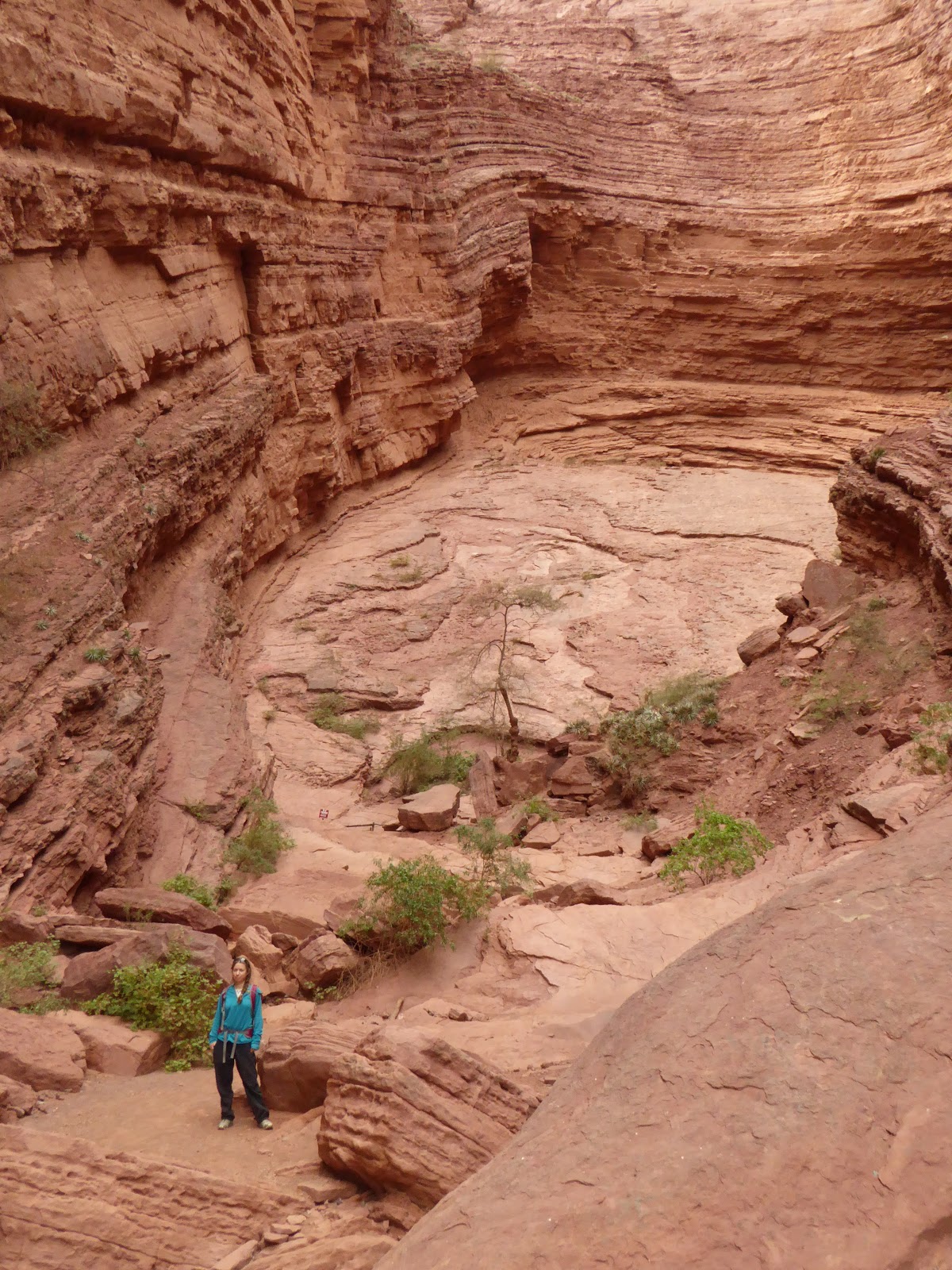
We also did a nice hike a few km out of town, up a small canyon passing several waterfalls. It was great fun - more of a rock climb in places than a walk! We were advised to get a guide, but decided to go it alone and enjoyed it all the more for the challenge of trying to work out where the path went. We also drove through the big canyon, the Quebrada de las Conchas, admiring the otherworldly landscapes. The scenery round Humahuaca was unbelievable, but this was equally so! Amazing formations of red sandstone, looking so much like slightly eroded pillars, pinnacles and other man-made features that it was hard to believe they were natural. The highlights were two huge hollows carved out of the rock, with layers upon layers of twisted rock forming two massive spaces like amphitheatres. The acoustics were incredible!

The Garganta del Diablo formation, in the Quebrada de las Conchas
We are still in Cafayate, planning to do another wine tasting or two today before we head south tomorrow. Where to is still to be decided. The problem is that none of the buses from Cafayate go where we want to - so we are going to have to rethink our route a little. We are still ultimately aiming for Mendoza, where we hope to reunite with our London friends Ralph and Shehnaaz in the next week or two.

Another lovely view in the Quebrada de las Conchas

Thursday, 5 May 2016

Mountains Through a Kaleidoscope

Exploring the northwest of Argentina feels a lot different to the rest of the country. It has a much larger indigenous population, and the sounds, tastes and buildings could belong to any of the other nearby countries - the north of Chile, or the south of Perú or Bolivia. The main cities are Salta and San Salvador de Jujuy (or just Jujuy), but there is a string of small towns following the long Quebrada de Humahuaca ravine north towards the Chilean and Bolivian borders.

The Quebrada de Humahuaca, from Tilcara
We arrived in Salta from Corrientes with the intention of hiring a car to explore the region before heading south. Originally, our plan was to drive all the way 1000+km south to Mendoza, but the fee for leaving the car there made it prohibitively expensive. Also, I didn't fancy driving the whole way - Jo wasn't able to take the wheel as her licence was stolen in Perú. Instead, we decided to just take the car around the surrounding area and leave it in Cafayate, just 200km away.

The road up to the Hornical
Salta had the feel of a lot of the other Andean cities that we've liked along the way, like Arequipa in Perú or Sucre in Bolivia. It even has a cable car to the top of the nearby hill, which seems to be a trend in many South American cities (La Paz, Quito, Medellín, Rio de Janeiro, etc). Our highlight, though, was the High Mountain Archaeological Museum (or MAAM - the Spanish acronym). It contains the remains of two children sacrificed by the Inca to their mountain gods. They were buried at the top of the region's highest mountain, at 6739m, and their bodies and the intricate grave goods have been perfectly preserved in the freezing temperatures.

Salta's take on the ubiquitous cable car
We left Salta in our hire car, driving north along the Quebrada de Humahuaca on the RN9. We soon found that, although the main road was in good condition, almost anything off the side of it was less so. Trying to get to the Lagunas de Yala, we had to turn round along one dirt road as it had been completely covered by a landslide. We did make it there a different way, making slow progress along another dirt road as we tried to protect our car from any flying pebbles. It was worth it for the great views along the valley from the winding mountain roads, even if the lagunas weren't that spectacular.

Not this way, then
The real reason for visiting this area is to see the celebrated coloured mountains. The most famous of these is the Hill of the Seven Colours rising above the small town of Purmamarca. The hill certainly lives up to its name! As this is probably the most accessible of the coloured mountains, it is also the most visited. Many of the towns in this area have been overrun by stalls of llama wool knitted into every form imaginable. This didn't prevent us from enjoying the spectacular hill and the drive past the town (and more coloured valley walls) up to the Argentinian salt flats, the Salinas Grandes.

Only Seven colours?
The salt flats, although not as big or as well known as those at Uyuni in Bolivia, are still an impressive sight. They stretch miles into the distance, with no point of reference until the mountains on the horizon. This was where we first discovered that cars don't run so well at 4000m above sea level, needing a lot more effort to get up the hills! 

Walking across the Salina Grande
The next time we went this high was to yet another coloured mountain, called the Hornocal, following a tip from an English couple to whom we got chatting in a restaurant in Tilcara. After a long hour drive along another gravel track outside of the town of Humahuaca, the view suddenly appeared before us of one of the most jaw-dropping sights of our trip so far. The entire opposite side of the valley was like a giant kaleidoscope. The Hornocal is also called the Hill of the Fourteen Colours, rather trumping the Seven in Purmamarca! It was relatively quiet and doesn't appear in so many guidebooks as the other hill, maybe because of the more difficult location.

The Hornocal
We had based ourselves in the small town of Tilcara, which is perfectly positioned to drive to many of the sights in the region. It is also home to a Pucará - a pre-Inca fort - looking over the Quebrada. Unfortunately, it was misguidedly reconstructed in the 1950s and isn't viewed as particularly authentic. However, because of its strategic position, it does have fantastic views over the entire valley. The whole Quebrada de Humahuaca has been listed by UNESCO, not so much for its natural beauty, but because of its archaeological sites. It has been in continuous use for over 10,000 years as an important route down from the Andean highlands to the lowlands of the south of the continent.

The reconstructed Pucará de Tilcara
After finishing driving around the dry, desert-like Quebrada, we are now moving across to the more humid, jungle-like Calilegua National Park. We will then be heading south towards the wine growing regions of Cafayate and Mendoza.

A closer view of the Hornical