Wednesday, 20 April 2016

A Mission to Paraguay

We reluctantly left the stunning waterfalls at Iguazú to head south through Argentina's Misiones province. We wanted to stop at a small town called San Ignacio on the way to Paraguay as it has the ruins of an old Jesuit mission there. The Jesuits were very active in this part of the world, with 30 missions in Brazil, Argentina and Paraguay. A few of them are now listed as world heritage sites so, obviously, we had to go.

The entrance to the church in San Ignacio in Argentina
The Jesuits started building missions in the Guaraní area in 1610, and continued up until they were expelled from South America by the Spanish empire in 1767. Their aim was to convert the native people to Christianity, but without imposing other European values on them. This was a significant difference from all of the other evangelising schemes of the time. We visited similar Jesuit missions in the east of Bolivia and on the island of Chiloé in Chile, although each location has distinct architecture. The churches in Bolivia and Chile are active to this day, but all that is left here are impressive red sandstone ruins.

The ruins in Trinidad in Paraguay
After we'd visited the ruin in San Ignacio, we went to withdraw some money before departing to Paraguay. This proved more difficult than we'd anticipated, however. The only two ATMs in town were empty of money, because it was a Sunday. No problem - we went on Monday morning instead. Where we found a looong queue of everybody else wanting money that couldn't get any at the weekend. Only one ATM was working now. When we got to the front of the line, the ATM ran out of money. Luckily, the hostel we stayed in let us pay in pounds, which we'd managed to not spend until now. This actually worked out okay for us - the ATMs in Argentina, after the fiasco of the Dolar Blue rate, now charge an 87 Peso (~£5) fee every time you use them, with a maximum withdrawal of 2000 Pesos (~£100). That's if you can find one that works and has money, of course.

Sunset over the Paraná River from Encarnación, Paraguay
We eventually escaped the fiscal peril of Argentina into Paraguay, where transactions are measured in thousands of Guaranis - there are 8000 Guaranis to £1. From the city of Encarnación, which is blessed with wonderful sunsets over the Paraná river, we went to visit the Paraguayan Jesuit ruins. These are very similar to the Argentine ones, but are bigger and better preserved. More importantly, they have a separate World Heritage Site listing, so we had to go there too.

Ornate Jesuit doorway in Trinidad, Paraguay
We're going to spend a bit more time in Paraguay, visiting a nature reserve and the capital Asunción. After that, we're returning to Argentina to explore the north of the country.

Sunday, 17 April 2016

The Incredible Iguazú Falls

The Iguazú Falls - maybe one of the most famous sights in South America, and something we'd certainly heard of before we got to this continent! We'd both been looking forward to seeing this amazing set of waterfalls for the whole trip so far. Although we've had to skip most of Brazil in order to see everything else we want to see before June (we'll be returning one day!), Rio and Iguazú were the two places we really wanted to get to this time.

The Iguazú Falls from the Argentine side
The Iguazú Falls are on the Iguazú river, located right on the border between Brazil and Argentina. They are shared between the two countries - both sides have their own Iguazú National Park, and both of these are UNESCO World Heritage sites! The falls are not just one waterfall, but a huge set of 275 drops in total, ranging from 60 - 82m in height and extending for 2.7 km along the river. Two thirds of the falls are in Argentine territory, and the Argentine park is a lot bigger, but there are absolutely spectacular views from both sides. Eleanor Roosevelt is said to have remarked, on her first sight of the falls, 'Poor Niagara', and you can see why.

Panorama from the Brazilian side
When looking at places to stay near Iguazú, we remembered a recommendation we'd had a while ago. The English couple we did our crazy long Machu Picchu trek with, Ivonne and Robin, had mentioned a hotel that was located actually within the Brazilian national park itself, within 2 minutes walk from the falls and even with views of them from some of the rooms. We'd had this in the back of our mind for some time and couldn't resist looking into it. Even when we found it was way, way above our budget, we couldn't quite make ourselves relinquish our dream of staying there, and thus it was that we booked without doubt our biggest accommodation splurge of the trip so far - 3 nights in the 5 star Belmond Hotel Das Cataratas!

Champagne breakfast in front of our hotel
The hotel was amazing. We enjoyed all of its perks - the gym (after which we couldn't walk for days, haha), the beautiful pool, the bar (best pisco sour since Peru), the breakfast time champagne ... and even the room service (ironically because this was the cheapest way to eat - the two onsite restaurants were both quite unaffordable!). But without doubt the biggest perk of all was the proximity to the falls, and the exclusive access in the mornings and evenings when the park was closed to the public. We often had the falls completely to ourselves. We got our first view of the falls the evening we arrived, around sunset. The viewpoint was literally just opposite the hotel, and there were only a few other people around. WOW! I can't even attempt to describe the beauty of this moment - the photos will have to do the talking for me.

Our first view of the falls, from the viewpoint in front of our hotel
The next morning, we got up early and went to see the falls before the park opened to the public. While the day before we'd only seen the view from the first viewpoint, today we followed the path down towards Devil's Throat, the most famous waterfall. In a short 15 minute walk, we were greeted with one spectacular vista after another. It just got better and better! We hadn't really appreciated the sheer size and number of the waterfalls from the hotel viewpoint, and now could see them stretching much further than we'd realised. It was just avalanches of water in all directions. Unbelievable. Near the end of the path, there was a metal walkway out into the river around the top of some of the falls, from where we could look down and see the water suddenly just disappear over the edge of a cliff. We got totally soaked from all the mist! At the very end of the path, we arrived at a stunning view of the Devil's Throat, the biggest waterfall of them all. I could have stood there all day, watching the tons of water come hurtling down and hearing the incredible thundering noise. Again, WOW.

The misty walkway near the Devil's Throat
After three nights, we reluctantly left our nice hotel. We weren't done with the falls yet though and were headed next over the border to Argentina, to see them from the other side. En route, we visited Brazil's Parque das Aves (Bird Park), which is right next to the national park entrance. We'd read mixed reviews of this but loved it and were very glad we went! They have a huge collection of birds, mostly from the Amazon region. Yes, they were in captivity, but most had been rescued from much worse situations, and the enclosures seemed large and not too crowded. We saw so many weird and wonderful birds that we'd never have got to see otherwise. Among my favourites were the three or four different species of toucan, the harpy eagles, and the gigantic walk-in enclosure with eight different types of macaw flying / perching everywhere!

Green-billed toucan in Parque das Aves
We'd been quite looking forward to returning to Argentina. It's a country we feel we know fairly well by now, after spending quite a lot of time here previously. But unfortunately, on our first evening in the country, we had a bad experience that somewhat tarred our formerly positive feeling about returning. As we were walking back to our hostel after dinner, we passed a house with a dog behind a closed gate. It came running, barking, and threw itself at the gate. A lot of dogs here behave like this, so we were unperturbed, until another dog appeared from nowhere, ran at us and bit me on the leg! This dog turned out to belong to the same house, but had been left loose in the street.

Scarlet macaws, with one blue-and-yellow one, in the Parque das Aves
The bite wasn't too bad; it swelled up a bit and looked like a red weal but didn't properly break the skin (now, several days later, it is just a very impressive bruise). However, worse than the bite itself was the attitude of the owner. She would not admit the dog was dangerous, would not agree that it shouldn't be left to roam freely on the street, would not even apologise until the neighbours too, who had seen the whole thing and whose Spanish was obviously a lot better than ours, got involved. What a rude, unpleasant person! The neighbours did not seem to like her either - when she'd gone, they apologised on her behalf even though it was in no way their fault, and told us the same dog had bitten someone before. Fortunately most Argentinians we've met have been super friendly and nice; the opposite of this woman. It was a horrible thing to happen on our first day back in Argentina though.

View of the San Martín waterfall, on the Argentine side of the falls
This incident meant we changed our plans a little and stayed an extra night in Puerto Iguazú so I could get the bite checked by a doctor (various doctor friends at home had advised this just in case of any risk of rabies). It was very easy, and not too expensive, to see a doctor at the private clinic, and she reassured us the bite should be fine, and that rabies is controlled in Argentina. Rather than going to the national park after this, we decided it was too late and instead went to visit an animal rescue sanctuary nearby. All the animals here were from the jungle regions of Argentina and had been rescued from appalling conditions, often being kept as pets in tiny cages. So it was sad seeing some of the birds missing eyes or legs, or unable to fly, but also positive that they are now being looked after well.

Part of the Itaipú Dam in Brazil
On our second day in Argentina, we actually crossed back over the border to Brazil so that we could visit the Itaipu Dam there. The dam is on the river that divides Brazil and Paraguay, and is huge - 7km long and around 200m high. It was built as a joint venture between the two countries, and the hydroelectric power it produces supplies both Brazil and Paraguay with a significant proportion of their electricity. In fact, Brazil is so much bigger than Paraguay that it pays the latter around a million dollars a day to use more of the dam's turbines. So Brazil takes 90% of the power produced, and Paraguay 10%. Despite this, in 2013, the dam supplied 75% of Paraguay's electricity, and 17% of Brazil's. It was cool to see the dam, though I think we got more from reading about if afterwards than from the very touristy open top bus tour we did.

In front of the Devil's Throat, Argentine side
Finally, on our third day in Argentina, we made it to the Argentine side of the falls. We were glad we'd saved this till last, as it was even better than the Brazilian side! The national park is a lot bigger, and we spent the whole day there walking along several different trails. On this side, we could get a lot closer to most of the waterfalls, and see them both from above and below. As it was a sunny day, there were rainbows everywhere! We also got the best panoramic view yet, with the falls continuing as far as we could see. Argentina also seemed to win on the butterfly front. There'd been a few on the Brazilian side, but here was another level! We had to walk through literally clouds of them. It was impossible to escape; they were EVERYWHERE. All shapes, sizes and colours and all, it seemed, constantly wanting to land on human beings! This was a massive challenge for me but my desire to see the falls overcame my fear (mostly); I did spend a lot of time swearing, running through the biggest clouds and flapping my hat / bag at them though!

One of several big clumps of butterflies.These would fly up into the air all around us when we passed!
The highlight of the Argentine side was another view of the Devil's Throat. This time, we got much closer to it, and could hear its roar from several hundred metres away, increasing as we approached. Quite a large proportion of the total volume of water in the falls is funneled down this one narrow chasm, and the sheer force of it is astounding. I can't describe just how exhilarating it was to stand there, getting completely drenched, and marvelling at this gigantic torrent of water throwing itself down right next to us. No other waterfall I've ever seen comes anywhere near the magnificence of this spectacle! Once again, we felt utterly awed by the power of nature.

Panorama of the Devil's Throat and surrounding waterfalls, Argentine side
We've now (unwillingly) left the Iguazú area, and will spend a bit more time in Argentina before we move on to Paraguay. The take home message from this post though is - go to the Iguazú Falls! If it's not on your bucket list, it should be.

Sunday, 10 April 2016

Rio de Janeiro

A horrendous set of flights took us from French Guiana to Rio. We left Cayenne at 5:30pm in order to spend 8 hours in the airport in the northern Brazilian city of Belém. We left there at 3am for Belo Horizonte before a final, hour long, flight to our destination. It seems that this is common in Brazil - our later journey to Foz do Iguaçu would also require three flights.

Rio from Corcovado
Rio is a beautiful city, best seen from its many heights. Or from its beaches. Or from street level. We shared our time between all of these, hitting all of the major sights - Sugarloaf Mountain, Christ the Redeemer, Copacabana, Ipanema... It's strange to be in a place where you already know all of the names and sights, but this doesn't detract from the experience at all.

Copacabana Beach
Half of the city is set along Guanabara Bay and the rest along the Atlantic coast. We walked down from the hilly Santa Teresa area, where we were staying, to Flamengo beach where we received our first view of the classic Rio scenery. A long, lively beach filled with people playing beach volleyball and football, sloping down to the bay and the distinctive hills on the other side. Around the corner is Copacabana beach, and we climbed the hill at the end to Leme fort. There were great views of the sweep of the beach, but also to Sugarloaf on the other side. Copacabana is separated from Ipanema beach by a headland, and we spent several evenings sitting on the bare rock here to enjoy the sunset.

Sunset over Ipanema Beach
Although we enjoy walking, it's not possible to get to the top of Sugarloaf without rock climbing or taking the cable car. We took the cable car, first to the accompanying hill Morro de Urca, then to the top of Sugarloaf itself. Unfortunately, we'd picked a day when the top was covered in cloud. No matter - the sunset views from Urca over Botafogo and Guanabara Bay were spectacular, and Sugarloaf was lit beautifully.

The cable car to Sugarloaf Mountain
Most people ascend Corcovado to visit the iconic art deco statue of Jesus by train or minibus, but we'd heard that it's possible to walk up. We started in Parque Lage and made our way up the 700m ascent, which got gradually steeper and slipperier. At one point we had to use a chain pinned to the cliff to get up a particularly precarious part. The effort was worth it - the views at the top over the whole of the city are unmissable. We took the train down.

Worshipping at Christ the Redeemer
Rio is currently preparing to host the Olympics and, therefore, is busy building and renovating everything. From what we saw, there will be plenty that is pushed right up to the wire. There are some new trams being prepared in the city centre, but the tracks are still being laid; and some buildings (the National Library, for example) were receiving facelifts, but political infighting has led to all work being stopped. This has left important parts of the city's architecture covered in scaffolding and sheets for one of its biggest events.

Olympic City sign next to Rio's newest museum, the 'Museum of the Future'
On many of the hills, and integrated with the rest of the city, are the favelas - inner city slums. There are lots of companies offering tours in many shapes and forms, but we decided against any of them. We're sure that many of the companies operate very ethically, but there are plenty that don't as well. Because of the tight integration of the poorer areas, Rio can be quite a dangerous city. We were followed by some assumably unsavoury characters after leaving a bank (ironically which hadn't worked with our card), but we shook them off by wandering around a supermarket for a while. We also heard a lot of firecrackers going off, which are often used as signals by the drug gangs. These were the only times when we felt unsafe, though.

Sunset from the Morro de Urca over Botofogo
We've now left Rio on our second batch of Brazilian flights to Foz do Iguaçu, to see the Iguazu Falls. They have been on top of my list of things to visit for a long time, so I'm excited to finally make it there.

Sunday, 3 April 2016

A Nice Slice of France - In South America

As you may have noticed from previous posts we have recently been travelling, for us, relatively quickly. After four nights in Guyana and five in Suriname, the final stop on our fleeting visit to these smaller countries was French Guiana, or just 'Guyane', as its inhabitants call it. We entered the country by crossing the river from Suriname, which marks the border.

The river border between Suriname and French Guiana
French Guiana is not actually a country in its own right, but an overseas territory of France, originally a penal colony. While Guyana (formerly British) and Suriname (formerly Dutch) both fought hard to gain their independence in the 1960s and 1970s, French Guiana shows no sign of following suit any time soon! The population is tiny, with only around 300,000 people, and is a mix of Creole (mixed French and African ancestry), French, Asian and Amerindian ethnic groups. The currency is the Euro, and the official language is, of course, French.  We didn't have great expectations for here, but as it turned out, we spent more time here than either of the other two countries and were pleasantly surprised by how much we enjoyed it. The roads are good, everyone has cars, the food is excellent, as is the (French) wine, you can drink the tap water, and can even throw the toilet paper in the toilet (quite novel for us now!). It really felt a lot like being in France, except with a tropical climate and a LOT of mosquitoes. Quite surreal.

Old prison cells at the Camp de la Transportation in St Laurent
French Guiana isn't really cut out for budget travellers. Most tourists are French people on holiday, and they are either on organised tours or have rented cars. There is a real dearth of public transport - everyone has their own car - so it was quite challenging for us to get around. As an example, to get from where we were staying in Cayenne to the airport (10 km or so), we had no other option than to take a taxi, which cost 40 Euros! No buses. There are also no hostels and very few cheap hotels, and food is super expensive, whether you're eating out or cooking at home.

Beautiful orchids in the Guyane Botanical Garden, between Kourou and Cayenne
We decided AirBnB was our best option for accommodation, and were very lucky with our hosts here. We've found that increasingly often these days, hostels and guesthouses list themselves on AirBnB, and you have to look closely to work out if you will actually be in someone's house, or just in a hotel. But all three places we stayed here were in the original spirit of the concept, i.e. just someone's spare room. At each place we stayed, the people were extremely friendly and welcoming, and spoke at least a little English or Spanish (our French is practically non-existent)! We found ourselves frequently being offered free food, wine, or cocktails, and even lifts from place to place. I'm not sure how we'd ever have got from Kourou to Cayenne on Easter Sunday if it weren't for our fantastic hosts in Kourou offering to drive us! They stopped in the Guyane Botanical Garden on the way too, which was a bonus.

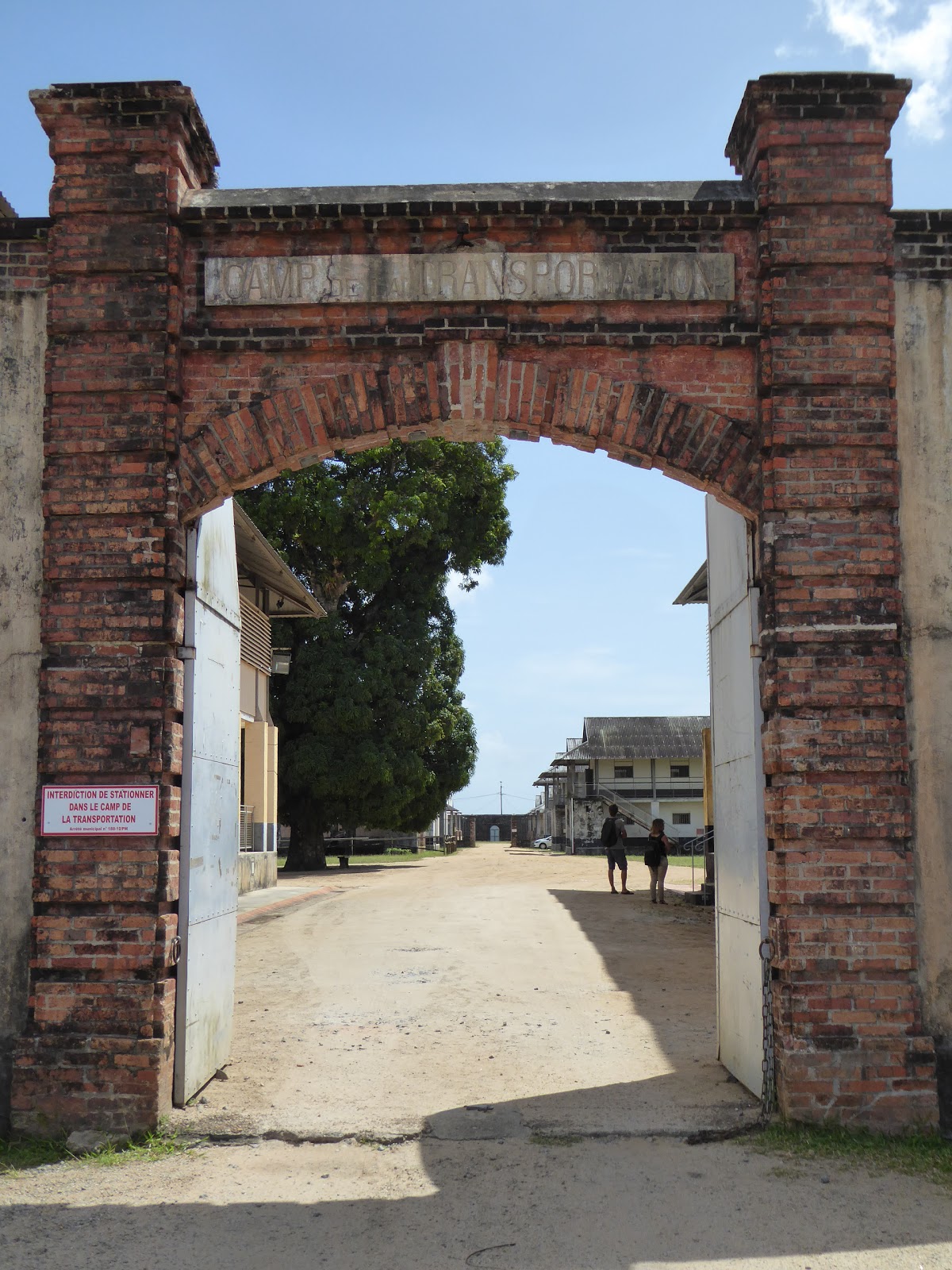
The entrance to the Camp de la Transportation, in St Laurent
Our first stop in French Guiana was St Laurent du Maroni, the town on the border with Suriname. There is actually a fairly large number of Surinamese people living here; many choose to have children here in order to try and get French citizenship for their kids. Our AirBnB host, Florence, picked us up from the port and also kindly offered to drive us to the big supermarket in town - we had decided to cook every night in this country in order to try and save money. The supermarket, SuperU, was AMAZING. I wandered around with eyes like saucers, marvelling at all the items that are impossible to find in most of South America but were miraculously here. There was fresh bread of all kinds, even wholemeal bread with chorizo in it. French cakes and pastries. Pure orange juice. Fresh fruit and vegetables. Herbs and spices of every kind. Salad, even rocket! The only downside was the prices. As I mentioned, food is expensive here. It was still a shock just how expensive though. One pepper cost 2 Euros. 4 mushrooms cost 4 Euros, or if you preferred a 500g packet, this was 15 Euros. It wasn't anything in particular, it was just uniformly sky high prices, regardless of the shop or town we were in. The only cheap thing was the wine - you can get a decent bottle for less than two peppers!

Shackled to the very uncomfortable bed at the Camp de la Transportation
We only spent one night in St Laurent, just enough time to visit the Camp de la Transportation, a former prison here. A tour is compulsory, but we were the only English-speaking people and managed to get a guide to ourselves rather than having to go around with the big French group. The prison operated for 100 years, only closing in the 1950s, and it was an eye-opening experience to walk around the buildings and get an idea of what life was like for the prisoners (pretty awful). Overcrowded, disease-ridden conditions, forced labour in the heat every day, horrific punishments including being kept in isolation in the dark for months... One of the worst parts was that even when a prisoner was freed having completed his sentence, he was legally required to remain in French Guiana for the same length of time as he had already served in jail. So 10 years in the prison meant 10 years more still living in the colony. Many of these 'freed' prisoners would just end up returning to the prison as they had no money and nowhere else to go.

View of Devil's Island, from Ile Royale in the Iles du Salut View from Ile Royale (St Joseph's island is in the background)
Our next stop was the coastal town of Kourou, about 200 km west of St Laurent. Kourou is famous for two things - the Iles du Salut (prison islands a few km off the coast), and the Centre Spatial Guyanais. The latter is a space centre and a major base for European rocket launches. Interestingly, the Kourou rocket launch site is one of the closest in the world to the equator, only 500 km or so away, which makes it a particularly good location as the earth's spin gives the rocket an extra boost. There are launches from here every month or two, but sadly we arrived at the wrong time to witness one, which must be an incredible sight. Ah well, maybe when we travel to Florida or Kazakhstan...!

Former prison building on Ile Royale
We did however continue the prison theme in Kourou and visit the Iles du Salut. This involved a 2 hour, very rough ride in a catamaran. Most people on the boat were quite ill; I was glad I took a seasickness tablet beforehand! There are three islands, all formerly used as prison camps, and we were only able to visit the biggest one, Ile Royale. Perhaps the most famous of the three is Devil's Island, which we could see from Ile Royale but visits are not permitted. Papillon (Henry Charriere) was imprisoned here, as well as at the prison in St Laurent (NB We discovered that most of his book is made up or actually happened to other people; read it with a pinch of salt!). Most of the prison is now ruined and people just come to the island for a day trip. You can sunbathe, swim, windsurf... there is even a hotel and restaurant. For us, the best part was just exploring the island ourselves - a lot of it is just jungle, and we saw monkeys and agoutis (large rodents) while also spotting the remains of various prison buildings.

A monkey and an agouti, in the jungle on Ile Royale
While we enjoyed St Laurent and Kourou a lot, Cayenne was a bit of a let down. We had read there was not a lot to do there, but, silly us, didn't believe this (it's a capital city!). Perhaps our impressions were tainted by the weather - it rained almost constantly for 3 of the 4 days we were there. We had ostensibly been in the 'rainy season' throughout our time in the Guyanas and Suriname, but this would usually mean just a couple of showers! In the city centre we only managed to have a quick look at the main square and cathedral, before taking shelter in the central market, which did have an excellent fruit juice stall at least! On the one day it didn't rain, we went for a jungle walk nearby where we were staying. It was pretty cool to feel in the middle of the rainforest, despite being right near a city. The circuit took 2 hours or so, and we saw more monkeys, plus a large iguana, and heard a lot of birds and frogs. We failed to spot a sloth though, which was disappointing as sightings are apparently very common on this trail.

Cool looking thicket of bamboo, along the Sentier du Rorota jungle trail near Cayenne
From French Guiana we are heading down into Brazil, ending our short break from Latin America. Brazil will feel different again to everywhere else we've been though, as the language is Portuguese rather than Spanish and we speak even less Portuguese than we can French! We considered going overland to Brazil, but this looked quite challenging. The relations between the two countries aren't great - there has been a bridge built across the river border since 2013, but Brazil hasn't bothered to build an immigration building or even a paved road to get there, so the bridge remains closed. The journey would thus involve getting to the border somehow from Cayenne (difficult), getting a boat over, and then a journey of anything from 10 hours to 3 days along a dirt road to the nearest proper town in Brazil. Hmm. It wasn't that difficult a decision to opt to fly instead, even though the journey to Rio de Janeiro would involve a ridiculous overnight journey of 3 flights and an 8 hour stopover! More on that next time...

Friday, 25 March 2016

Sea Turtles in Suriname

We got up early for our bus from Guyana to Suriname at 5am. Too early, as it turns out, as it arrived at 6, before bouncing along the road to Moleson Creek. This small town is on the Courantyne River, which forms the border with Suriname. We stamped out of the country here, and boarded a car ferry to take us the 30 minutes to the other side.

The immigration process on the other side can be a very slow affair - locals in the know sprint off the boat to get in line first. We adopted this policy - several of us walking quickly, keeping just behind the border guard leading the way. Jo sabotaged one guy ahead of us by accidentally standing on his flip-flop, and we got a prized spot near the front of the line. We got through quickly, but then had to wait for an hour or so as the other people in our bus took their time to get past the queue. We finally arrived in Paramaribo, the Surinamese capital, 12 hours after we'd set off.

The palm garden in Paramaribo
Paramaribo, for us, wasn't the most appealing of cities. There are plenty of white, balconied colonial houses along a few streets near the Suriname River, a small fort and a public garden filled with hundreds of tall palm trees. On Sunday mornings, people get together to have birdsong competitions where they pit their prized 'twatwas' against each other. Unfortunately, the timing didn't work out for us to see this. We did see lots of people carrying birdcages around during the week though! Apart from that, we found the city a little lacking in soul. It was pretty quiet and felt a lot more like a small country town than a capital city. It's very spread out and most people have cars to get around. We found it very difficult to find essentials like grocers and pharmacies - there didn't seem to be any in the centre at all. Although almost every shop calls itself a 'supermarket', they are more like corner shops and don't stock fresh produce, which limited our ability to cook for ourselves.

Colonial buildings and cars in Paramaribo
Apart from the capital city, the other things to do in Suriname are go to the jungle (moth-y) or go to a sea turtle nesting site. We opted for the latter, but baulked at the 175 Euros quoted by tour agencies for a single night. Instead, we took a bus to Albina, the border town with French Guiana, then negotiated a small boat to take us the 2 hours down the river estuary to Christaankondre. This is a village at the mouth of the river, close to the Atlantic Ocean, which is completely cut off from the rest of the country except by boat. We took a basic room in the only place to stay and joined a small tour group to go and see the turtles that night.

Christiaankondre - in the middle of nowhere
We were rewarded with a full moon giving us great light to search for turtle tracks along the beach. This is the easiest way to find them as at the top of the trail they dig a hole to lay in while laying their eggs. They lay between 100-200, then bury them in sand and dash back to the sea. We found several turtles, and they were enormous - maybe 2 metres in length. We saw every stage in the process: the finding a suitable spot and clearing it; the digging the hole; the laying; the burying; and the dash back to sea We also saw a couple of people in this very remote area who were probably stealing the eggs to sell. Although the beaches here have a nominal guard, it is very easy to go there when the guards are not.

The back of a green turtle laying eggs
The next morning, we found another boat to take us back to Albina, the border town. We took yet another boat across the Maroni River into French Guiana. The border process on either side was the most lax we've seen anywhere in the world, and this time there were no queues to negotiate! We are going to spend about a week in this French territory, before flying into Brazil.

Monday, 21 March 2016

A Very Smelly City

We departed Curaçao late in the evening, after a great few days there. As we mentioned previously, one of our main reasons for visiting was to use it as a stop off point between Colombia and Guyana, thus avoiding Venezuela. We found there was a cheap daily flight from Curaçao to Georgetown, the Guyanese capital, with InselAir.

Georgetown, viewed from the air
What we didn't realise when we booked this flight, was how notoriously bad InselAir is. As it is one of the only carriers offering short hops around the Caribbean and the north coast of South America, it has a bit of a monopoly. It seems this means it can run its flights whenever it wants, and the scheduled times mostly bore no resemblance to the actual departures!  Our flight was meant to leave at 9:30 pm, the last of the evening from Curaçao. It actually went at 11:10 pm, from a different departure gate. The time and departure was announced suddenly - up till then we'd heard nothing about it. We were quite fortunate it seems, as three other InselAir flights scheduled to leave before ours had not even arrived when we were boarding. Art, our host in Curaçao, told us the InselAir flights are always like this!

St George's Cathedral, in Georgetown
Anyway, we eventually arrived safely in Georgetown at 1am. We had been a little worried that our taxi pick up would not be there, or the driver would be an axe-murderer (safety is quite an issue in Georgetown, especially late at night). However, all went smoothly. Other than the fact that the airport is not in fact in Georgetown but out in the jungle nearly an hour's drive away... hence it was full of moths. BIG ones. Like, the biggest moths I've ever seen, all at once. It was a complete nightmare for me, and when we got in the taxi and there was one inside, I nearly had a heart attack! Luckily, once in the city, moth sizes / numbers became a lot more manageable.

Interior of St George's Cathedral
Guyana is probably the least well known and the least travelled country in all of South America. This little nation, with a population of only 750,000 people, used to be a British colony and only became independent in 1966. The British influence is evident in several respects: the official language is English (it's the only country on the continent that speaks English as its first language), they drive on the left hand side of the road, they are passionate about cricket, and they are fond of tea (in teapots). Oh, and the local beer, Banks Beer, first brewed while Guyana was still a British colony, is probably the best national lager we've had in South America. The country is also very multicultural - another legacy of the British, who brought slaves over from Africa and indentured labourers from India. The largest ethnic groups today are East Indian and African. It is the poorest country in South America, behind Bolivia and Paraguay, and the local currency is the Guyanese dollar, of which there are about 300 to a pound. It's quite entertaining when you hear that your dinner will be 1000 dollars! Given that it is so poor, it seems strange how expensive it is - just a few days here will severely dent a backpacker's budget, we found out.

The City Hall in Georgetown
When we arrived in Georgetown itself, the first thing that hit us was the smell... not in a good way! The city has open sewers, is very dirty, and all water channels / rivers are literally black. Everywhere stinks of poo. However, we got used to this fairly quickly! Georgetown also has a reputation for being unsafe, as I mentioned - there is a high incidence of petty crime and certain areas are definite no-go zones for tourists. We were a little nervous at first to just walk around on our own, but our host said it would be fine, so we spent a lot of time just strolling round the city absorbing the atmosphere. We had no problems at all; in fact. on the contrary, people were mostly pretty friendly and curious to see white faces. While Georgetown has quite a gritty feel to it, we enjoyed it, as it is just so completely different to anywhere else in South America. It was great seeing Asian shops everywhere, hearing English spoken (albeit in a Caribbean accent we often couldn't understand!), watching cricket with locals, and hearing Indian-influenced styles of music.

The 1763 Monument, in Revolution Square
We explored the city over 2 days. There aren't many attractions, but the huge wooden cathedral, St George's, was quite impressive. It is apparently the largest wooden church in the world - the locals are quite proud of this! We also visited the City Hall, another colonial wooden structure, decaying somewhat but still very nice; the National Library; and the National Museum. The museum's main exhibition was about Guyana's big festival here, Mashramani, which takes place in February every year to commemorate the anniversary of the country becoming a republic. The photos and costumes on display, and the excitement of local people when discussing this, suggested this country does have one thing in common with the rest of the continent - it loves its carnival! Another day, we walked over to Revolution Square, where there is an interesting African themed memorial to a slave revolt that took place here in 1763. Passing the Botanical Gardens and Zoo en route here we randomly saw two beautiful macaws flying right overhead, reminding us just how close to the jungle Georgetown really is.

Old fashioned adverts lining Georgetown's sea wall... They even had a Marmite advert!
We had planned to go straight from Georgetown over the border to Suriname. Suriname is the only country for which we need a visa - well, a 'tourist card' for us as UK citizens. The process of applying for this was a little complicated. First we had to go to the Surinamese embassy, which was cunningly concealed in a posh residential area of Georgetown. We spent a while walking around looking for it, and eventually located it with the help of some locals. The security guard at the embassy asked us, did we have a photocopy of our passport photo pages? Forewarned about this, we said yes. Did we have a photocopy of our Guyana entry stamp page? Erm, no. Did we have 35 US dollars each? Erm no, but we had $25, which was what it had cost last week. The lady packed us off to change some more Guyanese dollars into USD, and get the other photocopy. We later found out the charge for the tourist card had gone up only 2 days ago - doh!

Aerial view of the jungle near Kaieteur Falls
When we returned to the embassy with all we needed, the security lady finally let us into the office itself. The lady at the desk there told us we'd need to leave our passports and come and pick them up again that afternoon. We couldn't do that, we said, as we had a tour booked that afternoon. We asked if we could come back the following morning instead (Friday). Well, the office MIGHT be closed, she said, as there MIGHT be a national holiday. Could she find out, we asked. No, no-one knew, apparently. There were some local elections happening and the embassy staff didn't yet know if they'd be working or not! We grew steadily more frustrated as we knew the embassy would definitely be shut at the weekend. Eventually we pestered her enough that she managed to get our tourist cards issued straight away! Not sure why you normally have to wait until the afternoon...

At Kaieteur Falls
The reason we couldn't go back to the embassy that afternoon was that we had booked ourselves on a trip to Kaieteur Falls, perhaps Guyana's most spectacular natural attraction. The majority of the country is pristine jungle (well, with the odd gold mine), and the Kaieteur waterfall is deep in the interior, hidden in the rainforest. The only option for getting there, other than a 5 day hike, is a short flight in a small 12 seater plane. It was an expensive tour, but 100% worth it! We flew for an hour over a sea of trees, seeing nothing but this huge expanse of green for miles and miles, interrupted only by the muddy brown rivers snaking their way across the country. As we neared our landing point, the pilot made a big turn, and we had our first sight of the Kaieteur Falls. Wow!

The beautiful Kaieteur Falls
We landed at an airstrip literally in the middle of the jungle, and had 2 hours on a guided walk that took us to three different viewpoints of the falls. It has to be one of the most spectacular in the world, not just for its size (the highest single drop waterfall in the world) but for its stunning setting. The waterfall drops from a rocky outcrop, and all around is rainforest. The power of the water was incredible, even though our guide told us it was currently only about 60% full due to the recent dry weather. In the mist around the falls we could see rainbows. I'm so glad we made it here, as it was really something special. We didn't want to leave, and wished the other tourists who accompanied us on the flight would stop taking photos occasionally so we could just gaze in peace for longer!

Rainbows in the mist
While there is doubtless plenty more to see and do in Guyana, chiefly jungle-based adventures, we are trying to push on through these three little countries at the top of the continent. The prices here are high, and we still have a lot more to squeeze in before we return home in June. So for now, it's goodbye Guyana, as we head on to Suriname (a gruelling 12 hour bus-boat-bus-bus journey, more on that next entry!)

View down the valley from the bottom of the falls